







Question: Subject: Operating Systems Please explain how to solve it. Thank you. Similarly to the malloc.py simulator at the end of Chapter 17, the following shows
Subject: Operating Systems
Please explain how to solve it. Thank you.
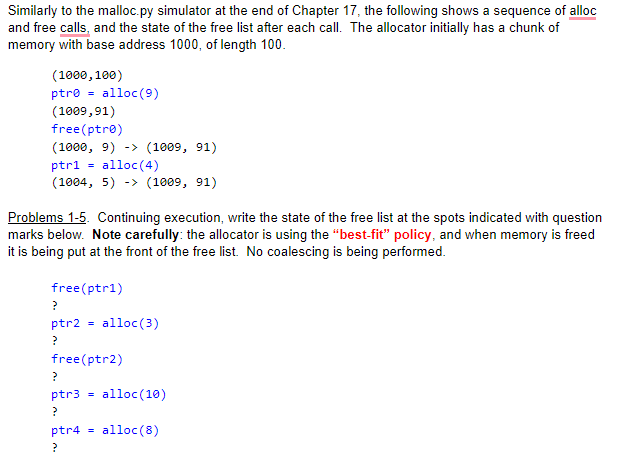
Similarly to the malloc.py simulator at the end of Chapter 17, the following shows a sequence of alloc and free calls, and the state of the free list after each call. The allocator initially has a chunk of memory with base address 1000, of length 100 (1000, 100) ptro alloc(9) (1009,91) free (ptro) (1000, 9) -> (1009, 91) ptri alloc(4) (1004, 5) -> (1009, 91) Problems 1-5. Continuing execution, write the state of the free list at the spots indicated with question marks below. Note carefully: the allocator is using the "best-fit" policy, and when memory is freed it is being put at the front of the free list. No coalescing is being performed. free (ptri) ? ptr2 = alloc(3) ? free (ptr2) ? ptr3 alloc(10) ? ptr4 alloc(8)
Step by Step Solution
There are 3 Steps involved in it

Get step-by-step solutions from verified subject matter experts
 Study Help