







Question: SUBJECT: RESEARCH METHOD TITLE: RESEARCH CHAPTER: METHODLOLOGY QUESTION: Based on the paragraph, please answer/list down INSTRUMENT (VALIDATED QUESTIONNAIRE). INTRODUCTION The present study investigated the cross-cultural
SUBJECT: RESEARCH METHOD
TITLE: RESEARCH
CHAPTER: METHODLOLOGY
QUESTION:
Based on the paragraph, please answer/list down INSTRUMENT (VALIDATED QUESTIONNAIRE).
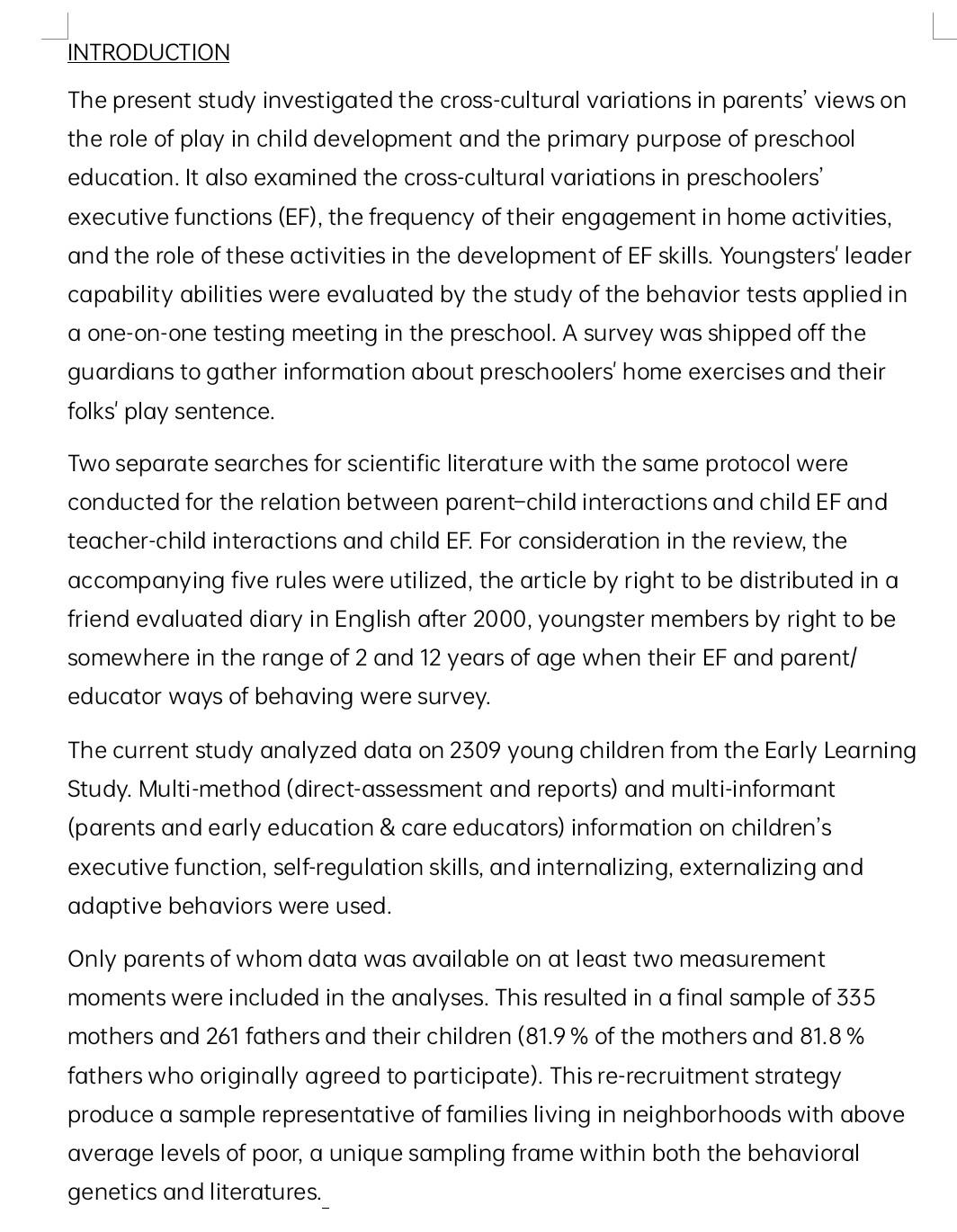
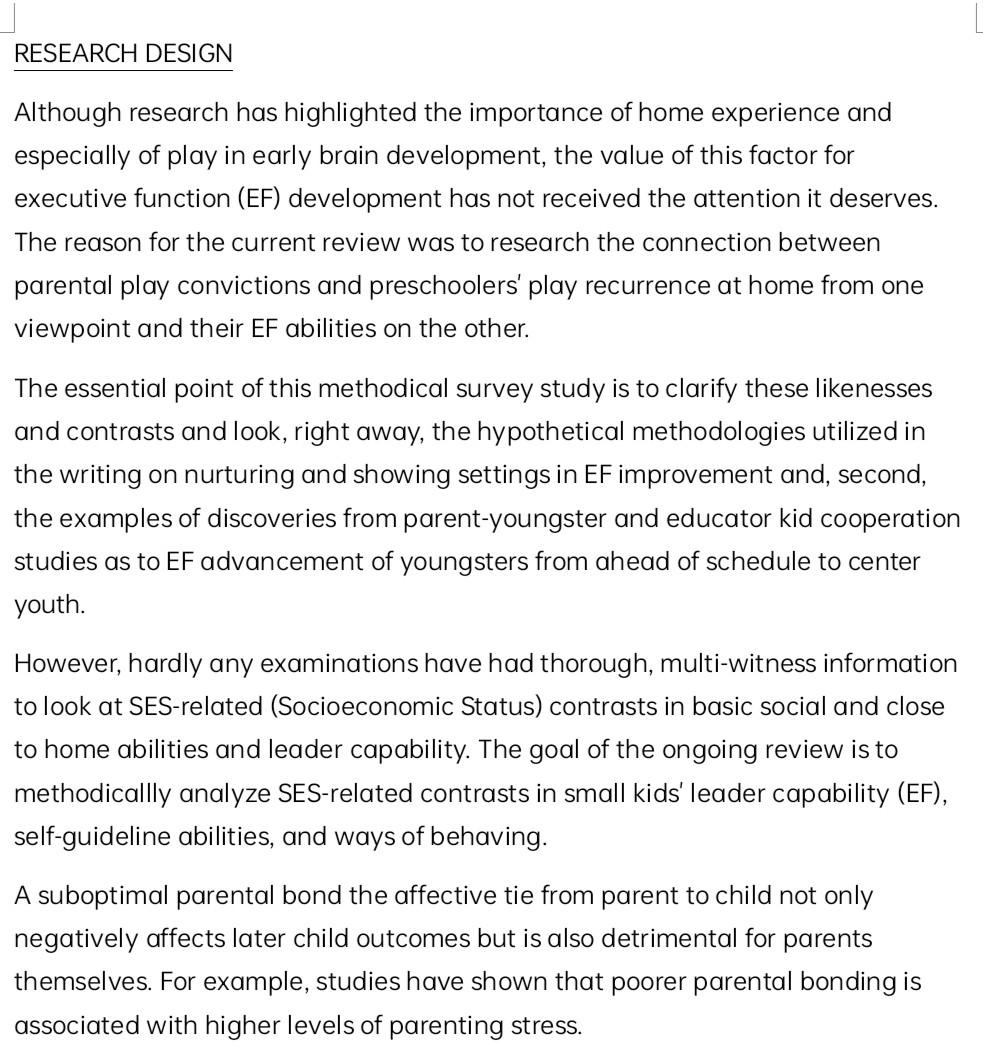
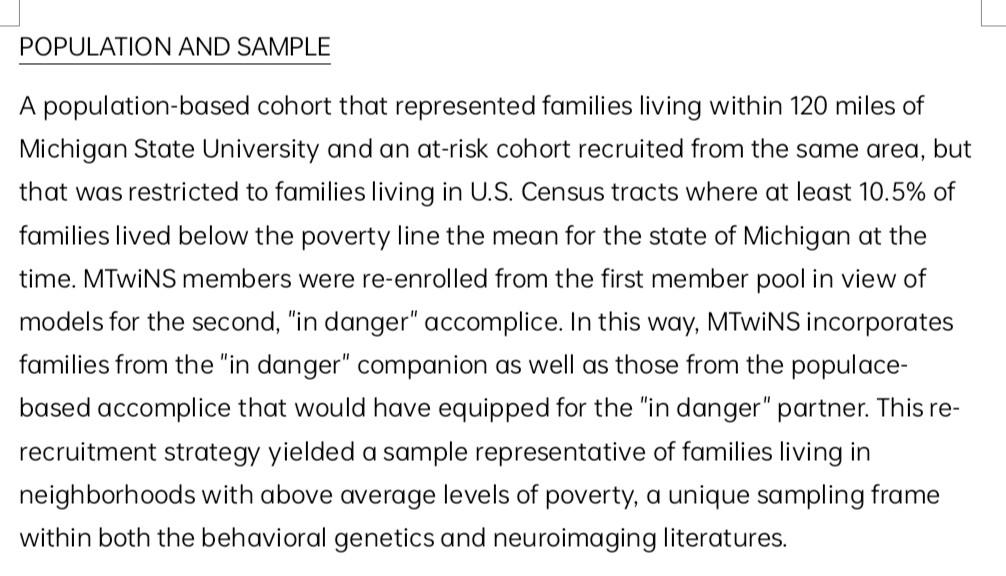
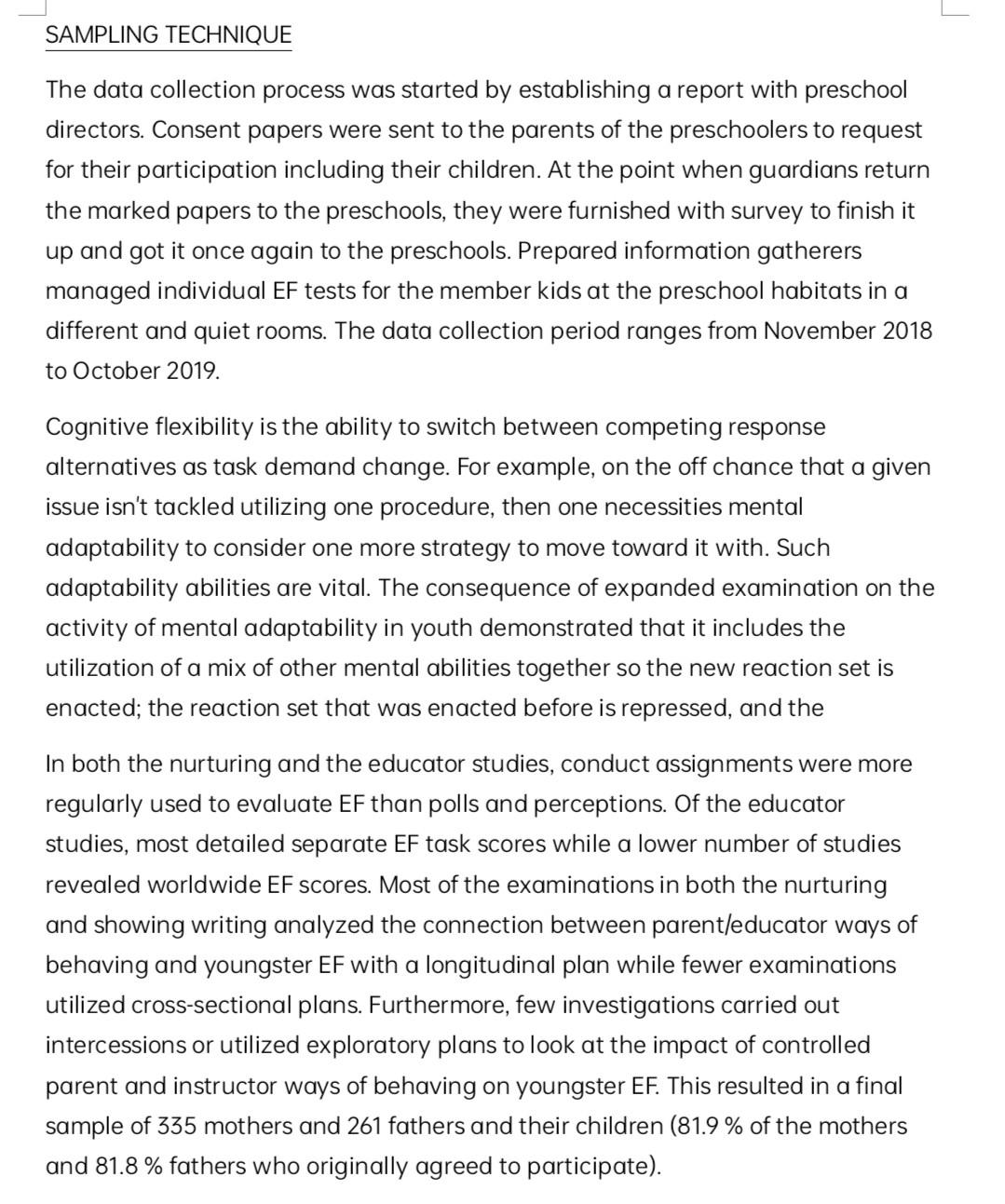
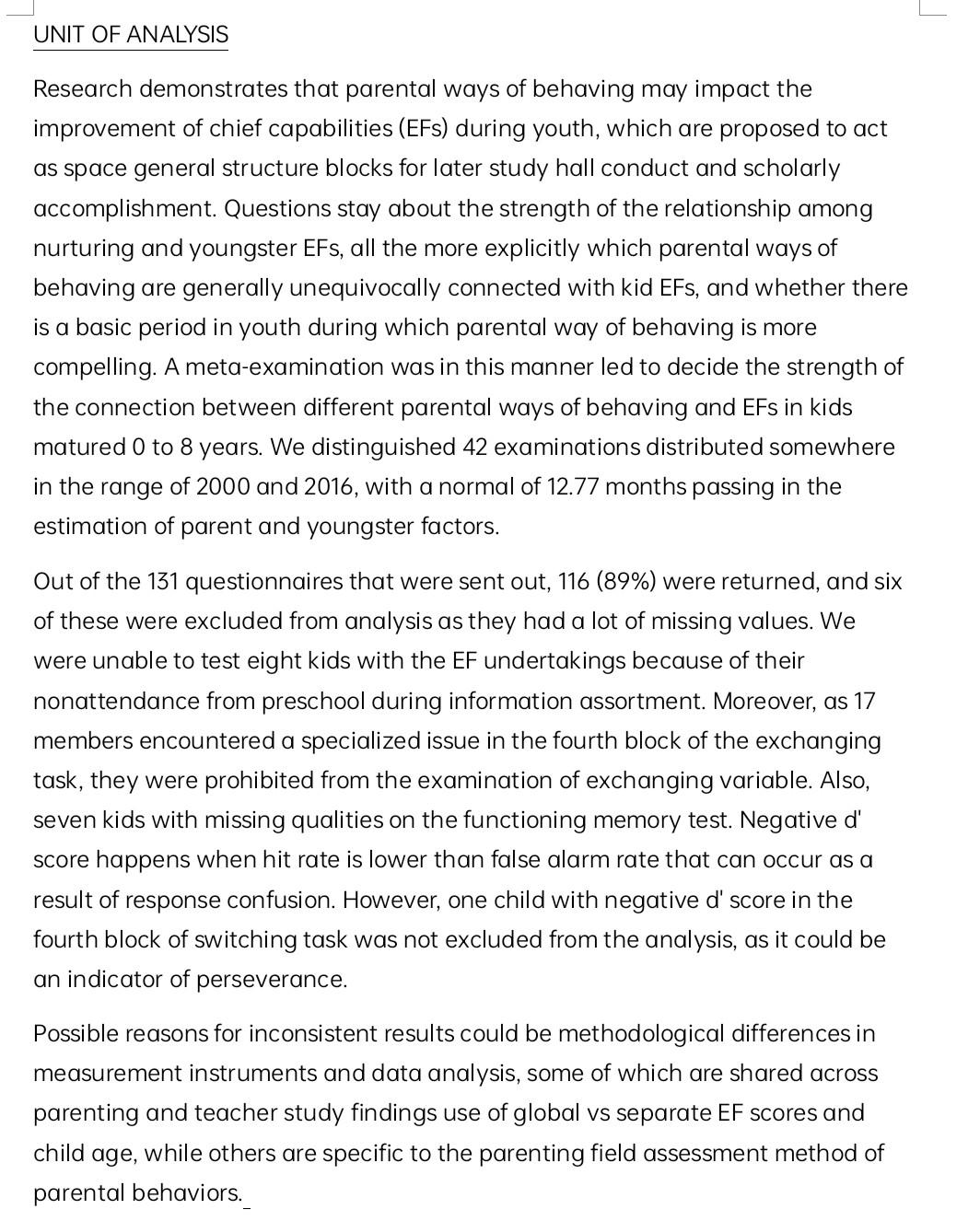
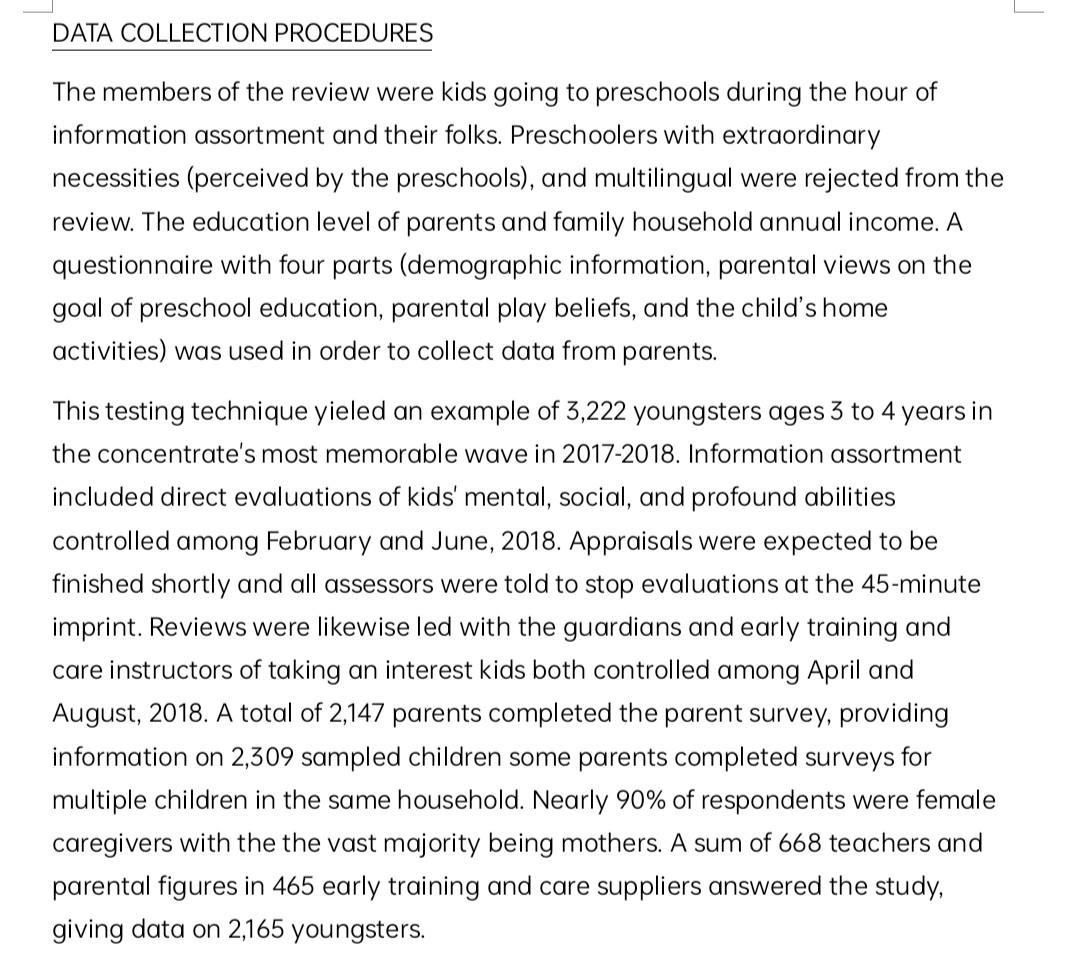
INTRODUCTION The present study investigated the cross-cultural variations in parents' views on the role of play in child development and the primary purpose of preschool education. It also examined the cross-cultural variations in preschoolers' executive functions (EF), the frequency of their engagement in home activities, and the role of these activities in the development of EF skills. Youngsters' leader capability abilities were evaluated by the study of the behavior tests applied in a one-on-one testing meeting in the preschool. A survey was shipped off the guardians to gather information about preschoolers' home exercises and their folks' play sentence. Two separate searches for scientific literature with the same protocol were conducted for the relation between parent-child interactions and child EF and teacher-child interactions and child EF. For consideration in the review, the accompanying five rules were utilized, the article by right to be distributed in a friend evaluated diary in English after 2000, youngster members by right to be somewhere in the range of 2 and 12 years of age when their EF and parent/ educator ways of behaving were survey. The current study analyzed data on 2309 young children from the Early Learning Study. Multi-method (direct-assessment and reports) and multi-informant (parents and early education \& care educators) information on children's executive function, self-regulation skills, and internalizing, externalizing and adaptive behaviors were used. Only parents of whom data was available on at least two measurement moments were included in the analyses. This resulted in a final sample of 335 mothers and 261 fathers and their children (81.9\% of the mothers and 81.8% fathers who originally agreed to participate). This re-recruitment strategy produce a sample representative of families living in neighborhoods with above average levels of poor, a unique sampling frame within both the behavioral genetics and literatures. RESEARCH DESIGN Although research has highlighted the importance of home experience and especially of play in early brain development, the value of this factor for executive function (EF) development has not received the attention it deserves. The reason for the current review was to research the connection between parental play convictions and preschoolers' play recurrence at home from one viewpoint and their EF abilities on the other. The essential point of this methodical survey study is to clarify these likenesses and contrasts and look, right away, the hypothetical methodologies utilized in the writing on nurturing and showing settings in EF improvement and, second, the examples of discoveries from parent-youngster and educator kid cooperation studies as to EF advancement of youngsters from ahead of schedule to center youth. However, hardly any examinations have had thorough, multi-witness information to look at SES-related (Socioeconomic Status) contrasts in basic social and close to home abilities and leader capability. The goal of the ongoing review is to methodicallly analyze SES-related contrasts in small kids' leader capability (EF), self-guideline abilities, and ways of behaving. A suboptimal parental bond the affective tie from parent to child not only negatively affects later child outcomes but is also detrimental for parents themselves. For example, studies have shown that poorer parental bonding is associated with higher levels of parenting stress. A population-based cohort that represented families living within 120 miles of Michigan State University and an at-risk cohort recruited from the same area, but that was restricted to families living in U.S. Census tracts where at least 10.5% of families lived below the poverty line the mean for the state of Michigan at the time. MTwiNS members were re-enrolled from the first member pool in view of models for the second, "in danger" accomplice. In this way, MTwiNS incorporates families from the "in danger" companion as well as those from the populacebased accomplice that would have equipped for the "in danger" partner. This rerecruitment strategy yielded a sample representative of families living in neighborhoods with above average levels of poverty, a unique sampling frame within both the behavioral genetics and neuroimaging literatures. SAMPLING TECHNIQUE The data collection process was started by establishing a report with preschool directors. Consent papers were sent to the parents of the preschoolers to request for their participation including their children. At the point when guardians return the marked papers to the preschools, they were furnished with survey to finish it up and got it once again to the preschools. Prepared information gatherers managed individual EF tests for the member kids at the preschool habitats in a different and quiet rooms. The data collection period ranges from November 2018 to October 2019. Cognitive flexibility is the ability to switch between competing response alternatives as task demand change. For example, on the off chance that a given issue isn't tackled utilizing one procedure, then one necessities mental adaptability to consider one more strategy to move toward it with. Such adaptability abilities are vital. The consequence of expanded examination on the activity of mental adaptability in youth demonstrated that it includes the utilization of a mix of other mental abilities together so the new reaction set is enacted; the reaction set that was enacted before is repressed, and the In both the nurturing and the educator studies, conduct assignments were more regularly used to evaluate EF than polls and perceptions. Of the educator studies, most detailed separate EF task scores while a lower number of studies revealed worldwide EF scores. Most of the examinations in both the nurturing and showing writing analyzed the connection between parent/educator ways of behaving and youngster EF with a longitudinal plan while fewer examinations utilized cross-sectional plans. Furthermore, few investigations carried out intercessions or utilized exploratory plans to look at the impact of controlled parent and instructor ways of behaving on youngster EF. This resulted in a final sample of 335 mothers and 261 fathers and their children (81.9\% of the mothers and 81.8% fathers who originally agreed to participate). UNIT OF ANALYSIS Research demonstrates that parental ways of behaving may impact the improvement of chief capabilities (EFs) during youth, which are proposed to act as space general structure blocks for later study hall conduct and scholarly accomplishment. Questions stay about the strength of the relationship among nurturing and youngster EFs, all the more explicitly which parental ways of behaving are generally unequivocally connected with kid EFs, and whether there is a basic period in youth during which parental way of behaving is more compelling. A meta-examination was in this manner led to decide the strength of the connection between different parental ways of behaving and EFs in kids matured 0 to 8 years. We distinguished 42 examinations distributed somewhere in the range of 2000 and 2016, with a normal of 12.77 months passing in the estimation of parent and youngster factors. Out of the 131 questionnaires that were sent out, 116 (89\%) were returned, and six of these were excluded from analysis as they had a lot of missing values. We were unable to test eight kids with the EF undertakings because of their nonattendance from preschool during information assortment. Moreover, as 17 members encountered a specialized issue in the fourth block of the exchanging task, they were prohibited from the examination of exchanging variable. Also, seven kids with missing qualities on the functioning memory test. Negative d score happens when hit rate is lower than false alarm rate that can occur as a result of response confusion. However, one child with negative d' score in the fourth block of switching task was not excluded from the analysis, as it could be an indicator of perseverance. Possible reasons for inconsistent results could be methodological differences in measurement instruments and data analysis, some of which are shared across parenting and teacher study findings use of global vs separate EF scores and child age, while others are specific to the parenting field assessment method of parental behaviors. DATA COLLECTION PROCEDURES The members of the review were kids going to preschools during the hour of information assortment and their folks. Preschoolers with extraordinary necessities (perceived by the preschools), and multilingual were rejected from the review. The education level of parents and family household annual income. A questionnaire with four parts (demographic information, parental views on the goal of preschool education, parental play beliefs, and the child's home activities) was used in order to collect data from parents. This testing technique yieled an example of 3,222 youngsters ages 3 to 4 years in the concentrate's most memorable wave in 2017-2018. Information assortment included direct evaluations of kids' mental, social, and profound abilities controlled among February and June, 2018. Appraisals were expected to be finished shortly and all assessors were told to stop evaluations at the 45-minute imprint. Reviews were likewise led with the guardians and early training and care instructors of taking an interest kids both controlled among April and August, 2018. A total of 2,147 parents completed the parent survey, providing information on 2,309 sampled children some parents completed surveys for multiple children in the same household. Nearly 90% of respondents were female caregivers with the the vast majority being mothers. A sum of 668 teachers and parental figures in 465 early training and care suppliers answered the study, giving data on 2,165 youngsters
Step by Step Solution
There are 3 Steps involved in it

Get step-by-step solutions from verified subject matter experts
 Study Help