



Question: Subject: Stochastic Processes A laboratory blood test is 95% effective in detecting a certain disease when it is actually present. However, the test also yields
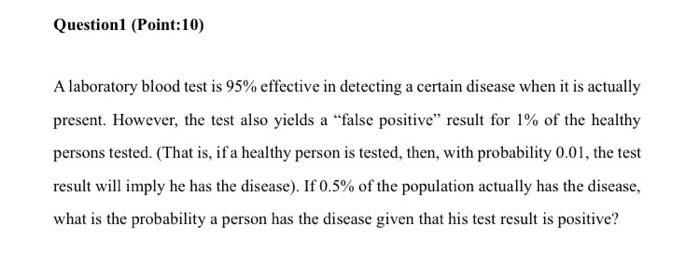
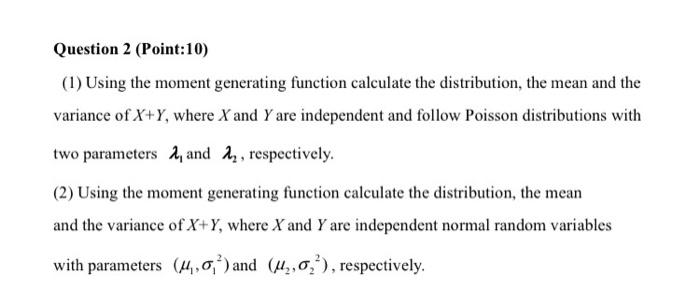
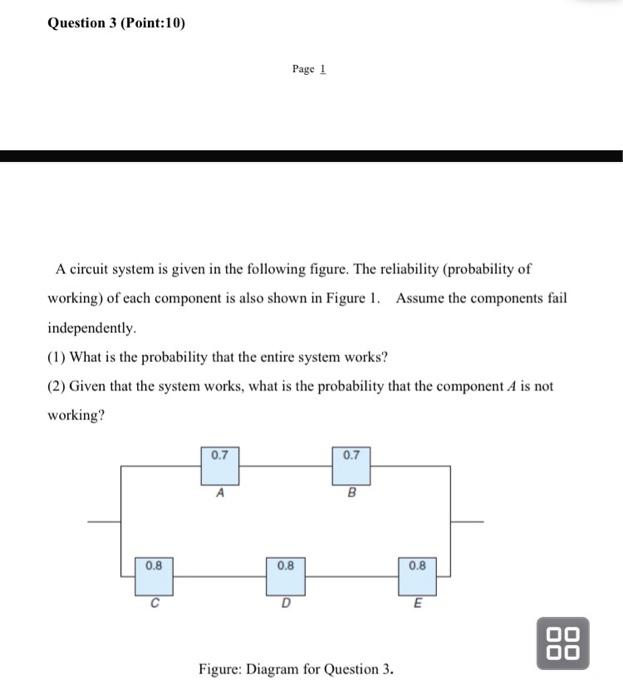


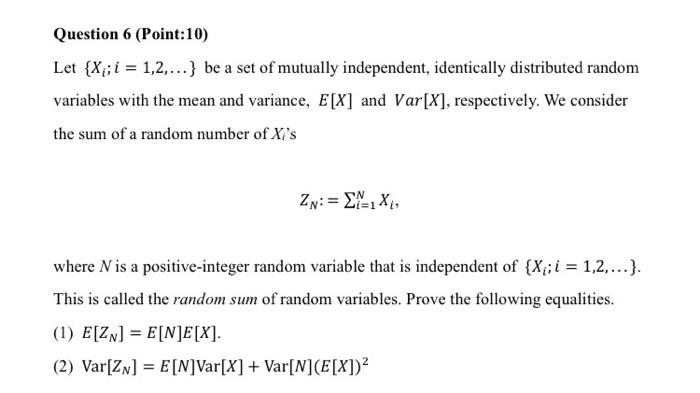
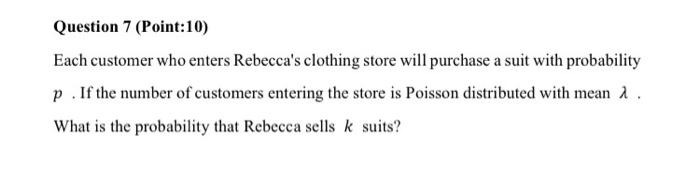
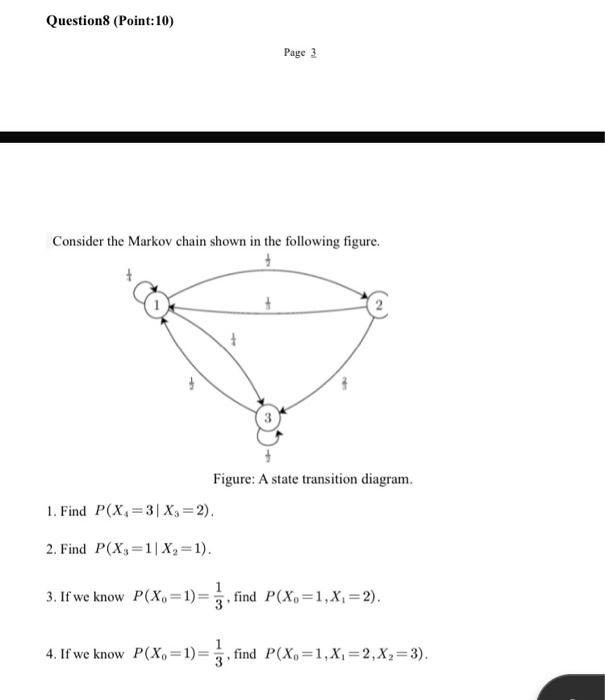
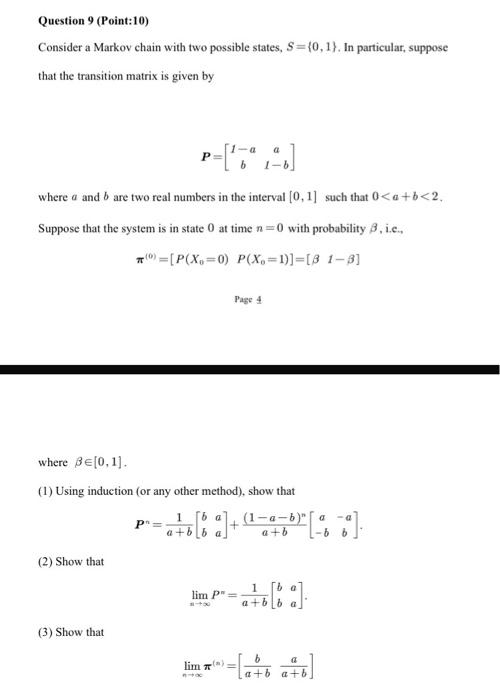

A laboratory blood test is 95% effective in detecting a certain disease when it is actually present. However, the test also yields a "false positive" result for 1% of the healthy persons tested. (That is, if a healthy person is tested, then, with probability 0.01, the test result will imply he has the disease). If 0.5% of the population actually has the disease, what is the probability a person has the disease given that his test result is positive? Question 2 (Point:10) (1) Using the moment generating function calculate the distribution, the mean and the variance of X+Y, where X and Y are independent and follow Poisson distributions with two parameters 1 and 2, respectively. (2) Using the moment generating function calculate the distribution, the mean and the variance of X+Y, where X and Y are independent normal random variables with parameters (1,12) and (2,22), respectively. A circuit system is given in the following figure. The reliability (probability of working) of each component is also shown in Figure 1. Assume the components fail independently. (1) What is the probability that the entire system works? (2) Given that the system works, what is the probability that the component A is not working? Figure: Diagram for Question 3. Let X and Y be jointly continuous random variables with joint PDF fX,Y(x,y)={cx+10x,y0,x+y
Step by Step Solution
There are 3 Steps involved in it

Get step-by-step solutions from verified subject matter experts