







Question: Submit Answer 9. [-/10 Points] DETAILS MY NOTES ASK YOUR TEACHER P, C, & A are shown below. P = 46, C = 16, &
![Submit Answer 9. [-/10 Points] DETAILS MY NOTES ASK YOUR TEACHER](https://dsd5zvtm8ll6.cloudfront.net/si.experts.images/questions/2024/09/66e4644aba3b7_91466e4644a7f4ca.jpg)
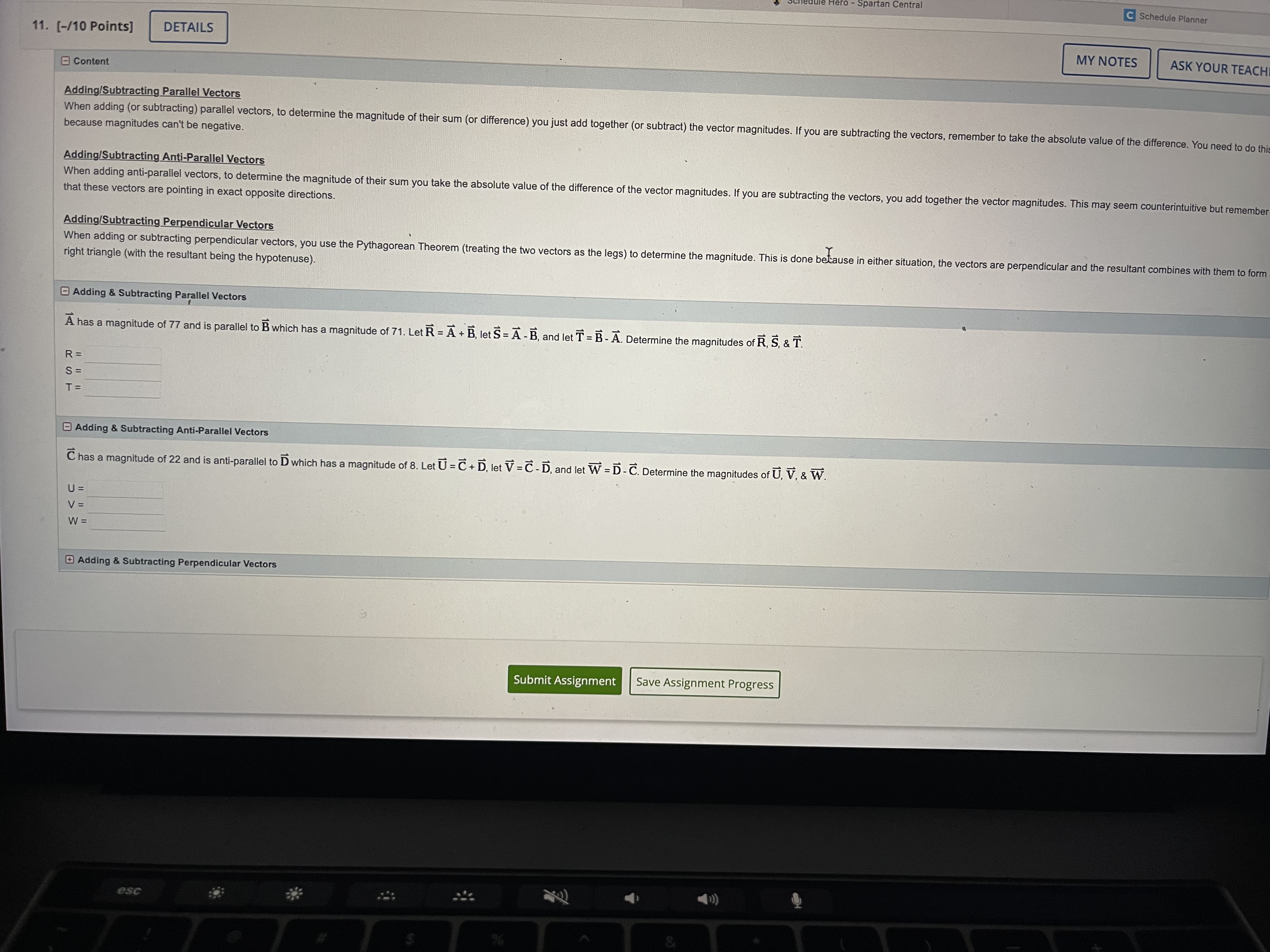
Submit Answer 9. [-/10 Points] DETAILS MY NOTES ASK YOUR TEACHER P, C, & A are shown below. P = 46, C = 16, & A = 48. Let R = P - C + A. Determine the components of each vector as well as the magnitude & direction of R. For hardcopies of this assignment, you can draw R in the blank box below. You are expected to know how to draw vectors and may be asked to do so on a test. Vector P Vector C Vector A Vector R 20' 4 PX Cx Ax = RX = P y = Cy = Ay = Ry R = Direction of R = . from the VERTICAL in quadrant --- Choose quadrant --- 10. [-/10 Points] DETAILS MY NOTES ASK YOUR TEACHER P, W, & L are shown below. P = 36, W = 24, & L = 14. Let R = 9P + 4W - 2L. Determine the components of each vector as well as the magnitude & direction of R. For hardcopies of this assignment, you can draw R in the blank box below. You are expected to know how to draw vectors and may be asked to do so on a test. Vector P Vector W Vector L Vector R 80' Px WX= RX Py = Wy = LY = Ry = R = Direction of R = relative to the HORIZONTAL in quadrant --- Choose quadrant --- C esc % 5 6 7 deleteC Schedule Planner 11. [-/10 Points] DETAILS MY NOTES ASK YOUR TEACH Content Adding/Subtracting Parallel Vectors When adding (or subtracting) parallel vectors, to determine the magnitude of their sum (or difference) you just add together (or subtract) the vector magnitudes. If you are subtracting the vectors, remember to take the absolute value of the difference. You need to do th because magnitudes can't be negative. Adding/Subtracting Anti-Parallel Vectors When adding anti-parallel vectors, to determine the magnitude of their sum you take the absolute value of the difference of the vector magnitudes. If you are subtracting the vectors, you add together the vector magnitudes. This may seem counterintuitive but remember that these vectors are pointing in exact opposite directions Adding/Subtracting Perpendicular Vectors When adding or subtracting perpendicular vectors, you use the Pythagorean Theorem (treating the two vectors as the legs) to determine the magnitude. This is done because in either situation, the vectors are perpendicular and the resultant combines with them to form ight triangle (with the resultant being the hypotenuse). Adding & Subtracting Parallel Vectors A has a magnitude of 77 and is parallel to B which has a magnitude of 71. Let R = A + B, let S = A - B, and let T = B - A. Determine the magnitudes of R, S, & T. R S T = Adding & Subtracting Anti-Parallel Vectors C has a magnitude of 22 and is anti-parallel to D which has a magnitude of 8. Let U = C + D, let V = C - D, and let W = D - C. Determine the magnitudes of U. V, & W. U = V = W = Adding & Subtracting Perpendicular Vectors Submit Assignment Save Assignment Progress esc
Step by Step Solution
There are 3 Steps involved in it

Get step-by-step solutions from verified subject matter experts
 Study Help