







Question: Summaries the articles 7:06 III '3' . ' 7:06 Across the globe, nearly 800 million people live without any access to electricity about 600 million
Summaries the articles
7:06 III '3' . '
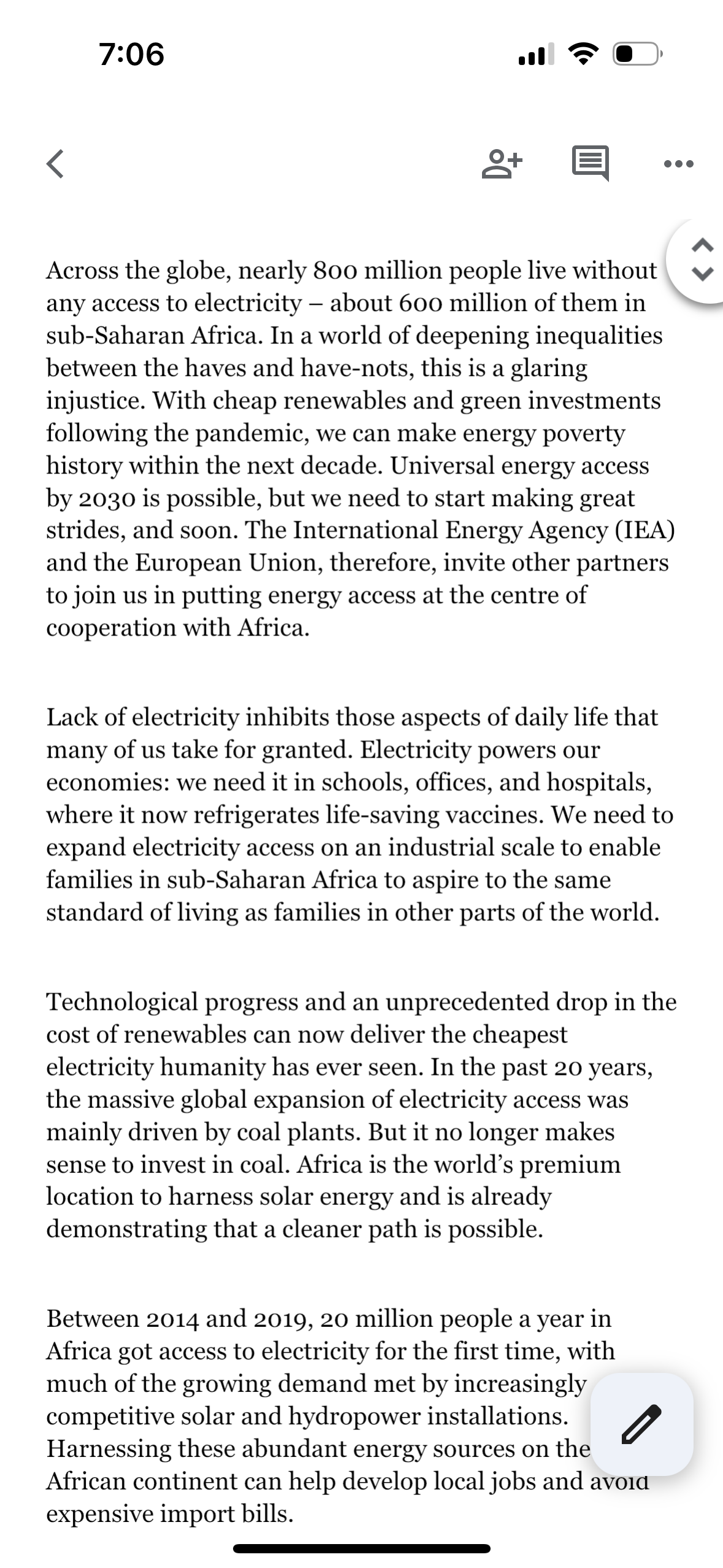
7:06 Across the globe, nearly 800 million people live without any access to electricity about 600 million of them in sub-Saharan Africa. In a world of deepening inequalities between the haves and have-nots, this is a glaring injustice. With cheap renewables and green investments following the pandemic, we can make energy poverty history within the next decade. Universal energy access by 2030 is possible, but we need to start making great strides, and soon. The International Energy Agency (IEA) and the European Union, therefore, invite other partners to join us in putting energy access at the centre of cooperation with Africa. Lack of electricity inhibits those aspects of daily life that many of us take for granted. Electricity powers our economies: we need it in schools, offices, and hospitals, where it now refrigerates life-saving vaccines. We need to expand electricity access on an industrial scale to enable families in sub-Saharan Africa to aspire to the same standard of living as families in other parts of the world. Technological progress and an unprecedented drop in the cost of renewables can now deliver the cheapest electricity humanity has ever seen. In the past 20 years, the massive global expansion of electricity access was mainly driven by coal plants. But it no longer makes sense to invest in coal. Africa is the world's premium location to harness solar energy and is already demonstrating that a cleaner path is possible. Between 2014 and 2019, 20 million people a year in Africa got access to electricity for the first time, with much of the growing demand met by increasingly competitive solar and hydropower installations. Harnessing these abundant energy sources on the African continent can help develop local jobs and avoid expensive import bills.
Step by Step Solution
There are 3 Steps involved in it

Get step-by-step solutions from verified subject matter experts
 Study Help