



Question: summarise the work please thank you (e) How might you expand on the simple empirical model in (d)? Relate your suggestion to paper(s) we covered

summarise the work please thank you
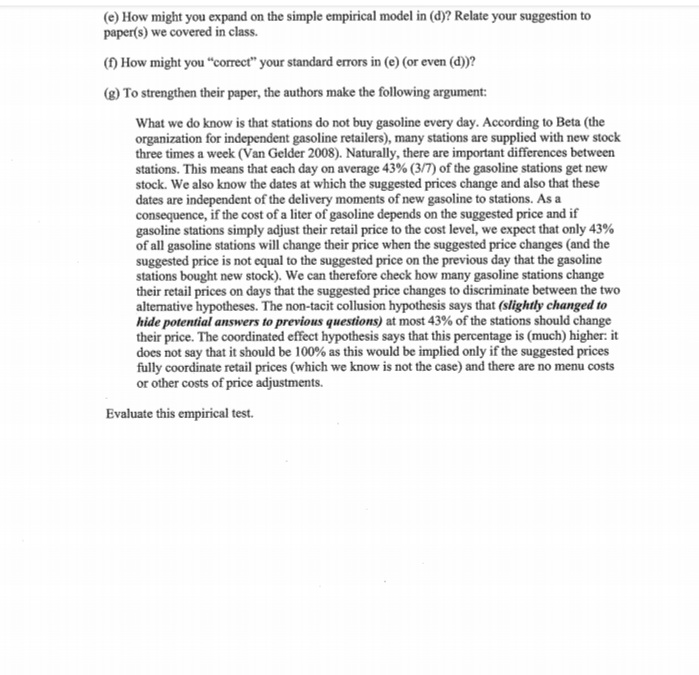
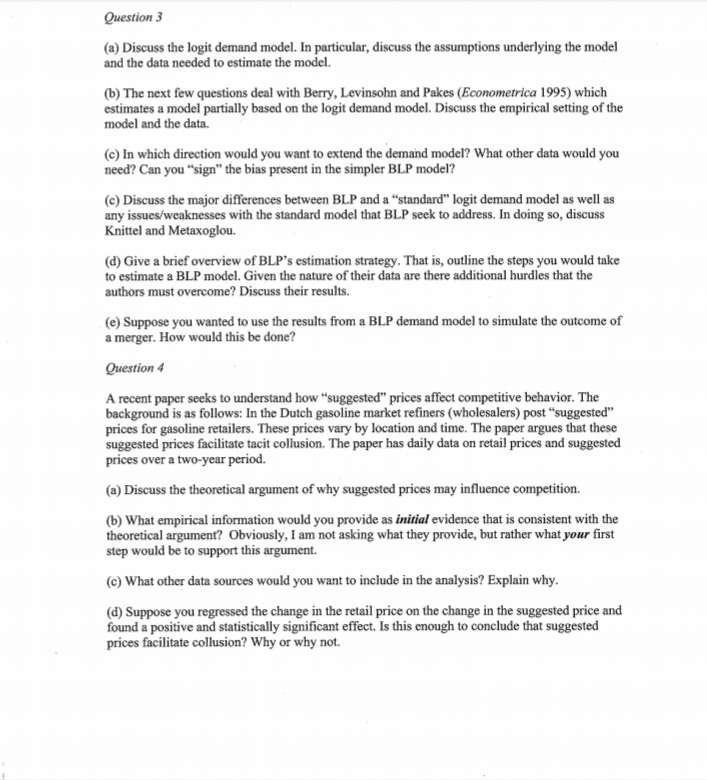
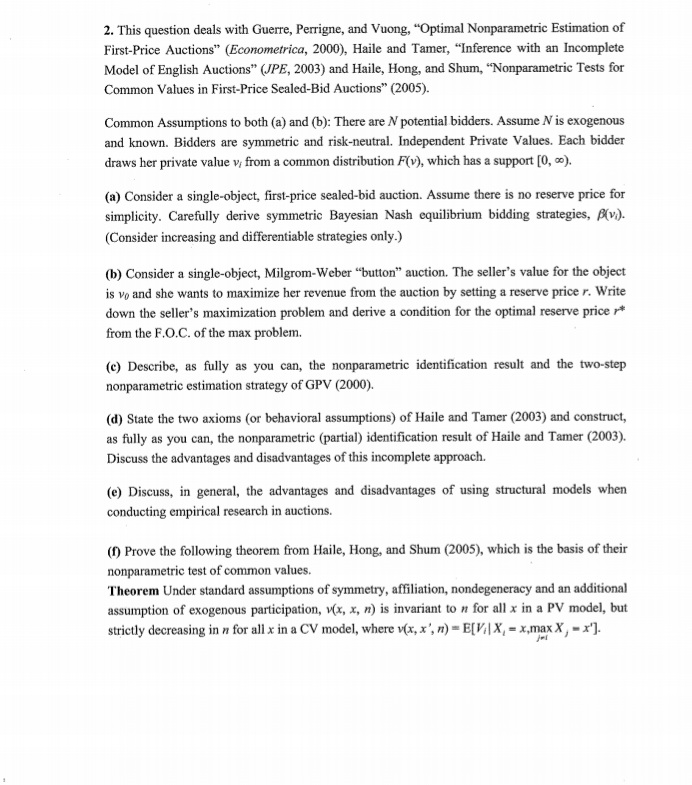

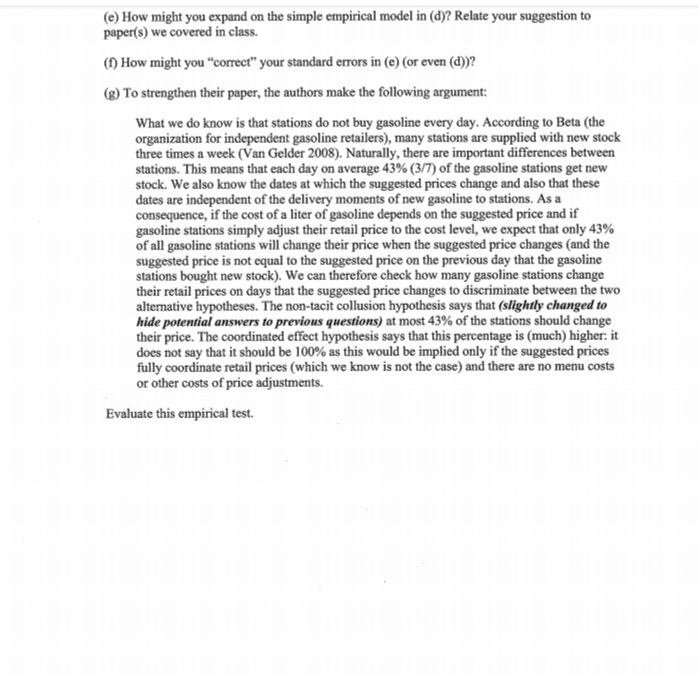
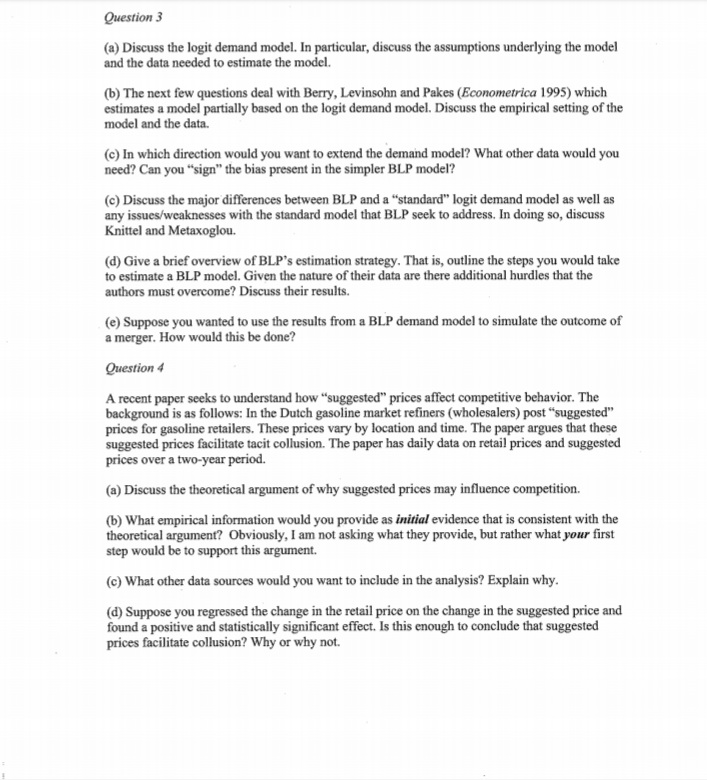
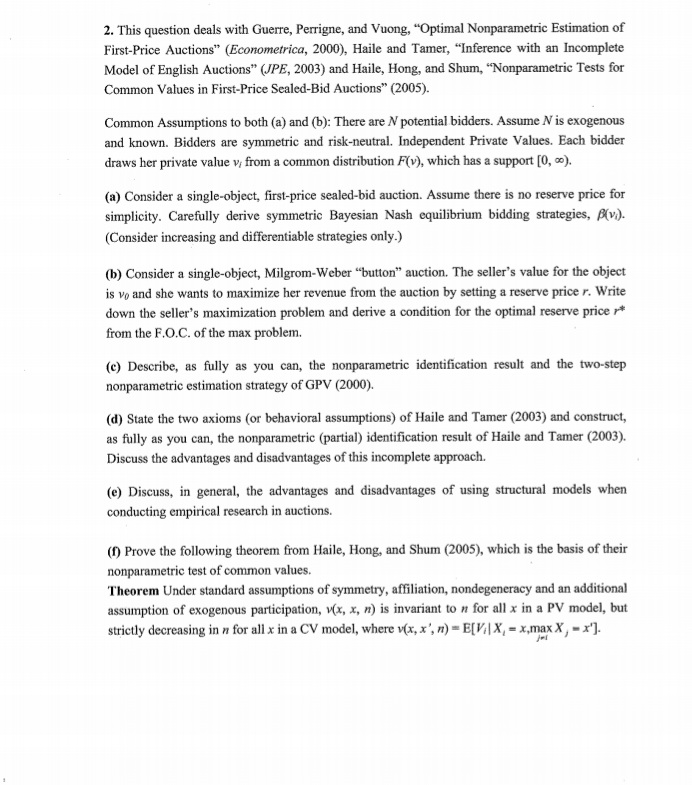
(e) How might you expand on the simple empirical model in (d)? Relate your suggestion to paper(s) we covered in class. (f) How might you "correct" your standard errors in (e) (or even (d))? (g) To strengthen their paper, the authors make the following argument: What we do know is that stations do not buy gasoline every day. According to Beta (the organization for independent gasoline retailers), many stations are supplied with new stock three times a week (Van Gelder 2008). Naturally, there are important differences between stations. This means that each day on average 43% (3/7) of the gasoline stations get new stock. We also know the dates at which the suggested prices change and also that these dates are independent of the delivery moments of new gasoline to stations. As a consequence, if the cost of a liter of gasoline depends on the suggested price and if gasoline stations simply adjust their retail price to the cost level, we expect that only 43% of all gasoline stations will change their price when the suggested price changes (and the suggested price is not equal to the suggested price on the previous day that the gasoline stations bought new stock). We can therefore check how many gasoline stations change their retail prices on days that the suggested price changes to discriminate between the two alternative hypotheses. The non-tacit collusion hypothesis says that (slightly changed to hide potential answers to previous questions) at most 43% of the stations should change their price. The coordinated effect hypothesis says that this percentage is (much) higher. it does not say that it should be 100% as this would be implied only if the suggested prices fully coordinate retail prices (which we know is not the case) and there are no menu costs or other costs of price adjustments. Evaluate this empirical test.Question 3 (a) Discuss the logit demand model. In particular, discuss the assumptions underlying the model and the data needed to estimate the model. (b) The next few questions deal with Berry, Levinsohn and Pakes (Econometrica 1995) which estimates a model partially based on the logit demand model. Discuss the empirical setting of the model and the data. (c) In which direction would you want to extend the demand model? What other data would you need? Can you "sign" the bias present in the simpler BLP model? (c) Discuss the major differences between BLP and a "standard" logit demand model as well as any issues/weaknesses with the standard model that BLP seek to address. In doing so, discuss Knittel and Metaxoglou. (d) Give a brief overview of BLP's estimation strategy. That is, outline the steps you would take to estimate a BLP model. Given the nature of their data are there additional hurdles that the authors must overcome? Discuss their results. (e) Suppose you wanted to use the results from a BLP demand model to simulate the outcome of a merger. How would this be done? Question 4 A recent paper seeks to understand how "suggested" prices affect competitive behavior. The background is as follows: In the Dutch gasoline market refiners (wholesalers) post "suggested" prices for gasoline retailers. These prices vary by location and time. The paper argues that these suggested prices facilitate tacit collusion. The paper has daily data on retail prices and suggested prices over a two-year period. (a) Discuss the theoretical argument of why suggested prices may influence competition. (b) What empirical information would you provide as initial evidence that is consistent with the theoretical argument? Obviously, I am not asking what they provide, but rather what your first step would be to support this argument. (c) What other data sources would you want to include in the analysis? Explain why. (d) Suppose you regressed the change in the retail price on the change in the suggested price and found a positive and statistically significant effect. Is this enough to conclude that suggested prices facilitate collusion? Why or why not.2. This question deals with Guerre, Perrigne, and Vuong, "Optimal Nonparametric Estimation of First-Price Auctions" (Econometrica, 2000), Haile and Tamer, "Inference with an Incomplete Model of English Auctions" (JPE, 2003) and Haile, Hong, and Shum, "Nonparametric Tests for Common Values in First-Price Sealed-Bid Auctions" (2005). Common Assumptions to both (a) and (b): There are A potential bidders. Assume N is exogenous and known. Bidders are symmetric and risk-neutral. Independent Private Values. Each bidder draws her private value , from a common distribution F(v), which has a support [0, 20). (a) Consider a single-object, first-price sealed-bid auction. Assume there is no reserve price for simplicity. Carefully derive symmetric Bayesian Nash equilibrium bidding strategies, A(v.). (Consider increasing and differentiable strategies only.) (b) Consider a single-object, Milgrom-Weber "button" auction. The seller's value for the object is vo and she wants to maximize her revenue from the auction by setting a reserve price r. Write down the seller's maximization problem and derive a condition for the optimal reserve price * from the F.O.C. of the max problem. (c) Describe, as fully as you can, the nonparametric identification result and the two-step nonparametric estimation strategy of GPV (2000). (d) State the two axioms (or behavioral assumptions) of Haile and Tamer (2003) and construct, as fully as you can, the nonparametric (partial) identification result of Haile and Tamer (2003). Discuss the advantages and disadvantages of this incomplete approach. (e) Discuss, in general, the advantages and disadvantages of using structural models when conducting empirical research in auctions. (f) Prove the following theorem from Haile, Hong, and Shum (2005), which is the basis of their nonparametric test of common values. Theorem Under standard assumptions of symmetry, affiliation, nondegeneracy and an additional assumption of exogenous participation, v(x, x, ") is invariant to # for all x in a PV model, but strictly decreasing in " for all x in a CV model, where v(x, x', ") = E[V,[X, = x,max X, = x'].1. This question deals with Chevalier and Ellison, "Risk Taking by Mutual Funds as a Response to Incentives" (1997, /PE), Chevalier and Ellison, "Career Concerns of Mutual Fund Managers" (1999, OJE), Hubbard, "An Empirical Examination of Moral Hazard in the Vehicle Inspection Market" (1998, RAND) and Ferrall and Shearer, "Incentives and Transactions Costs Within the Firm: Estimating an Agency Model Using Payroll Records" (1999, ReStud). (a) For Chevalier and Ellison (1997), discuss carefully what the empirical setting is and what their main research question is. Also, describe their data set and empirical strategy. (b) For Chevalier and Ellison (1999), explain why the (implicit) incentive structure for younger managers and that for older managers may differ? What are their empirical findings? Compare this paper (1999) with the previous one (1997). What are their similarities? What are the differences? (c) For Hubbard (1998), discuss carefully what the empirical setting is and what his main research question is. Also, describe the data set and empirical strategy. (d) What are empirical findings of Hubbard (1998)? Compare and contrast this paper with two papers by Chevalier and Ellison (1997, 1999). What do you think can be their common theme? How do they differ in their empirical approaches? (e) For Ferrall and Shearer (1999), discuss carefully what the empirical setting is and what their main research question is. Also, describe their data set and empirical model as fully as you can. (f) Why do you think Ferrall and Shearer (1999) employ a structural approach? Discuss a possibility of using non-structural(reduced-form) approaches as an alternative empirical strategy
Step by Step Solution
There are 3 Steps involved in it

Get step-by-step solutions from verified subject matter experts