Question: summarize and make eas WarreN, C. ., These cases come 1o us from the States of Kansas, South Carolina, Virginia, and Delaware. They are premised
summarize and make eas
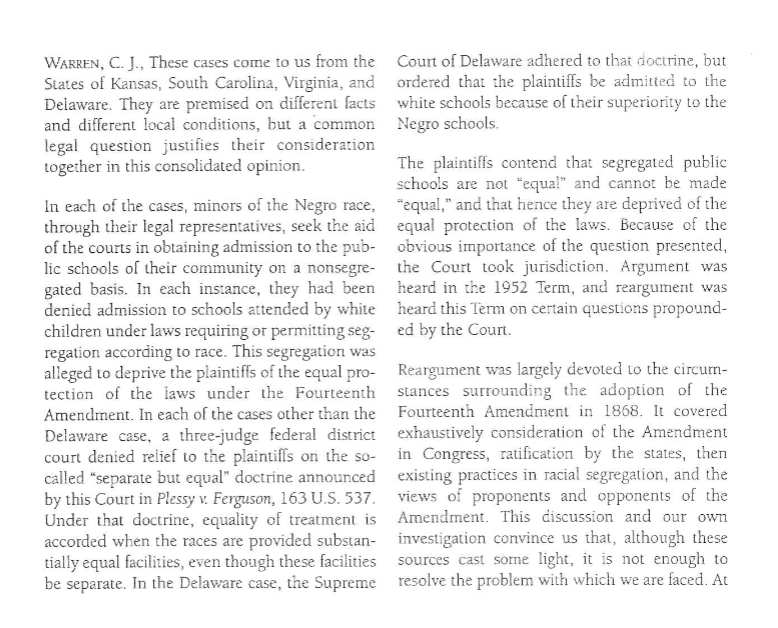
WarreN, C. ., These cases come 1o us from the States of Kansas, South Carolina, Virginia, and Delaware. They are premised on different facts and different local conditions, but a common legal question justifies their consideration together in this consclidated opinion. In each of the cases, minors of the Negro race, through their legal representatives, seek the aid of the courts in obtaining admission to the pub- lic schools ol their community on a nonsegre- gated basis. In each instance, they had been denied admission to schools zitended by white children under laws requiring ot permitting seg- regation according to race. This segregation was alleged to deprive the plaintiffs of the equal pro- tection of the iaws under the Fourteenth Amendment. In each of the cases other than the Delaware case, 2 three-judge federal district court denied relief to the plaintifls on the so- called \"separate but equal\" doctrine announced by this Court in Plessy v. Ferguson, 163 U.S. 537. Under that doctrine, equality of treatment is accorded when the races are provided substan- tially equal facilities, even though these facilities be separate. In the Delaware case, the Supreme Court of Delaware adhered to that doctrine, but ordered that the plaintiffs be admited to the white schools because of their superiority to the Negro schools. The plaintiffs contend that segregated public schools are not \"equal\" and cannot be made \"equal,\" and that hence they are deprived of the equal protection of the laws. Because of the obvious importance of the question presented, the Court tocok jurisdiction. Argument was heard in the 1952 Term, and reargument was heard this Term on certain questions propound- ed by the Court. Reargument was largely devotled to the circum- stances surrounding the adoption of the Fourteenth Amendment in 1868. It covered exhaustively consideration of the Amendment in Congress, ratification by the states, then existing practices in racial segregation, and the views of proponents and opponents of the Amendment. This discussion and our own investigation convince us that, although these sources cast some light, it is not enough to resolve the problem with which we are faced. At









 Study Help