Question: summarize each reading in 150 words or more. reading 1: reading 2: NOWHE, E FAST (OR FURIOUS): THE NONEXISTENT U.S. FIREARMS ICKING STATUTE AND THE
summarize each reading in 150 words or more.
reading 2:
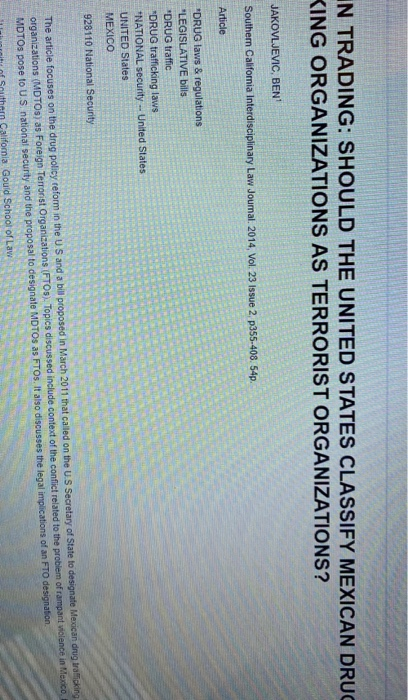
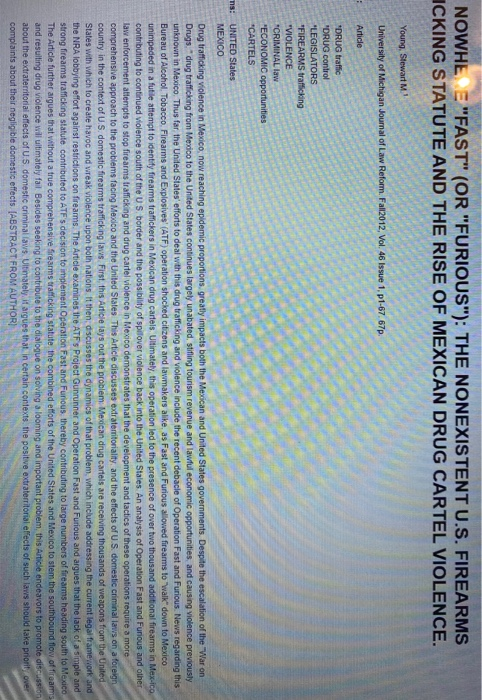
NOWHE, E "FAST" (OR "FURIOUS"): THE NONEXISTENT U.S. FIREARMS ICKING STATUTE AND THE RISE OF MEXICAN DRUG CARTEL VIOLENCE. Young, Stewart M' University of Michigan Journal of Law Reform. Fall2012, Vol. 46 Issue 1, p1-6767p. Article *DRUG traffic "DRUG control "LEGISLATORS "FIREARMS trafficking "VIOLENCE "CRIMINAL law "ECONOMIC opportunities "CARTELS UNITED States MEXICO Drug trafficking violence in Mexico, now reaching epidemic proportions greatly impacts both the Mexican and United States governments. Despite the escalation of the War on Drugs. * drug trafficking from Mexico to the United States continues largely unabated, stifling tourism revenue and lawful economic opportunities and causing violence previously unknown in Mexico. Thus far the United States' efforts to deal with this drug trafficking and violence include the recent debacle of Operation Fast and Furious News regarding this Bureau of Alcohol. Tobacco Firearms and Explosives' (ATF) operation shocked citizens and lawmakers alike, as Fast and Furious allowed firearms to walk down to Mexico unimpeded in a futile attempt to identity firearms traffickers in Mexican drug cartels Ultimately, this operation led to the presence of over two thousand additional firearms in Mexico contributing to continued violence south of the US border and the possibility of spillover violence back into the United Stales An analysis of Operation Fast and Furious and other law enforcement attempts to stop firearms trafficking and drug cartel violence in Mexico demonstrates that the development and tactics of these operations require a more comprehensive approach to the problems facing Mexico and the United States This Article discusses extraterritoriality and the effects of U.S. domestic criminal laws on a foreign country in the context of U.S. domestic firearms trafficking laws. First this Article lays out the problem Mexican drug cartels are receiving thousands of weapons from the United States with which to create havoc and wreak violence upon both nations. It then discusses the dynamics of that problem, which include addressing the current legal framework and the NRA lobbying effort against restrictions on firearms. The Article examines the ATFs Project Gunrunner and Operation Fast and Furious and argues that the lack of a simple and strong firearms trafficking statute contributed to ATF's decision to implement Operation Fast and Furious, thereby contributing to large numbers of firearms heading south to Mexico The Article further argues that without a true comprehensive firearms trafficking statute the combined efforts of the United States and Mexico to stem the southbound flow of firearms and resulting drug violence will ultimately fail. Besides seeking to contribute to the dialogue on solving a looming and important problem, this article endeavors to promote discuss about the extraterritorial effects of US domestic criminal laws Ultimately. If argues that in certain contexts the positive extraterritorial effects of such laws should take priority over complaints about their negligible domestic effects. [ABSTRACT FROM AUTHOR] IN TRADING: SHOULD THE UNITED STATES CLASSIFY MEXICAN DRUG KING ORGANIZATIONS AS TERRORIST ORGANIZATIONS? JAKOVLJEVIC, BEN Southern California Interdisciplinary Law Journal 2014, Vol. 23 Issue 2 p355.408.54p. Article DRUG laws & regulations LEGISLATIVE bills "DRUG traffic DRUG trafficking laws *NATIONAL security - United States UNITED States MEXICO 928110 National Security ERIES GRAND The article focuses on the drug policy reform in the US and a bil proposed in March 2011 that called on the US Secretary of State to designate Mexican drug trafiking organizations (MDTOS) as Foreign Terrorist Organizations IFTOS). Topics discussed include context of the conflict related to the problem of rampant violence in Mexico MDTOs pose to US national security and the proposal to designate MDTOs as FTOS. It also discusses the legal implications of an FTO designation S IN bent of Southern California Gould School of Law NOWHE, E "FAST" (OR "FURIOUS"): THE NONEXISTENT U.S. FIREARMS ICKING STATUTE AND THE RISE OF MEXICAN DRUG CARTEL VIOLENCE. Young, Stewart M' University of Michigan Journal of Law Reform. Fall2012, Vol. 46 Issue 1, p1-6767p. Article *DRUG traffic "DRUG control "LEGISLATORS "FIREARMS trafficking "VIOLENCE "CRIMINAL law "ECONOMIC opportunities "CARTELS UNITED States MEXICO Drug trafficking violence in Mexico, now reaching epidemic proportions greatly impacts both the Mexican and United States governments. Despite the escalation of the War on Drugs. * drug trafficking from Mexico to the United States continues largely unabated, stifling tourism revenue and lawful economic opportunities and causing violence previously unknown in Mexico. Thus far the United States' efforts to deal with this drug trafficking and violence include the recent debacle of Operation Fast and Furious News regarding this Bureau of Alcohol. Tobacco Firearms and Explosives' (ATF) operation shocked citizens and lawmakers alike, as Fast and Furious allowed firearms to walk down to Mexico unimpeded in a futile attempt to identity firearms traffickers in Mexican drug cartels Ultimately, this operation led to the presence of over two thousand additional firearms in Mexico contributing to continued violence south of the US border and the possibility of spillover violence back into the United Stales An analysis of Operation Fast and Furious and other law enforcement attempts to stop firearms trafficking and drug cartel violence in Mexico demonstrates that the development and tactics of these operations require a more comprehensive approach to the problems facing Mexico and the United States This Article discusses extraterritoriality and the effects of U.S. domestic criminal laws on a foreign country in the context of U.S. domestic firearms trafficking laws. First this Article lays out the problem Mexican drug cartels are receiving thousands of weapons from the United States with which to create havoc and wreak violence upon both nations. It then discusses the dynamics of that problem, which include addressing the current legal framework and the NRA lobbying effort against restrictions on firearms. The Article examines the ATFs Project Gunrunner and Operation Fast and Furious and argues that the lack of a simple and strong firearms trafficking statute contributed to ATF's decision to implement Operation Fast and Furious, thereby contributing to large numbers of firearms heading south to Mexico The Article further argues that without a true comprehensive firearms trafficking statute the combined efforts of the United States and Mexico to stem the southbound flow of firearms and resulting drug violence will ultimately fail. Besides seeking to contribute to the dialogue on solving a looming and important problem, this article endeavors to promote discuss about the extraterritorial effects of US domestic criminal laws Ultimately. If argues that in certain contexts the positive extraterritorial effects of such laws should take priority over complaints about their negligible domestic effects. [ABSTRACT FROM AUTHOR] IN TRADING: SHOULD THE UNITED STATES CLASSIFY MEXICAN DRUG KING ORGANIZATIONS AS TERRORIST ORGANIZATIONS? JAKOVLJEVIC, BEN Southern California Interdisciplinary Law Journal 2014, Vol. 23 Issue 2 p355.408.54p. Article DRUG laws & regulations LEGISLATIVE bills "DRUG traffic DRUG trafficking laws *NATIONAL security - United States UNITED States MEXICO 928110 National Security ERIES GRAND The article focuses on the drug policy reform in the US and a bil proposed in March 2011 that called on the US Secretary of State to designate Mexican drug trafiking organizations (MDTOS) as Foreign Terrorist Organizations IFTOS). Topics discussed include context of the conflict related to the problem of rampant violence in Mexico MDTOs pose to US national security and the proposal to designate MDTOs as FTOS. It also discusses the legal implications of an FTO designation S IN bent of Southern California Gould School of Law