







Question: summarize each topic + observation Normal No Spacing Heading 1 unit of that cell phone cost the customer $100,000. C'mon, it's the world's greatest cell
summarize each topic + observation 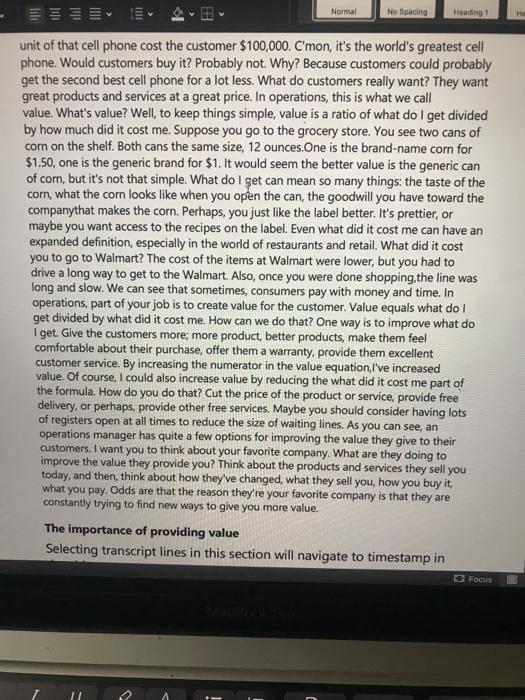
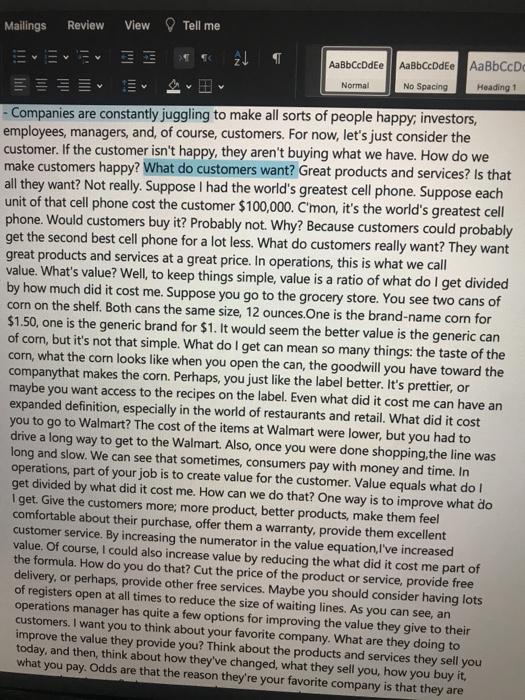
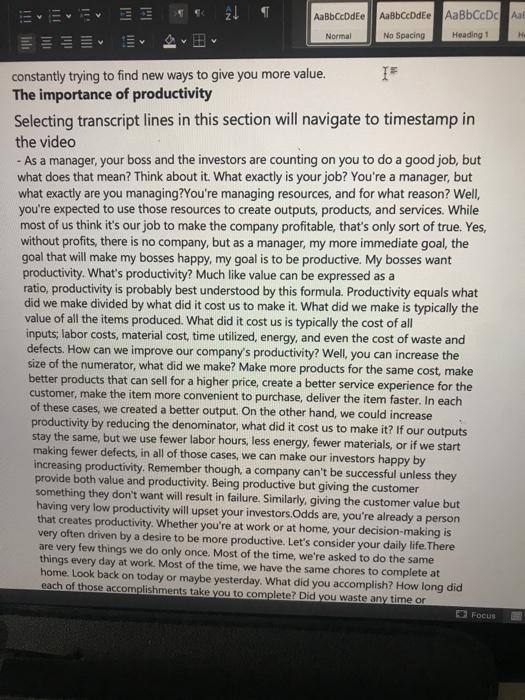
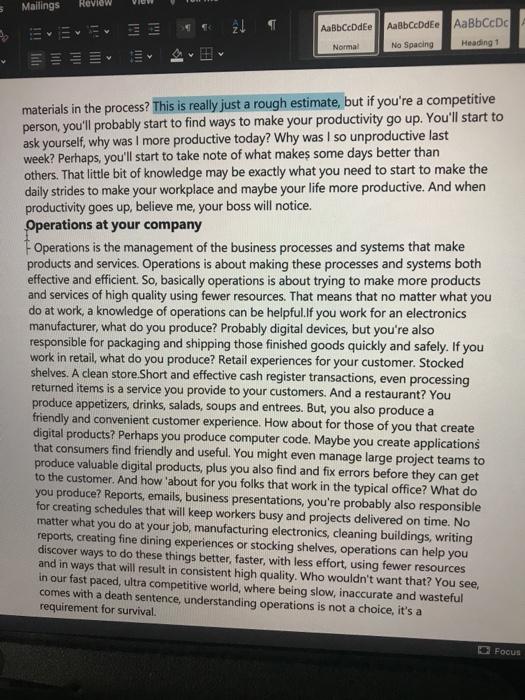
Normal No Spacing Heading 1 unit of that cell phone cost the customer $100,000. C'mon, it's the world's greatest cell phone. Would customers buy it? Probably not. Why? Because customers could probably get the second best cell phone for a lot less. What do customers really want? They want great products and services at a great price. In operations, this is what we call value. What's value? Well, to keep things simple, value is a ratio of what do I get divided by how much did it cost me. Suppose you go to the grocery store. You see two cans of corn on the shelf. Both cans the same size, 12 ounces.One is the brand-name corn for $1.50, one is the generic brand for $1. It would seem the better value is the generic can of corn, but it's not that simple. What do I get can mean so many things the taste of the corn, what the corn looks like when you open the can, the goodwill you have toward the companythat makes the corn. Perhaps, you just like the label better. It's prettier, or maybe you want access to the recipes on the label. Even what did it cost me can have an expanded definition, especially in the world of restaurants and retail. What did it cost you to go to Walmart? The cost of the items at Walmart were lower, but you had to drive a long way to get to the Walmart. Also, once you were done shopping the line was long and slow. We can see that sometimes, consumers pay with money and time. In operations, part of your job is to create value for the customer. Value equals what do I get divided by what did it cost me. How can we do that? One way is to improve what do I get. Give the customers more; more product, better products, make them feel comfortable about their purchase, offer them a warranty provide them excellent customer service. By increasing the numerator in the value equation, I've increased value. Of course, I could also increase value by reducing the what did it cost me part of the formula. How do you do that? Cut the price of the product or service provide free delivery, or perhaps, provide other free services. Maybe you should consider having lots of registers open at all times to reduce the size of waiting lines. As you can see, an operations manager has quite a few options for improving the value they give to their customers. I want you to think about your favorite company. What are they doing to improve the value they provide you? Think about the products and services they sell you today, and then think about how they've changed, what they sell you, how you buy it what you pay. Odds are that the reason they're your favorite company is that they are constantly trying to find new ways to give you more value. The importance of providing value Selecting transcript lines in this section will navigate to timestamp in Focus Mailings Review View Tell me 2 AaBbCcDdEe AaBbCcDdEe AaBbCcDo Normal No Spacing Heading 1 - Companies are constantly juggling to make all sorts of people happy, investors, employees, managers, and, of course, customers. For now, let's just consider the customer. If the customer isn't happy, they aren't buying what we have. How do we make customers happy? What do customers want? Great products and services? Is that all they want? Not really. Suppose I had the world's greatest cell phone. Suppose each unit of that cell phone cost the customer $100,000. C'mon, it's the world's greatest cell phone. Would customers buy it? Probably not. Why? Because customers could probably get the second best cell phone for a lot less. What do customers really want? They want great products and services at a great price. In operations, this is what we call value. What's value? Well, to keep things simple, value is a ratio of what do I get divided by how much did it cost me. Suppose you go to the grocery store. You see two cans of corn on the shelf. Both cans the same size, 12 ounces.One is the brand-name com for $1.50, one is the generic brand for $1. It would seem the better value is the generic can of com, but it's not that simple. What do I get can mean so many things: the taste of the corn, what the corn looks like when you open the can, the goodwill you have toward the companythat makes the corn. Perhaps, you just like the label better. It's prettier, or maybe you want access to the recipes on the label. Even what did it cost me can have an expanded definition, especially in the world of restaurants and retail. What did it cost you to go to Walmart? The cost of the items at Walmart were lower, but you had to drive a long way to get to the Walmart. Also, once you were done shopping, the line was long and slow. We can see that sometimes, consumers pay with money and time. In operations, part of your job is to create value for the customer. Value equals what do I get divided by what did it cost me. How can we do that? One way is to improve what do I get. Give the customers more, more product, better products, make them feel comfortable about their purchase, offer them a warranty, provide them excellent customer service. By increasing the numerator in the value equation, I've increased value. Of course, I could also increase value by reducing the what did it cost me part of the formula. How do you do that? Cut the price of the product or service, provide free delivery, or perhaps, provide other free services. Maybe you should consider having lots of registers open at all times to reduce the size of waiting lines. As you can see, an operations manager has quite a few options for improving the value they give to their customers. I want you to think about your favorite company. What are they doing to improve the value they provide you? Think about the products and services they sell you today, and then think about how they've changed, what they sell you, how you buy it, what you pay. Odds are that the reason they're your favorite company is that they are AaBbCcDdEe !! IIII AaBbCcDdEe AaBbCcDc Aal No Spacing Heading 1 Normal He llll constantly trying to find new ways to give you more value. The importance of productivity Selecting transcript lines in this section will navigate to timestamp in the video - As a manager, your boss and the investors are counting on you to do a good job, but what does that mean? Think about it. What exactly is your job? You're a manager, but what exactly are you managing?You're managing resources, and for what reason? Well, you're expected to use those resources to create outputs, products, and services. While most of us think it's our job to make the company profitable, that's only sort of true. Yes, without profits, there is no company, but as a manager, my more immediate goal, the goal that will make my bosses happy, my goal is to be productive. My bosses want productivity. What's productivity? Much like value can be expressed as a ratio, productivity is probably best understood by this formula. Productivity equals what did we make divided by what did it cost us to make it. What did we make is typically the value of all the items produced. What did it cost us is typically the cost of all inputs; labor costs, material cost, time utilized, energy, and even the cost of waste and defects. How can we improve our company's productivity? Well, you can increase the size of the numerator, what did we make? Make more products for the same cost, make better products that can sell for a higher price, create a better service experience for the customer, make the item more convenient to purchase, deliver the item faster. In each of these cases, we created a better output. On the other hand, we could increase productivity by reducing the denominator, what did it cost us to make it? If our outputs stay the same, but we use fewer labor hours, less energy, fewer materials, or if we start making fewer defects, in all of those cases, we can make our investors happy by increasing productivity. Remember though, a company can't be successful unless they provide both value and productivity. Being productive but giving the customer something they don't want will result in failure. Similarly, giving the customer value but having very low productivity will upset your investors.Odds are, you're already a person that creates productivity. Whether you're at work or at home, your decision-making is very often driven by a desire to be more productive. Let's consider your daily life. There are very few things we do only once. Most of the time, we're asked to do the same things every day at work. Most of the time, we have the same chores to complete at home look back on today or maybe yesterday. What did you accomplish? How long did each of those accomplishments take you to complete? Did you waste any time or Focus Mallings Review AaBbCcDdEe AaBbCcDdEe No Spacing AaBbCcDc Heading 1 Normal materials in the process? This is really just a rough estimate, but if you're a competitive person, you'll probably start to find ways to make your productivity go up. You'll start to ask yourself , why was more productive today? Why was I so unproductive last week? Perhaps, you'll start to take note of what makes some days better than others. That little bit of knowledge may be exactly what you need to start to make the daily strides to make your workplace and maybe your life more productive. And when productivity goes up, believe me, your boss will notice. Operations at your company Operations is the management of the business processes and systems that make products and services. Operations is about making these processes and systems both effective and efficient. So, basically operations is about trying to make more products and services of high quality using fewer resources. That means that no matter what you do at work, a knowledge of operations can be helpful.If you work for an electronics manufacturer, what do you produce? Probably digital devices, but you're also responsible for packaging and shipping those finished goods quickly and safely. If you work in retail, what do you produce? Retail experiences for your customer. Stocked shelves. A clean store short and effective cash register transactions, even processing returned items is a service you provide to your customers. And a restaurant? You produce appetizers, drinks, salads, soups and entrees. But, you also produce a friendly and convenient customer experience. How about for those of you that create digital products? Perhaps you produce computer code. Maybe you create applications that consumers find friendly and useful. You might even manage large project teams to produce valuable digital products, plus you also find and fix errors before they can get to the customer. And how about for you folks that work in the typical office? What do you produce? Reports, emails, business presentations, you're probably also responsible for creating schedules that will keep workers busy and projects delivered on time. No matter what you do at your job, manufacturing electronics, cleaning buildings, writing reports, creating fine dining experiences or stocking shelves, operations can help you discover ways to do these things better, faster, with less effort, using fewer resources and in ways that will result in consistent high quality. Who wouldn't want that? You see, in our fast paced, ultra competitive world, where being slow, inaccurate and wasteful comes with a death sentence, understanding operations is not a choice, it's a requirement for survival. Focus Step by Step Solution
There are 3 Steps involved in it
1 Expert Approved Answer
Step: 1 Unlock

Question Has Been Solved by an Expert!
Get step-by-step solutions from verified subject matter experts
Step: 2 Unlock
Step: 3 Unlock
 Study Help