







Question: summarize the attached article section Support structures Tertiary prevention is foremost about help and support to individuals exposed to sexual harassment, for example in terms
summarize the attached article section 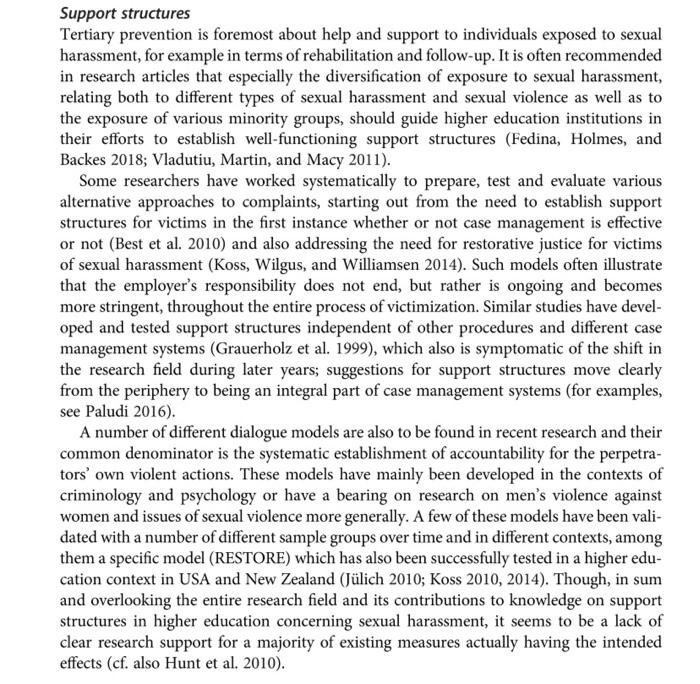
Support structures Tertiary prevention is foremost about help and support to individuals exposed to sexual harassment, for example in terms of rehabilitation and follow-up. It is often recommended in research articles that especially the diversification of exposure to sexual harassment, relating both to different types of sexual harassment and sexual violence as well as to the exposure of various minority groups, should guide higher education institutions in their efforts to establish well-functioning support structures (Fedina, Holmes, and Backes 2018; Vladutiu, Martin, and Macy 2011). Some researchers have worked systematically to prepare, test and evaluate various alternative approaches to complaints, starting out from the need to establish support structures for victims in the first instance whether or not case management is effective or not (Best et al. 2010) and also addressing the need for restorative justice for victims of sexual harassment (Koss, Wilgus, and Williamsen 2014). Such models often illustrate that the employer's responsibility does not end, but rather is ongoing and becomes more stringent, throughout the entire process of victimization. Similar studies have devel- oped and tested support structures independent of other procedures and different case management systems (Grauerholz et al. 1999), which also is symptomatic of the shift in the research field during later years; suggestions for support structures move clearly from the periphery to being an integral part of case management systems (for examples, see Paludi 2016). A number of different dialogue models are also to be found in recent research and their common denominator is the systematic establishment of accountability for the perpetra- tors' own violent actions. These models have mainly been developed in the contexts of criminology and psychology or have a bearing on research on men's violence against women and issues of sexual violence more generally. A few of these models have been vali- dated with a number of different sample groups over time and in different contexts, among them a specific model (RESTORE) which has also been successfully tested in a higher edu- cation context in USA and New Zealand (Jlich 2010; Koss 2010, 2014). Though, in sum and overlooking the entire research field and its contributions to knowledge on support structures in higher education concerning sexual harassment, it seems to be a lack of clear research support for a majority of existing measures actually having the intended effects (cf. also Hunt et al. 2010). a Step by Step Solution
There are 3 Steps involved in it
1 Expert Approved Answer
Step: 1 Unlock

Question Has Been Solved by an Expert!
Get step-by-step solutions from verified subject matter experts
Step: 2 Unlock
Step: 3 Unlock
 Study Help