Question: Summary Analysis Compose 3 reading questions IVEy | Publishing 9B20M215 ETHOS-SPIRIT OF THE COMMUNITY: TREKKING TOWARDS SOCIAL AND SUSTAINABLE VENTURING J. Robert Mitchell wrote this
Summary
Analysis
Compose 3 reading questions
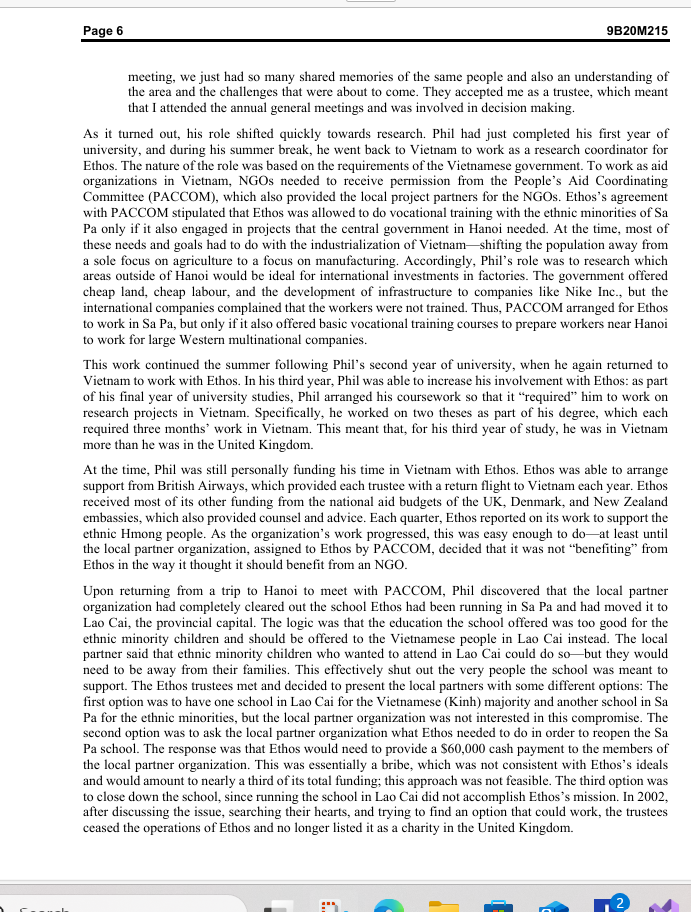
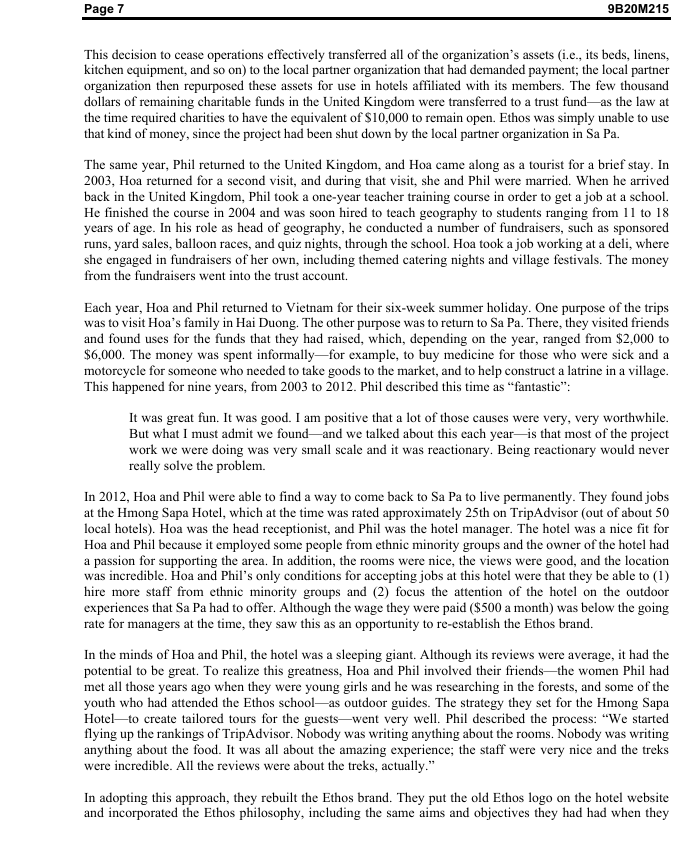
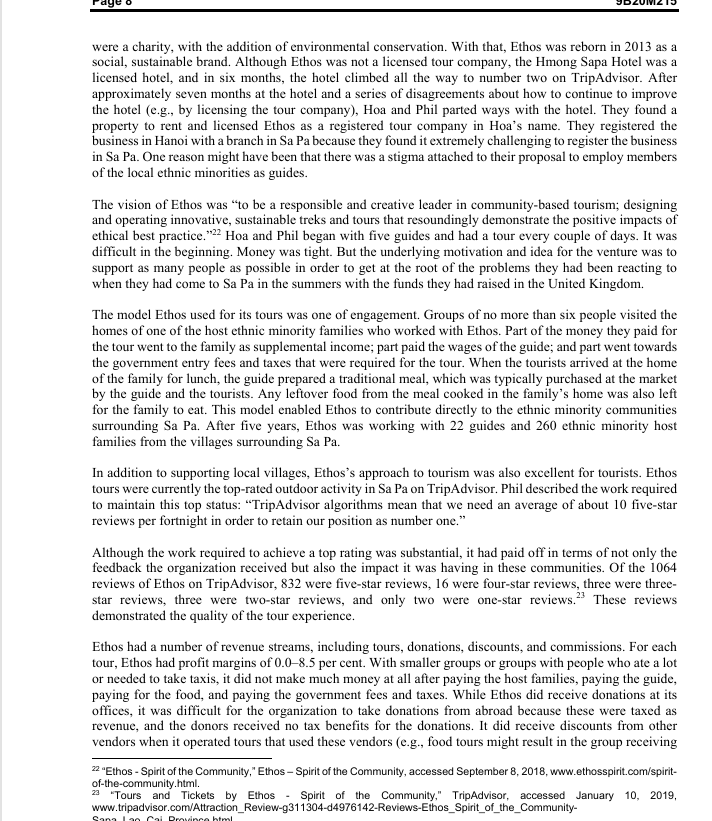
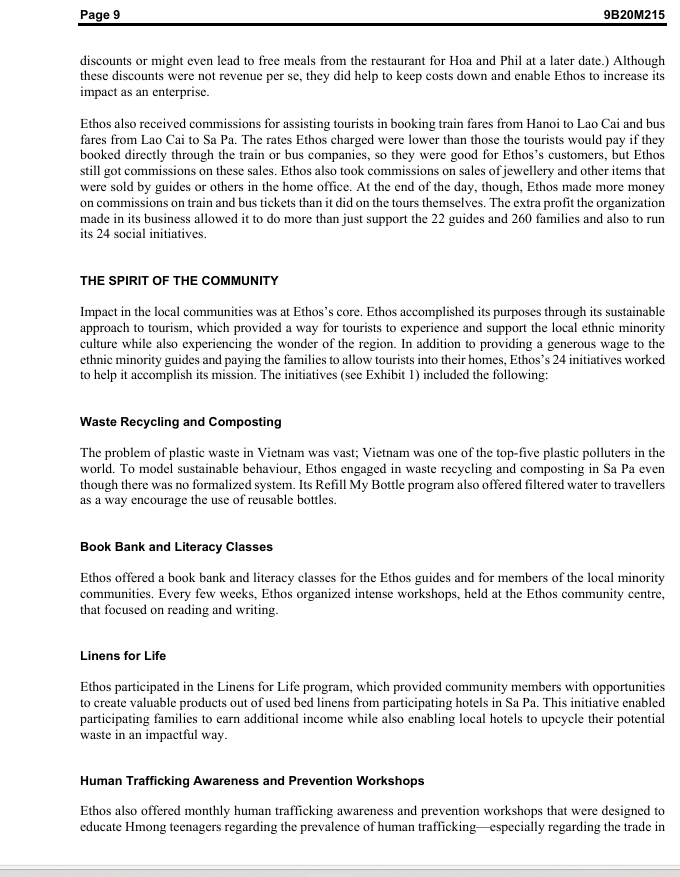
IVEy | Publishing 9B20M215 ETHOS-SPIRIT OF THE COMMUNITY: TREKKING TOWARDS SOCIAL AND SUSTAINABLE VENTURING J. Robert Mitchell wrote this case solely to provide material for class discussion. The author does not intend to illustrate either effective or ineffective handling of a managerial situation. The author may have disguised certain names and other identifying information to protect confidentiality. This publication may not be transmitted, photocopied, digitized, or otherwise reproduced in any form or by any means without the permission of the copyright holder. Reproduction of this material is not covered under authorization by any reproduction rights organization. To order copies of request permission to reproduce materials, contact Ivey Publishing, Ivey Business School, Western University, London, Ontario, Canada, NGG ON1; (1) 519.661.3208; (e) cases@ivey.ca; www.iveycases.com. Our goal is to publish materials of the highest quality; submit any errata to publishcases @ivey.ca. Copyright @ 2020, Ivey Business School Foundation Version: 2020-12-15 In early 2019, Hoa and Phil Hoolihan sat silently in the Sa Pa, Vietnam, home office of their sustainable tourism company Ethos - Spirit of the Community (Ethos), trying to process the reality of the situation they faced. They were already trying to do so much, and now they faced the possibility that their trekking guides from local minority ethnic groups might be unable to work by the end of the month. The local government had recently instituted a new policy requiring all local trekking guides be certified, but the government was not providing opportunities for certification. This change had significant implications for the survival of Ethos and its social initiatives. Although the Hoolihans were used to facing challenges with their social enterprise, they rarely faced a challenge of this magnitude. On the surface, Ethos was a tourism company that provided visitors to Sa Pa-a city in the mountainous region of Northern Vietnam-with authentic, unforgettable travel experiences that were sustainable and socially responsible.' As a social enterprise, however, Ethos's purpose was much more than providing great tours. Rather, its purpose was to make a substantive difference in the lives of the traditional, ethnic minority people of the region through 24 social initiatives, related to the United Nations Sustainable Development Goals and focused on promoting traditional culture, eliminating extreme poverty, empowering women, improving health, enabling the development of personal capabilities through small-scale development projects, and supporting local conservation (see Exhibit 1). However, the company's ability to support these initiatives was contingent on its access to a group of local female guides from the minority ethnic groups, who led the company's tours. Without the guides, the underlying business model could fall apart, and along with it, Ethos's ability to support so many different initiatives. Adding to the challenge was the frustration that, while the business model was being imperilled by the actions of the local government, new opportunities for growth were also emerging. If the Hoolihans could solve the certification challenge, they could begin to consider how to scale up the business. A number of options were available-perhaps too many: Should they continue their current deliberate and measured growth trajectory? Should they adopt a franchise-based approach and assist others like them to start similar ventures to grow the impact more quickly? Should they turn over more control to the local guides, so that they could expand to other cities and regions? Should they adopt a more focused approach, narrowing down See "Spirit of the Community," Ethos-Spirit of the Community, accessed September 8, 2018, www.ethosspirit.com/spirit-of- the-community.html.Page 2 9B20M215 the list of initiatives they undertook. Although they knew that something had to be done in order to mitigate the immediate threat-and soon-the bigger challenge might be figuring out the best direction for Ethos. What was the best direction for this social enterprise? SA PA: HISTORY Sa Pa was located in the Hoang Lien Son Mountains of Northern Vietnam, near Phan Xi Pang (Fansipan) peak-the highest peak in Southeast Asia-on the border with China. This area of Northern Vietnam was initially settled by the country's ethnic minorities, mainly the Hmong, Dao, Tay, and Giay people.' Sa Pa (formerly known as Cha Pa) was established as a summer resort in the early to mid-1900s by the French colonial government because of its cool and temperate weather. However, the breakout of conflict between the Vietnamese and the French in the 1940s led to the departure of the French from the region and a period of relative isolation for Sa Pa." Following wars with France (1945-1954) and the United States (1955-1975), Vietnam became more isolated from the West and was one of the poorest countries in the world until the mid-1980s." At that time, the government undertook a renewal process that enabled Vietnam to cut its poverty rate in half between 1990 and 2000." These changes opened Vietnam and brought the first foreign tourists to Sa Pa in the carly 1990s; they were followed by Vietnamese tourists,' who came to the region for treks through the mountains. With the tourists came change. As Duuong Bich Hanh wrote in a 2008 article in the Journal of Vietnamese Studies, In 1993, tourists had to spend the whole day on the train up from Hanoi to Lao Cai and pay fifty US dollars a huge amount at that time for Vietnam's living standard-to rent an old Russian jeep for the thirty-eight-kilometre journey from Lao Cai to Sa Pa. Ten years later, convenient night trains with air-conditioned wagons bring tourists to an upgraded Lao Cai station, where dozens of twenty- four-seat buses wait outside to take them to Sa Pa for . . . less than two dollars per seat. In 1993 there were two cafes and two guesthouses in town. By 2001, there were eighty-four guesthouses; by 2004, there were one hundred and fifty, with two thousand rooms." The effects of this growth and change were not necessarily positive for the minority ethnic people of Northern Vietnam. Overall, the majority Kinh people of Vietnam had a negative view of the minority people in the highlands near Sa Pa-a view that was not helped by the fact that some of these groups had assisted the United States in resisting the North Vietnamese army." Hanh described this opinion as follows: The Vietnamese majority [has] come to perceive ethnic minorities as a fairly homogenous population that is, on the one hand, poor, underdeveloped, and helpless, and on the other, colorful and exotic . . . ethnic minorities are often represented as essentially Other. . . . As a result, the ethnic minorities are often perceived as not only geographically and economically remote but also socially and culturally removed. 2 Jean Michaud and Sarah Turner, "Contending Visions of a Hill-Station in Vietnam," Annals of Tourism Research 33, no. 3 2006): 785-808. Ibid. Duwrong Bich Hanh, "Contesting Marginality: Consumption, Networks, and Everyday Practice among Hmong Girls in Sa Pa, Northwestern Vietnam," Journal of Vietnamese Studies 3, no. 3 (2008): 231-260 " Van Dao Truong, "Tourism and Poverty Alleviation: A Case Study of Sapa, Vietnam," PhD Thesis, University of Canterbury, New Zealand, 2014, https://ir.canterbury.ac.nz/bitstream/handle/10092/9244/Thesis_fulltext.pdf?sequence=1&isAllowed=y. Ibid. 7 Hanh, op. cit. Ibid. " Jane Hamilton-Merritt, Tragic Mountains: The Hmong, the Americans, and the Secret Wars for Laos, 1942-1992 (Bloomington, IN: Indiana University Press, 1999). 10 Hanh, op. cit.Page 3 9B20M215 In other words, the ethnic minorities were not seen by other Vietnamese as being Vietnamese. They were not even allowed to attend the same schools. The Hmong people, for instance, had a primary school enrolment of 42 per cent (with a 26 per cent dropout rate), whereas the overall primary enrolment rate in Vietnam was closer to 92 per cent.'' The ethnic minorities also did not benefit from the increased wealth that was enjoved by the Vietnamese majority in the region. Indeed, in the city of Sa Pa, many businesses were owned by the Kinh majority and primarily employed other Kinh people. In this way, Sa Pa ended up being a place where cthnic minoritics were an exotic \"tourist attraction\" that brought people and economic development to the region but not a place where ethnic minority groups could take part in that development in a meaningful way. As a result, ethnic minoritics had to continue to subsist in traditional ways, primarily through farming rice. Because of the high altitude of Sa Pa, rice farming here was not nearly as productive as it was in the lower areas of Viemam, which were populated by the majority Kinh people. Whereas those i the lowlands could harvest three crops of rice in a vear, the ethnic minority groups in the highlands could only harvest one crop of rice. Even then, the harvests were more challenging because the growing oceurred on the mountainsides. These picturesque step fields on the mountainside {see Exhibit 2) were delightful to view but challenging to work, and they did not provide enough food 1o last the year. Following the single rice harvest of the year, the minority ethnic men stayed at home, and the women travelled to Sa Pa to attempt to sell their handicrafis to tourists. This approach to selling began in the carly 19905 as young ethnic minority girls mteracted with the few tourists in the region and began to sell handicrafis to them on the streets. This approach of trying to sell to the tourists then broadened to include older women.'? Often, the women and girls would follow the tourists on their treks and then, at the end, would ask them to buy something from them." When asked why they followed the tourists to sell their handicrafis, some of the local women responded as follows: I have to take my son with me to sell handicrafis because 1 have nothing to eat. During the crop, 1 worked in the field. Now the crop is over, I sell handicrafts to eam some money. We do not have money to buy oil, salt, and food. If we sell rice to buy such things, we will not have enough to feed the family. Thus, we travel to town to sell handicrafts." Some days, they sold nothing; often, they sold nothing all week long. This approach to carning money did not provide these women with stable incomes,\" but it was one of the only means of survival their families had bevond farming. This was the situation that Phil Hoolihan saw when he arrived in Vietnam in the mid-1990s. PERSONAL BACKGROUNDS Phil Hoolihan was born in Manchester, United Kingdom (UK), to a surveyor father and primary school teacher mother. At the age of four, he moved with his family to Bielefeld, Germany, where his father worked as a civilian contractor on a large-scale military project. While in Germany, his family travelled extensively throughout Europe. These many holiday trips instilled a love of travel in Phil at an early age and opened his eyes to the world by changing the way he viewed himself. As a child, when he was not travelling, Phil spent extensive time outdoors. " Ibid. 2 Ibid. "2 Truong, op. cit. 4 Ibid. 5 Iil. Page 4 9B20M215 His love of travel and the outdoors led Phil to join Frontier, a UK-based non-profit organization upon finishing high school. Frontier was focused on safeguarding biodiversity and the integrity of ecosystems throughout the world." Founded in 1989, the organization had initially focused on cataloguing the diversity of the environment in Tanzania and then expanded to other countries like Vietnam. Phil saved up thousands of Pounds for a self-funded trip, and in 1997, ended up in a group working with the Government of Vietnam to collect biodiversity data that would be used to understand which areas had greater numbers of rare and unique species in order to delineate the boundaries of national parks. When his time with Frontier was over, Phil returned to the United Kingdom to begin his studies at the University of Liverpool and Manchester Metropolitan University. Mai Thanh Hoa was born in Hai Duong, Vietnam, a city located 1.5 hours east of Hanoi. Her father was a manager at a ceramics factory, and her mother was involved in the textile trade. Like Phil, Hoa spent hours playing outside as a child and grew to have a great love of the outdoors. Although she did not travel internationally, Hoa had a great interest in travel and tourism, which had been growing substantially as an industry in Vietnam from the 1990s to the carly 2000s." Following the completion of her primary and secondary studies, Hoa accordingly moved to Hanoi to study tourism at the Hanoi University of Culture. As part of her studies, Hoa engaged with her classmates in weekend case studies of different tourist locations in Vietnam. At that time, when tourists came to a village in a picturesque region, the entire village would provide food and lodging for the visitors. One weekend, Hoa and her entire class of 86 students were visiting a village, Mai Chau, as part of their studies. Phil had returned to Vietnam as part of his university studies and was visiting the same village on a weekend trip from Hanoi. What emerged in the evening was an impromptu panel discussion, in which the tourism students peppered the international visitors with questions. It was a big group of students, and Hoa realized that most of them were asking generic questions such as "Where are you from?" "How old are you?" "What are you studying?" "How do you like Vietnam?" and so on. In order to stand out and be noticed, Hoa decided to ask a question that was a bit more unique. When it was her turn, she asked Phil whether he had a dental plan. Her strategy worked, and Hoa and Phil ended up talking one-on-one and decided to keep in touch. FOUNDATION AND RE-EMERGENCE OF ETHOS Phil's role in the founding of Ethos was somewhat indirect. With Frontier, Phil ended up as part of a group working on a biodiversity project in Sa Pa. At the time, Sa Pa had few foreign tourists, and Phil was living in a tent on a main road near the city. In the mornings, when Phil and his colleagues woke up and opened the tent, there were usually five or six Hmong girls waiting to talk to them. The local girls liked to practice English with Phil and his group. Over the many months that Phil was there, the girls' language skills increased substantially. When the few tourists did come to the city, the young girls would interact with them, practicing the little bits of English that they were learning and trying to sell them trinkets. As the girls learned enough English to communicate, they began assisting increasing numbers of foreign tourists by acting as impromptu trekking guides as a way to earn extra money. While the ethnic minority families liked to have the extra money the girls earned by selling handicrafts to tourists, there were also negative effects: "About Frontier," Frontier, accessed October 1, 2018, www.frontiergap.com/AboutUs.aspx. 17 "Background & Mission: Biodiversity & Livelihoods," Frontier, accessed October 1, 2018, www.frontiergap.com/About- Us/Background-Mission.aspx. Wantanee Suntikul, Richard W. Butler, and David Airey, "A Periodization of the Development of Vietnam's Tourism Accommodation since the Open Door Policy," Asia Pacific Journal of Tourism Research 13, no. 1 (2008): 67-80.Page 5 9B20M215 The children, aged 6 to 16, are an immediate hit [with the tounsts] . . . All but the youngest have lost the shy nature of village children. They tease each other and joke around with foreigners at first meeting . . . Brash confidence and skill with [speaking, but not writing] languages are evidence of the range of influences on their young lives. But while tourists expect to discover traditional, indigenous peoples, as visitors staying only a few days, they seldom consider the strong impact of their own culture. Without question, the carefree life of travelers 15 a far cry from growing up in a poor village. As the girls leamn to enjoy the freedom tourists have, they are pulled further from their families. Some have all but abandoned their villages, and on the cold, cloudy streets of Sa Pa, they fall victim to abuse from foreigners and Vietnamese alike. No supervision has led to late nights of drinking and partying with tourists, to sexual abuse and even prostitution.\" In 1997, Diane and Peter Holdsworth also came to Sa Pa as tourists from the United Kingdom and saw the negative effects of a growing tourism industry on the ethnic minority girls. When the Holdsworths arrived, young girls came to them like they came to all other tourists to sell them handicrafts, guide them around the area, and try to carn money from them. However, Diane and Peter were different from most tourists, who came for a few days only; instead, they stayed in Sa Pa for three weeks. They noticed that the young girls often spent the night in Sa Pa instead of going back to their own villages in the nearby mountains. As Diane described, \"One night we were walking home, and six of the girls we knew were lying in the street under a plastic tarp, in the pouring rain, right in front of a karaoke bar. We snuck them into our guesthouse, where they all slept on the bed, and Pete and 1 slept on the floor. During their time in Sa Pa, the Holdsworths learmned of even greater problems. The couple recalled watching \"a 12-year-old girl lead a 33-year-old foreigner up a hill to have sex.! These experiences led them to seck out help to address these 1ssues. After a few weeks in Sa Pa, they returned to Hanoi to talk with several well-known international non-governmental organizations (NGOs) about the plight of these girls. But the NGOs responded by saying there was nothing they could do. This was partly because supporting ethnic minorities was too politically fraught, since the Hmong people had fought on the side of the United States in the Vietnam War and had not defended the Chinese border in 1979 in the war with China. As a result, the Holdsworths decided to create their own charity. Although Phil did not cross paths with the Holdsworths while he was there, many of the young Hmong girls he had befriended had also connected with the Holdsworths. When Phil left Sa Pa to return to the United Kingdom, he left his postal address with these young girls. In trying to establish their charity, Diane and Peter realized that these girls had a collection of foreigners\" addresses. Each day, they sat outside on a bench in the square and helped the girls write letters to these foreign friends, but they then also included letters of their personal hygiene, mechanics, chef training, health, and first aid. Phil recalled receiving one of these letters: Out of the blue one day, I receive a lettera hand-written note that was on behalf of a Hmong girl. It basically said, \"Hello, how are you. I miss you very much.\" But also there was a typed note with it. The typed note was from Diane and Peter, and they effectively said, \"Look, we know you are friends with the girls. This is who we are. We would like to set up a charity because we have been to the big organizations and they have said it is impossible. Would you be mterested in supporting us financially?\" Again, it was all done via letter. But [ wrote back to their postal address and said, \"l am a student. I am in no financial position to support, but would love to be involved in some capacity.\" We met in Swindon, which is about four or five hours from Manchester. In that first % Michael L. Gray, \"Spoiled by TourismHmang Children of Morthern Vietnam,\" World and 115, no. 10 (2000): 162-173. 0 |bid. 2 il B arton roem 512812024 10 - use andy Page 6 9B20M215 meeting, we just had so many shared memories of the same people and also an understanding of the arca and the challenges that were about to come. They accepted me as a trustee, which meant that I attended the annual general meetings and was involved in decision making. As it tumed out, his role shifted quickly towards research. Phil had just completed his first year of university, and during his summer break, he went back to Vietnam to work as a research coordinator for Ethos. The nature of the role was based on the requirements of the Vietnamese government. To work as aid organizations in Vietnam, NGOs needed to receive permission from the People's Aid Coordinating Committee (PACCOM), which also provided the local project partners for the NGOs. Ethos's agreement with PACCOM stipulated that Ethos was allowed to do vocational training with the ethnic minorities of Sa Pa only if it also engaged i projects that the central government in Hanoi needed. At the time, most of these needs and goals had to do with the industrialization of Vietnamshifting the population away from a sole focus on agriculture to a focus on manufacturing. Accordingly, Phil's role was to research which areas outside of Hanoi would be ideal for international investments in lactories. The government offered cheap land, cheap labour, and the development of infrastructure to companies like Nike Inc., but the international companies complaimed that the workers were not trained. Thus, PACCOM arranged for Ethos to work in 8a Pa, but only if' it also offered basic vocational training courses to prepare workers near Hanoi to work for large Western multinational companies. This work continued the summer following Phil's second year of university, when he again returned to Vietnam to work with Ethos. In his third year, Phil was able to increase his involvement with Ethos: as part of his final year of university studies, Phil arranged his coursework so that it \"required\" him to work on rescarch projects m Vietnam. Specifically, he worked on two theses as part of his degree, which each required three months\" work in Vietnam. This meant that, for his third year of study, he was in Vietnam more than he was in the United Kingdom. Al the time, Phil was still personally funding his time i Vietnam with Ethos. Ethos was able to arrange support from British Airways, which provided each trustee with a return flight to Vietnam cach year. Ethos received most of its other funding from the national aid budgets of the UK, Denmark, and New Zealand embassies, which also provided counsel and advice. Each quarter, Ethos reported on its work to support the ethnic Hmong people. As the organization's work progressed, this was easy enough to doat least until the local partner organization, assigned to Ethos by PACCOM, decided that it was not \"benefiting\" from Ethos in the way it thought it should benefit from an NGO. Upon returning from a trip to Hanoi to meet with PACCOM, Phil discovered that the local partner organization had completely cleared out the school Ethos had been running in Sa Pa and had moved it to Lao Cai, the provineial capital. The logic was that the education the school offered was too good for the ethnic minority children and should be offered to the Vietnamese people in Lao Cai instead. The local partner said that ethnic minority children who wanted to attend in Lao Cai could do sobut they would need to be away from their families. This effectively shut out the very people the school was meant to support. The Ethos trustees met and decided to present the local pariners with some different options: The first option was to have one school in Lao Cai for the Vietnamese (Kinh) majority and another school in Sa Pa for the ethnic minorities, but the local partner organization was not interested in this compromise. The second option was 1o ask the local partner organization what Ethos needed to do in order to reopen the Sa Pa school. The response was that Ethos would need to provide a $60,000 cash payment to the members of the local partner organization. This was essentially a bribe, which was not consistent with Ethos's ideals and would amount to nearly a third of its total funding; this approach was not feasible. The third option was to close down the school, since running the school in Lao Cai did not accomplish Ethos's mission. In 2002, afler discussing the issue, searching their hearts, and trying 1o find an option that could work, the trustees ceased the operations of Ethos and no longer listed it as a charity in the United Kingdom. = . M = sia -~ HD a4 Page 7 9B20M215 This decision to cease operations effectively transferred all of the organization's assets (1.c., its beds, linens, kitchen equipment, and so on) to the local partner organization that had demanded payment; the local partner organization then repurposed these assets for use in hotels affiliated with its members. The few thousand dollars of remaining charitable funds in the United Kingdom were transferred to a trust fundas the law at the time required charities to have the equivalent of 10,000 to remain open. Ethos was simply unable to use that kind of money, since the project had been shut down by the local partner organization in Sa Pa. The same year, Phil returned to the United Kingdom, and Hoa came along as a tourist for a brief stay. In 2003, Hoa returned for a second visit, and during that visit, she and Phil were married. When he arrived back in the United Kingdom, Phil took a one-year teacher traming course in order to get a job at a school. He finished the course in 2004 and was soon hired to teach geography to students ranging from 11 to 18 years of age. In his role as head of geography, he conducted a number of fundraisers, such as sponsored runs, yard sales, balloon races, and quiz nights, through the school. Hoa took a job working at a deli, where she engaged in fundraisers of her own, including themed catering nights and village festivals. The money from the fundraisers went into the trust account. Each year, Hoa and Phil returned to Vietnam for their six-week summer holiday. One purpose of the trips was to visit Hoa's family in Hai Duong. The other purpose was to return to Sa Pa. There, they visited friends and found uses for the funds that they had raised, which, depending on the year, ranged from $2,000 to $6,000. The money was spent informallyfor example, to buy medicine for those who were sick and a motoreyele for someone who needed to take goods to the market, and to help construct a latrine in a village. This happened for nine years, from 2003 to 2012 Phil described this time as \"fantastic It was great fun. It was good. [ am positive that a lot of those causes were very, very worthwhile. But what I must admit we foundand we talked about this cach yearis that most of the project work we were doing was very small scale and it was reactionary. Being reactionary would never really solve the problem. In 2012, Hoa and Phil were able to find a way to come back to Sa Pa to live permanently. They found jobs at the Hmong Sapa Hotel, which at the time was rated approximately 25th on TripAdvisor (out of about 50 local hotels). Hoa was the head receptionist, and Phil was the hotel manager. The hotel was a nice fit for Hoa and Phil because it employed some people from ethnic minority groups and the owner of the hotel had a passion for supporting the area. In addition, the rooms were nice, the views were good, and the location was mncredible. Hoa and Phils only conditions for accepting jobs at this hotel were that they be able to (1) hire more stafl from ethnic minority groups and (2) focus the attention of the hotel on the outdoor experiences that Sa Pa had to offer. Although the wage they were paid ($500 a month) was below the going rate for managers at the time, they saw this as an opportunity 1o re-establish the Ethos brand. In the minds of Hoa and Phil, the hotel was a sleeping giant. Although its reviews were average, it had the potential to be great. To realize this greatness, Hoa and Phil involved their friendsthe women Phil had met all those years ago when they were young girls and he was researching in the forests, and some of the youth who had attended the Ethos schoolas outdoor guides. The strategy they set for the Hmong Sapa Hotelto create tailored tours for the guestswent very well. Phil described the process: \"We started flying up the rankings of TripAdvisor. Nobody was writing anything about the rooms. Nobody was writing anything about the food. It was all about the amazing experience; the stall were very nice and the treks were incredible. All the reviews were about the treks, actually.\" In adopting this approach, they rebuilt the Ethos brand. They put the old Ethos logo on the hotel website and incorporated the Ethos philosophy, including the same aims and objectives they had had when they raye o FODLUIVIL 1D were a charity, with the addition of environmental conservation. With that, Ethos was reborn in 2013 as a social, sustainable brand. Although Ethos was not a licensed tour company, the Hmong Sapa Hotel was a licensed hotel, and in six months, the hotel climbed all the way to number two on TripAdvisor. After approximately seven months at the hotel and a series of disagreements about how to continue to improve the hotel (e.g., by licensing the tour company), Hoa and Phil parted ways with the hotel. They found a property to rent and licensed Ethos as a registered tour company i Hoa's name. They registered the business in Hanoi with a branch in Sa Pa because they found it extremely challenging to register the business in Sa Pa. One reason might have been that there was a stigma attached to their proposal to employ members of the local ethnic mmorities as guides. The vision of Ethos was \"to be a responsible and creative leader in community-based tourism; designing and operating innovative, sustainable treks and tours that resoundingly demonstrate the positive impacts of cthical best practice.\" Hoa and Phil began with five guides and had a tour every couple of days. It was difficult in the beginning. Money was tight. But the underlying motivation and idea for the venture was to support as many people as possible in order to get at the root of the problems they had been reacting to when they had come to Sa Pa in the summers with the funds they had raised in the United Kingdom. The model Ethos used for its tours was one of engagement. Groups of no more than six people visited the homes of one of the host ethnic minority families who worked with Ethos. Part of the money they paid for the tour went to the family as supplemental income; part paid the wages of the guide; and part went towards the government entry fees and taxes that were required for the tour. When the tourists arrived at the home of the family for lunch, the guide prepared a traditional meal, which was typically purchased at the market by the guide and the tourists. Any leftover food from the meal cooked in the family's home was also left for the family to eat. This model enabled Ethos to contribute directly to the ethnic minority communities surrounding Sa Pa. Afier five years, Ethos was working with 22 guides and 260 ethnic minonty host families from the villages surrounding Sa Pa. In addition to supporting local villages, Ethos's approach to tourism was also excellent for tourists. Ethos tours were currently the top-rated outdoor activity in Sa Pa on TripAdwvisor. Phil described the work required to maintain this top status: \"TripAdvisor algorithms mean that we need an average of about 10 five-star reviews per fortnight in order to retain our position as number one.\" Although the work required to achieve a top rating was substantial, it had paid off in terms of not only the feedback the organization received but also the impact it was having in these communities. OF the 1064 reviews ol Ethos on TripAdvisor, 832 were five-star reviews, 16 were four-star reviews, three were three- star reviews, three were two-star reviews, and only two were one-star reviews. These reviews demonstrated the quality of the tour experience. Ethos had a number of revenue streams, including tours, donations, discounts, and commissions. For each tour, Ethos had profit margins of 0.0-8.5 per cent. With smaller groups or groups with people who ate a lot or needed to take taxis, it did not make much money at all after paying the host families, paying the guide, paying for the food, and paying the government fees and taxes. While Ethos did receive donations at its offices, it was difficult for the organization to take donations from abroad because these were taxed as revenue, and the donors received no tax benefits for the donations, It did receive discounts from other vendors when 1t operated tours that used these vendors (e.g., food tours might result in the group receiving \" \"Ethos - Spirit of the Community,\" Ethos Spirit of the Community, accessed September 8, 2018, www_ethosspint com/spirit- of-the-community html. \" *Taurs and Tickets by Ethos - Spirit of the Community,\"" TripAdvisor, accessed January 10, 2019, www tripadvisor comiAttraction_Review-g311304-d4976142-Reviews-Ethos_Spirit_of_the_Community- Qana |an Mal Deadnens kil Page 9 9B20M215 discounts or might even lead to free meals from the restaurant for Hoa and Phil at a later date.) Although these discounts were not revenue per se, they did help to keep costs down and enable Ethos to increase its mpact as an enterprise. Ethos also received commissions for assisting tourists in booking train fares from Hanoi to Lao Cai and bus fares from Lao Cai to Sa Pa. The rates Ethos charged were lower than those the tourists would pay if they booked directly through the train or bus companies, so they were good for Ethos's customers, but Ethos still got commissions on these sales. Ethos also took commissions on sales of jewellery and other items that were sold by guides or others in the home office. At the end of the day, though, Ethos made more money on commissions on train and bus tickets than it did on the tours themselves. The extra profit the organization made in its business allowed it to do more than just support the 22 guides and 260 families and also to run its 24 social initiatives. THE SPIRIT OF THE COMMUNITY Impact in the local communities was at Ethos's core. Ethos accomplished its purposes through its sustainable approach to tourism, which provided a way for tourists 1o experience and support the local ethnic minority culture while also experiencing the wonder of the region. In addition o providing a generous wage to the ethnic minority guides and paying the families to allow tourists into their homes, Ethos's 24 initiatives worked to help it accomplish its mission. The initiatives (see Exhibit 1) included the following: Waste Recycling and Composting The problem of plastic waste in Vietnam was vast; Vietnam was one of the top-five plastic polluters in the world. To model sustamable behaviour, Ethos engaged in waste recyeling and composting in Sa Pa even though there was no formalized system. Its Refill My Bottle program also offered filtered water to travellers as a way encourage the use of reusable bottles. Book Bank and Literacy Classes Ethos offered a book bank and literacy classes for the Ethos guides and for members of the local minority communities. Every few weeks, Ethos organized intense workshops, held at the Ethos community centre, that focused on reading and writing. Linens for Life Ethos participated in the Linens for Life program, which provided community members with opportunitics to create valuable products out of used bed linens from participating hotels in Sa Pa. This initiative enabled participating families to earn additional income while also enabling local hotels to upeyele their potential waste in an impactful way. Human Trafficking Awareness and Prevention Workshops Ethos also offered monthly human trafficking awareness and prevention workshops that were designed to educate Hmong teenagers regarding the prevalence of human traffickingespecially regarding the trade in Page 10 9B20M215 young girls to China (given its proximity). This course was taught exclusively in the Hmong language by young, female leaders in the Hmong community. It was imtended to help attendees understand what human trafficking was and why it occurred and to ensure girls knew how to protect themselves against trafficking. Health and Hygiene Seminars The health and hygiene seminars focused on the basics of washing hands; cleaning teeth; and stopping the spread of diseases through coughs, sneezes, proximity to animals, and poor food preparation. Hmong women taught classes as part of this initiative, and all those m attendance were given toothpaste, toothbrushes, and soapgetting at the root causes of the illness and discase that Hoa and Phil had addressed m themr summer trips. These programs made a difference because they educated and informed. For example, i 2016 alone, one village had lost 11 girls to trafficking. One component of Ethos's educational program on human trafficking was to teach girls what they could do if they were kidnapped. Giang Thi Ca, a 22-year-old woman from the Hmong tribe, described why these programs were vital: \"My sister-in-law was kidnapped [to China] when she was 15 years old. She was sold from one family to another. When she escaped, she tried to call her family but couldn't because she didn't know about international dialing codes.\"" As a result of her family's experience, Ca decided to assist in the workshops run by Ethos. Ethos taught such basics as one of its steps to help the ethnic minority girls, All of its initiatives had a similar impact. MOVING FORWARD Although Hoa and Phil had done a great job of taking the charity the Holdsworths had founded in 1997 and turning it into a vibrant community and social venture, the real question was, What should they do next with Ethos? They faced an immediate challenge with the local government, of course, but they were running a popular social venture while also tackling a large number of important initiatives. Should they narrow the focus of their initiatives, or work to increase profitability? Moreover, what should they do about their own involvement in Ethos? Should they adopt a franchise-based approach and assist others like them to start similar ventures? Should they turn over more control to the local guides, who were, after all, mentioned in nearly all of the outstanding TripAdvisor reviews? How could they continue to make a substantive difference in the lives of the traditional, ethnic minority people of the region and establish Ethos as a long-term social venture while also accomplishing their own personal long-term goals? The couple had a nice life and were making a substantial difference in the lives of others with their social ventureand while they had some money saved, they did not have health msurance or a pension of any kind. They did not have children yet, but wanted to have children someday. These realities, and the challenges of running the business and trying to deliver on the many initiatives, made them think deeply about where they wanted to go next with Ethos. They would not have traded the last five years for anything, but Hoa and Phil also know that they needed to think about the next 50both for themselves and for the people they were helping in and around Sa Pa. # Rabyn Wilson, \"Ethical Trekking Groups in Vietnam Empower Marginalised Tribes,\" Ecologist: Informed by Nature, January 19, 2018, accessed October 9, 2018, hitps:ltheecologist org/20185an/19/athical-trekking-groups-tackla-poverty-vietnam- reparis-robynfwilson. Page 11 B20M215 EXHIBIT 1: ETHOS'S 24 CURRENT INITIATIVES 1. Waste Recycling and Composting 2. Book Bank and Literacy Classes 3. Linens for Life 4. Operation Smile Vietnam 5. Aseso [Adaptive Sustainable Engineering Support Organisation] Cookstove and Chimney Initiative 6. Ethos Water Tanks 7. Refill My Bottle 8. Plant-for-the-Planet 9. Adopt a Spot 10. Composting Toilets 11. Human Trafficking Awareness and Prevention Workshops 12. Hot Showers with ASWA 13. Workshops and Traditional Cultural Skills 14. Accommodation for Cha 15. Leadership Training for Phenh 16. Textiles Social Enterprise 17. Small Business Start-Ups and Consultancy 18. Documentation of Traditional Cultures and Practices 19. Health and Hygiene Seminars 301 AY 24-25 (SU/FA24) at California State University - Fullerton from 5/28/2024 to 1/27/2025. 20. Medical Projects 21. Winter Jackets 22. Building Citizenships 23. Culture in the News 24. Travelling and Learning for Ethos Team Note: See the current list of Ethos initiatives at "Spirit of the Community," Ethos, accessed September 8, 2018, www.ethosspirit.com/uploads/2/2/8/3/22832778/ethos_projects.pdf. Source: Company documents.Page 12 9B20M215 EXHIBIT 2: PICTURESQUE STEP FIELDS OF SA PA, VIETNAM Source: Author files
Step by Step Solution
There are 3 Steps involved in it
1 Expert Approved Answer
Step: 1 Unlock
Question Has Been Solved by an Expert!
Get step-by-step solutions from verified subject matter experts
Step: 2 Unlock
Step: 3 Unlock
Students Have Also Explored These Related Law Questions!










 Study Help