Question: summary for the case study Apple Case In partnership with BusinessWeek, the Boston Consulting Group conducts an annual survey of top executives of the 1,500
summary for the case study
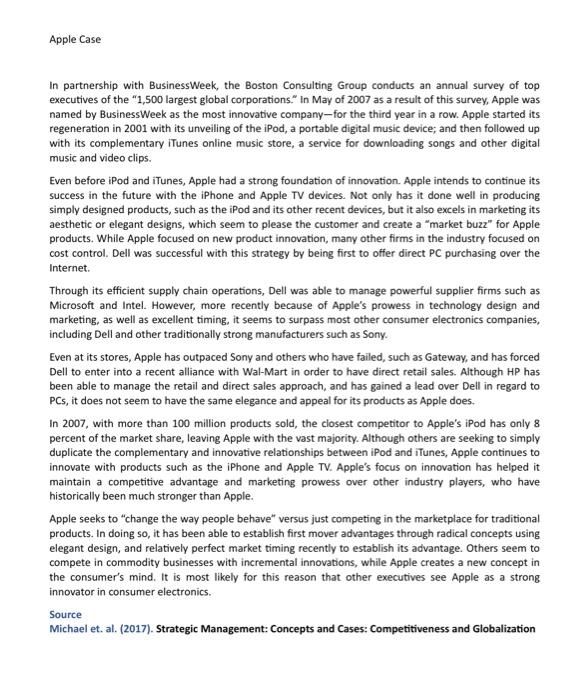
Apple Case In partnership with BusinessWeek, the Boston Consulting Group conducts an annual survey of top executives of the "1,500 largest global corporations. In May of 2007 as a result of this survey, Apple was named by BusinessWeek as the most innovative company-for the third year in a row. Apple started its regeneration in 2001 with its unveiling of the iPod, a portable digital music device; and then followed up with its complementary iTunes online music store, a service for downloading songs and other digital music and video clips. Even before iPod and iTunes, Apple had a strong foundation of innovation. Apple intends to continue its success in the future with the iPhone and Apple TV devices. Not only has it done well in producing simply designed products, such as the iPod and its other recent devices, but it also excels in marketing its aesthetic or elegant designs, which seem to please the customer and create a "market buzz" for Apple products. While Apple focused on new product innovation, many other firms in the industry focused on cost control. Dell was successful with this strategy by being first to offer direct PC purchasing over the Internet Through its efficient supply chain operations, Dell was able to manage powerful supplier firms such as Microsoft and Intel. However, more recently because of Apple's prowess in technology design and marketing, as well as excellent timing, it seems to surpass most other consumer electronics companies, including Dell and other traditionally strong manufacturers such as Sony Even at its stores, Apple has outpaced Sony and others who have failed, such as Gateway, and has forced Dell to enter into a recent alliance with Wal-Mart in order to have direct retail sales. Although HP has been able to manage the retail and direct sales approach, and has gained a lead over Dell in regard to PCs, it does not seem to have the same elegance and appeal for its products as Apple does. In 2007, with more than 100 million products sold, the closest competitor to Apple's iPod has only 8 percent of the market share, leaving Apple with the vast majority. Although others are seeking to simply duplicate the complementary and innovative relationships between iPod and iTunes, Apple continues to innovate with products such as the iPhone and Apple TV. Apple's focus on innovation has helped it maintain a competitive advantage and marketing prowess over other industry players, who have historically been much stronger than Apple. Apple seeks to "change the way people behave" versus just competing in the marketplace for traditional products. In doing so, it has been able to establish first mover advantages through radical concepts using elegant design, and relatively perfect market timing recently to establish its advantage. Others seem to compete in commodity businesses with incremental innovations, while Apple creates a new concept in the consumer's mind. It is most likely for this reason that other executives see Apple as a strong innovator in consumer electronics. Source Michael et. al. (2017). Strategic Management: Concepts and Cases: Competitiveness and Globalization Apple Case In partnership with BusinessWeek, the Boston Consulting Group conducts an annual survey of top executives of the "1,500 largest global corporations. In May of 2007 as a result of this survey, Apple was named by BusinessWeek as the most innovative company-for the third year in a row. Apple started its regeneration in 2001 with its unveiling of the iPod, a portable digital music device; and then followed up with its complementary iTunes online music store, a service for downloading songs and other digital music and video clips. Even before iPod and iTunes, Apple had a strong foundation of innovation. Apple intends to continue its success in the future with the iPhone and Apple TV devices. Not only has it done well in producing simply designed products, such as the iPod and its other recent devices, but it also excels in marketing its aesthetic or elegant designs, which seem to please the customer and create a "market buzz" for Apple products. While Apple focused on new product innovation, many other firms in the industry focused on cost control. Dell was successful with this strategy by being first to offer direct PC purchasing over the Internet Through its efficient supply chain operations, Dell was able to manage powerful supplier firms such as Microsoft and Intel. However, more recently because of Apple's prowess in technology design and marketing, as well as excellent timing, it seems to surpass most other consumer electronics companies, including Dell and other traditionally strong manufacturers such as Sony Even at its stores, Apple has outpaced Sony and others who have failed, such as Gateway, and has forced Dell to enter into a recent alliance with Wal-Mart in order to have direct retail sales. Although HP has been able to manage the retail and direct sales approach, and has gained a lead over Dell in regard to PCs, it does not seem to have the same elegance and appeal for its products as Apple does. In 2007, with more than 100 million products sold, the closest competitor to Apple's iPod has only 8 percent of the market share, leaving Apple with the vast majority. Although others are seeking to simply duplicate the complementary and innovative relationships between iPod and iTunes, Apple continues to innovate with products such as the iPhone and Apple TV. Apple's focus on innovation has helped it maintain a competitive advantage and marketing prowess over other industry players, who have historically been much stronger than Apple. Apple seeks to "change the way people behave" versus just competing in the marketplace for traditional products. In doing so, it has been able to establish first mover advantages through radical concepts using elegant design, and relatively perfect market timing recently to establish its advantage. Others seem to compete in commodity businesses with incremental innovations, while Apple creates a new concept in the consumer's mind. It is most likely for this reason that other executives see Apple as a strong innovator in consumer electronics. Source Michael et. al. (2017). Strategic Management: Concepts and Cases: Competitiveness and Globalization









 Study Help