







Question: Summary Required for this Article : Sexual Orientation Wage Gaps across Local Labour Market Contexts: Evidence from Canada Nicole Denier and Sean Waite This article
Summary Required for this Article : 
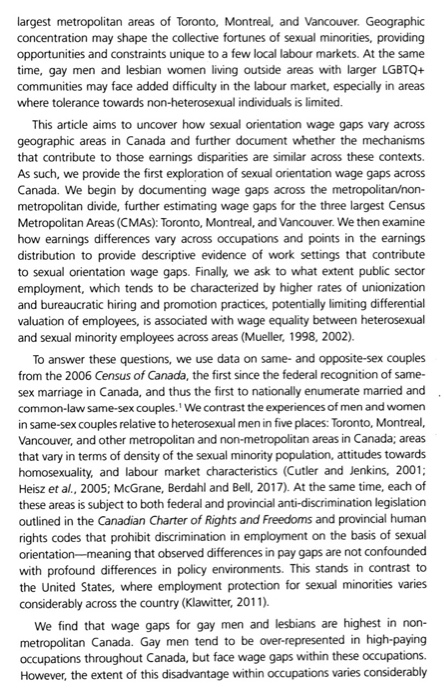
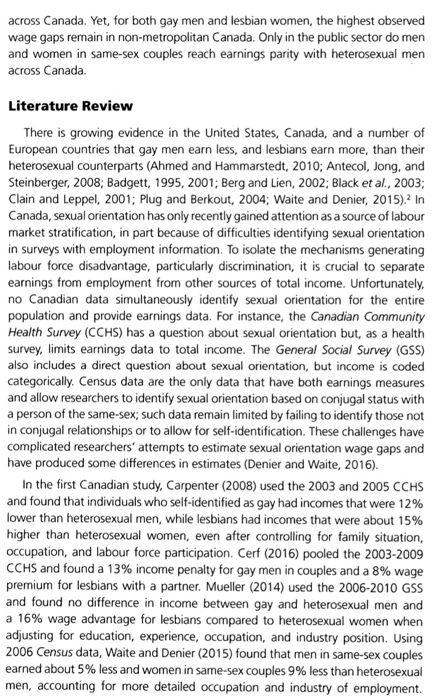
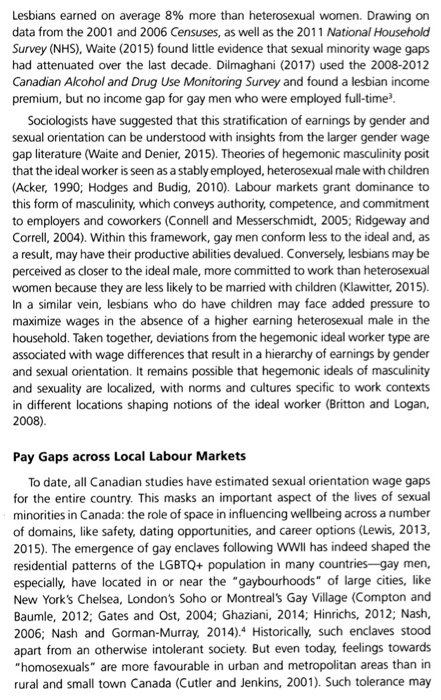
Sexual Orientation Wage Gaps across Local Labour Market Contexts: Evidence from Canada Nicole Denier and Sean Waite This article examines sexual orientation wage gaps across local labour market contexts. Using the 2006 Canadian Census, we explore how wage gaps vary across metropolitan and non-metropolitan areas. We further evaluate whether the mechanisms contributing to wage gaps diverge across these contexts, focusing on how wage gaps differ across occupations and sectors of employment. Our results show that wage gaps are highest in non-metropolitan Canada. The underlying components of wage gaps fluctuate across Canada, especially for gay men. Sexual orientation pay gaps are reduced in public sector employment, even where private sector wage gaps are highest. These results suggest that local social and labour market contexts are associated with the earnings outcomes of sexual minorities. KEYWORDS: sexual orientation, earnings, labour markets, occupations, public sector. Introduction Mounting evidence suggests that sexual orientation matters in the labour market (Klawitter, 2015). Research in Canada, specifically. points to a wage hierarchy not only by gender, but also by sexual orientation, with heterosexual men out-earning gay men, lesbians, and heterosexual women (Waite and Denier, 2015). Little research has looked at how residential concentration in large metropolitan areas factors into the creation of these wage differences. This is an important question, as sexual minorities, particularly gay men, tend to live in large urban centres. As we show, of the men in same-sex couples identified in our sample, 86% lived in metropolitan areas, with a full 57% in the three Nicole Denier, Postdoctoral Fellow, Department of Sociology, Colby College, Waterville, Maine, United States (nicole.denier@colby.edu). Sean Waite, Assistant Professor, Department of Sociology, University of Western Ontario, Social Science Centre, London, Ontario, Canada (swaite3@uwo.ca). Acknowledgements: The authors thank Michael R. Smith and participants at the Canadian Population Society and Population Change and Lifecourse Strategic Knowledge Cluster Graduate Research Development Conference, and Canadian Population Society Meetings for helpful comments and suggestions in the development of the manuscript. We acknowledge Statistics Canada and the Quebec Inter-University Centre for Social Statistics for providing access to the restricted data used in analysis. The views expressed herein represent those of the authors alone. largest metropolitan areas of Toronto, Montreal, and Vancouver. Geographic concentration may shape the collective fortunes of sexual minorities, providing opportunities and constraints unique to a few local labour markets. At the same time, gay men and lesbian women living outside areas with larger LGBTQ+ communities may face added difficulty in the labour market, especially in areas where tolerance towards non-heterosexual individuals is limited This article aims to uncover how sexual orientation wage gaps vary across geographic areas in Canada and further document whether the mechanisms that contribute to those earnings disparities are similar across these contexts. As such, we provide the first exploration of sexual orientation wage gaps across Canada. We begin by documenting wage gaps across the metropolitanon- metropolitan divide, further estimating wage gaps for the three largest Census Metropolitan Areas (CMAs): Toronto, Montreal, and Vancouver. We then examine how earnings differences vary across occupations and points in the earnings distribution to provide descriptive evidence of work settings that contribute to sexual orientation wage gaps. Finally, we ask to what extent public sector employment, which tends to be characterized by higher rates of unionization and bureaucratic hiring and promotion practices, potentially limiting differential valuation of employees, is associated with wage equality between heterosexual and sexual minority employees across areas (Mueller, 1998, 2002). To answer these questions, we use data on same- and opposite-sex couples from the 2006 Census of Canada, the first since the federal recognition of same- sex marriage in Canada, and thus the first to nationally enumerate married and common-law same-sex couples.' We contrast the experiences of men and women in same-sex couples relative to heterosexual men in five places: Toronto, Montreal, Vancouver, and other metropolitan and non-metropolitan areas in Canada; areas that vary in terms of density of the sexual minority population, attitudes towards homosexuality, and labour market characteristics (Cutler and Jenkins, 2001; Heisz et al., 2005; McGrane, Berdahl and Bell, 2017). At the same time, each of these areas is subject to both federal and provincial anti-discrimination legislation outlined in the Canadian Charter of Rights and Freedoms and provincial human rights codes that prohibit discrimination in employment on the basis of sexual orientation-meaning that observed differences in pay gaps are not confounded with profound differences in policy environments. This stands in contrast to the United States, where employment protection for sexual minorities varies considerably across the country (Klawitter, 2011). We find that wage gaps for gay men and lesbians are highest in non- metropolitan Canada. Gay men tend to be over-represented in high-paying occupations throughout Canada, but face wage gaps within these occupations. However, the extent of this disadvantage within occupations varies considerably across Canada. Yet, for both gay men and lesbian women, the highest observed wage gaps remain in non-metropolitan Canada. Only in the public sector do men and women in same-sex couples reach earnings parity with heterosexual men across Canada. Literature Review There is growing evidence in the United States, Canada, and a number of European countries that gay men earn less, and lesbians earn more than their heterosexual counterparts (Ahmed and Hammarstedt, 2010; Antecol, Jong, and Steinberger, 2008; Badgett, 1995, 2001; Berg and Lien, 2002; Black et al., 2003; Clain and Leppel, 2001; Plug and Berkout, 2004; Waite and Denier, 2015). In Canada, sexual orientation has only recently gained attention as a source of labour market stratification, in part because of difficulties identifying sexual orientation in surveys with employment information. To isolate the mechanisms generating labour force disadvantage, particularly discrimination, it is crucial to separate earnings from employment from other sources of total income. Unfortunately, no Canadian data simultaneously identify sexual orientation for the entire population and provide earnings data. For instance, the Canadian Community Health Survey (CCHS) has a question about sexual orientation but, as a health survey, limits earnings data to total income. The General Social Survey (GS) also includes a direct question about sexual orientation, but income is coded categorically. Census data are the only data that have both earnings measures and allow researchers to identify sexual orientation based on conjugal status with a person of the same-sex, such data remain limited by failing to identify those not in conjugal relationships or to allow for self-identification. These challenges have complicated researchers' attempts to estimate sexual orientation wage gaps and have produced some differences in estimates (Denier and Waite, 2016). In the first Canadian study, Carpenter (2008) used the 2003 and 2005 CCHS and found that individuals who self-identified as gay had incomes that were 12% lower than heterosexual men, while lesbians had incomes that were about 15% higher than heterosexual women, even after controlling for family situation, occupation, and labour force participation. Cerf (2016) pooled the 2003-2009 CCHS and found a 13% income penalty for gay men in couples and a 8% wage premium for lesbians with a partner. Mueller (2014) used the 2006-2010 GSS and found no difference in income between gay and heterosexual men and a 16% wage advantage for lesbians compared to heterosexual women when adjusting for education, experience, occupation, and industry position. Using 2006 Census data, Waite and Denier (2015) found that men in same-sex couples earned about 5% less and women in same-sex couples 9% less than heterosexual men, accounting for more detailed occupation and industry of employment. Lesbians earned on average 8% more than heterosexual women. Drawing on data from the 2001 and 2006 Censuses, as well as the 2011 National Household Survey (NHS), Waite (2015) found little evidence that sexual minority wage gaps had attenuated over the last decade. Dilmaghani (2017) used the 2008-2012 Canadian Alcohol and Drug Use Monitoring Survey and found a lesbian income premium, but no income gap for gay men who were employed full-time Sociologists have suggested that this stratification of earnings by gender and sexual orientation can be understood with insights from the larger gender wage gap literature (Waite and Denier, 2015). Theories of hegemonic masculinity posit that the ideal worker is seen as a stably employed, heterosexual male with children (Acker, 1990; Hodges and Budig, 2010). Labour markets grant dominance to this form of masculinity, which conveys authority, competence, and commitment to employers and coworkers (Connell and Messerschmidt, 2005; Ridgeway and Correll, 2004). Within this framework, gay men conform less to the ideal and, as a result, may have their productive abilities devalued. Conversely, lesbians may be perceived as closer to the ideal male, more committed to work than heterosexual women because they are less likely to be married with children (Klawitter, 2015). In a similar vein, lesbians who do have children may face added pressure to maximize wages in the absence of a higher earning heterosexual male in the household. Taken together, deviations from the hegemonic ideal worker type are associated with wage differences that result in a hierarchy of earnings by gender and sexual orientation. It remains possible that hegemonic ideals of masculinity and sexuality are localized, with norms and cultures specific to work contexts in different locations shaping notions of the ideal worker (Britton and Logan, 2008). Pay Gaps across Local Labour Markets To date, all Canadian studies have estimated sexual orientation wage gaps for the entire country. This masks an important aspect of the lives of sexual minorities in Canada: the role of space in influencing wellbeing across a number of domains, like safety, dating opportunities, and career options (Lewis, 2013, 2015). The emergence of gay enclaves following WWII has indeed shaped the residential patterns of the LGBTQ+ population in many countries-gay men, especially, have located in or near the "gaybourhoods" of large cities, like New York's Chelsea, London's Soho or Montreal's Gay Village (Compton and Baumle, 2012; Gates and Ost, 2004; Ghaziani, 2014; Hinrichs, 2012; Nash, 2006; Nash and Gorman-Murray, 2014). Historically, such enclaves stood apart from an otherwise intolerant society. But even today, feelings towards "homosexuals" are more favourable in urban and metropolitan areas than in rural and small town Canada (Cutler and Jenkins, 2001). Such tolerance may be the result of increased contact with or exposure to individuals of differing sexual orientations. Montreal, Toronto, and Vancouver are home to three of the largest gay enclaves in Canada: the Gay Village, Church-Wellesley Village, and Davie Village, respectively. The strong representation of LGBTQ+ populations in these areas, including the presence of anchor institutions and commemorative events, may help to solidify the collective identity and legitimacy of sexual minorities in these cities (Ghaziani, 2014). Indeed, in recent years major corporations (and employers) in these cities have sponsored commemorative events, like pride marches, to demonstrate some commitment to inclusion. Given these differences in attitudes and the density/visibility of the LGBTQ+ community, we may expect differences in wage gaps across Canada. The little international evidence available from individual states or local areas shows that the presence and magnitude of sexual orientation wage gaps may indeed be location-specific. Arabsheibani and Wadsworth (2004) show that wage gaps in the UK were found only in areas outside London. Similarly, Carpenter (2005) found no wage gap in California using the 2001 California Health Interview Survey. He offers that this null finding may be a result of more "liberal" views in the state, along with the presence of gay communities that have been integral to the passage of anti-discrimination legislation. A few studies in the United States have estimated the effect of state and local anti-discrimination policies on earnings gaps, and showed that there is significant variation in the effect of sexual orientation in earnings across states and metropolitan areas (Baumle and Poston, 2011; Klawitter and Flatt, 1998; Klawitter, 2011). These studies further indicated that the presence of local anti-discrimination policies, and a high density of same-sex couples in an area, decreased the wage disadvantage of gay men, but not that of lesbians (Baumle and Poston, 2011; Klawitter, 2011). In an innovative audit study, Tilcsik (2011) compared call back rates of gay male job applicants across U.S. states, and found hiring discrimination present in some, like Texas, but notably absent in more liberal states like New York. It remained unclear, though, whether this was a result of different attitudes or the presence of anti-discrimination legislation, which in the U.S. has been adopted in areas with larger gay communities. Documenting differences in pay in the cities in which sexual minorities live is crucial to understanding and situating broader patterns of disadvantage. One part of this is methodological: national estimates may obscure disadvantage in the labour markets in which people actually work. For instance, suppose gay men and lesbians live in a few higher-paying urban areas, while heterosexual populations are spread evenly across higher- and lower-paying urban and rural areas; estimating the wage gap relative to the whole heterosexual population will underestimate the true wage disadvantage experienced in these labour markets?. It may even suggest that sexual minorities have higher wages on average Examining smaller geographic areas can further provide insight into the factors that lead to wage disparities, as they better identify common labour market chances and organizational cultures encountered by employees. Gender scholars have long-pointed to the role of occupational context in shaping ideal worker norms and thus labour market outcomes. This is partially because certain occupations are deemed more/less appropriate for women, and further because female dominated occupations often pay less (Britton and Logan, 2008; England, 1992, 2010; Reskin and Roos, 1990). Gay men and lesbians are more likely to sort into gender atypical fields of study and occupations (Ueno, Pea-Talamantes, and Roach, 2013; Ueno, Roach, and Pea-Talamantes, 2013). Such patterns could disadvantage gay men who sort into lower-paid feminine occupations, but advantage lesbians who sort into more highly-paid masculine jobs. Yet, occupational position does little to explain sexual orientation earnings gaps (Antecol, Jong, and Steinberger, 2008; Carpenter, 2008; Waite and Denier, 2015). This may be in part because wages are determined at a more local level than occupation, taking place within a workplace or firm (Cohen and Huffman, 2004; Fortin and Huberman, 2002; Huffman, 2004). Indeed, women face earnings disadvantage not only as a result of occupational segregation, but also because they are blocked from the highest-paying firms or jobs within these labour market structures an effect commonly referred to as the "glass ceiling" in higher-paying professional occupations (Boudarbat and Connolly, 2013; Cotter et al., 2001; Roth, 2006). Evidence from linked employee-employer surveys has shown that women tend to be located more in lower-paying firms than men contributing to lower pay, but even within firms, women are paid less (Drolet and Mumford, 2012). Huffman (2004: 336) created occupation-industry- metropolitan area cells as proxies for jobs in the U.S., and found considerable geographic variation in the gender segregation of "jobs". The author also found that the within-job gender wage gap is larger the higher up in the local wage hierarchy is the job. Consequently, differences in the location of the highest- paying firms or jobs within occupations or industries, or the characteristics of jobs across places, may influence earnings disparities by sexual orientation. Local labour market contexts narrow in on the local organizational cultures in which work is carried out. Our analysis thus considers not only geographic variation in wage gaps, but also looks at whether earnings differences are similar in various occupations or points in the earnings distribution in different labour markets. This recognizes the diversity of earnings opportunities and character of wage inequality across Canada. For instance, in 2000, median annual earnings for full-time, full-year workers was $83,500 in Toronto, but only $65,000 in non-metropolitan Canada (Heisz et al., 2005). The ratio of earnings of full-time, full-year workers at the 90th and 10th percentiles in 2000 was 7.07 in non-CMA Canada, but 5.14 in Montreal (Heisz et al., 2005). Thus, a major part of an earnings gap in non-CMA Canada could be attributable to the larger relative penalty of employment in low-paying rather than high-paying jobs. A glass ceiling effect may be more pronounced in Toronto, where earnings at the top of the distribution are the highest. At the same time, certain types of employment may provide more equal opportunities uniformly across the country. Public sector employment, in particular, has been an avenue for women and minority groups to integrate into the labour force, as it tends to rely on clear rules in hiring and promotion practices that are often formulated in accordance with anti-discrimination legislation (Gunderson, 1979; Hou and Coulombe, 2010). The public sector also tends to be highly unionized, providing an additional mechanism to address potentially discriminatory actions (Mueller, 1998, 2002). Together, these forces may limit differential valuation of employees. Waite and Denier (2015) found that sexual orientation wage gaps were reduced and, in some cases, eliminated in the Canadian public sector nationally. To the extent that discretionary pay or taste- based discrimination produces earnings differences, public sector employment should uniformly reduce or eliminate wage gaps
Step by Step Solution
There are 3 Steps involved in it
1 Expert Approved Answer
Step: 1 Unlock

Question Has Been Solved by an Expert!
Get step-by-step solutions from verified subject matter experts
Step: 2 Unlock
Step: 3 Unlock
 Study Help