







Question: Summerize it in 300 words AN ACADEMIC PROGRAM PROFILE: WAYNE STATE UNIVERSITY Ingrid Guerra-Lopez Tim Spannaus Siba Dallal Introduction by Sung Pil Kang, PhD, and
Summerize it in 300 words
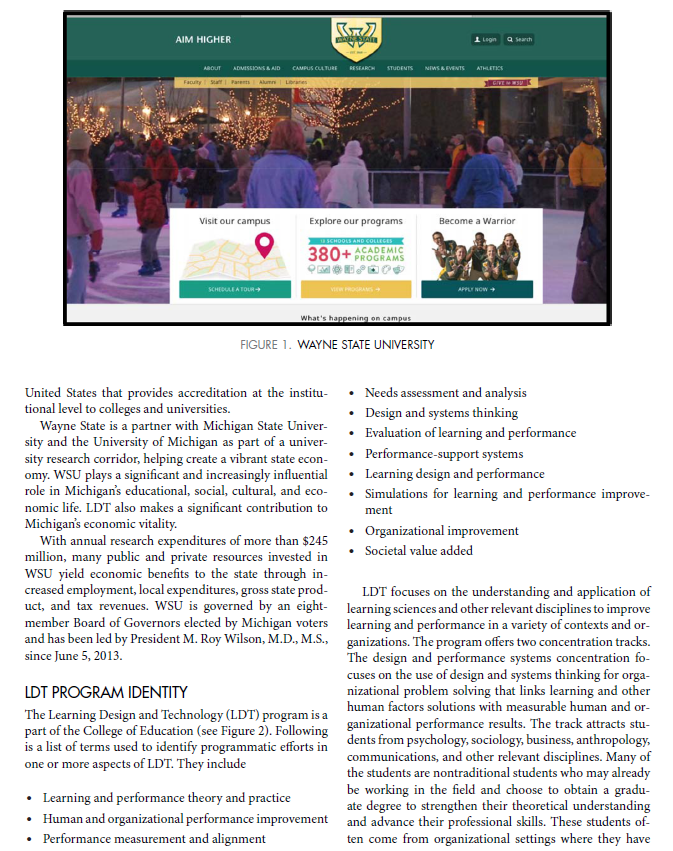
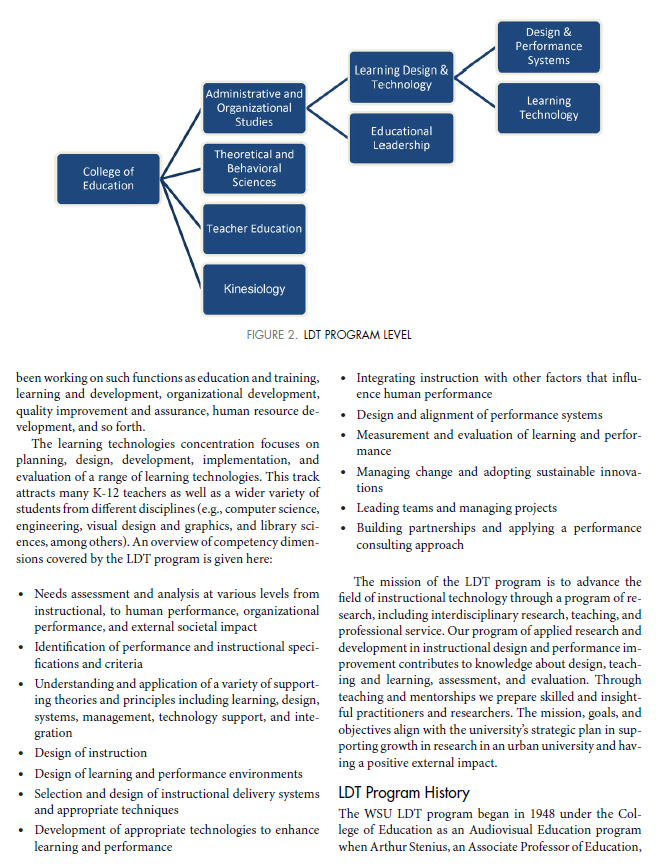
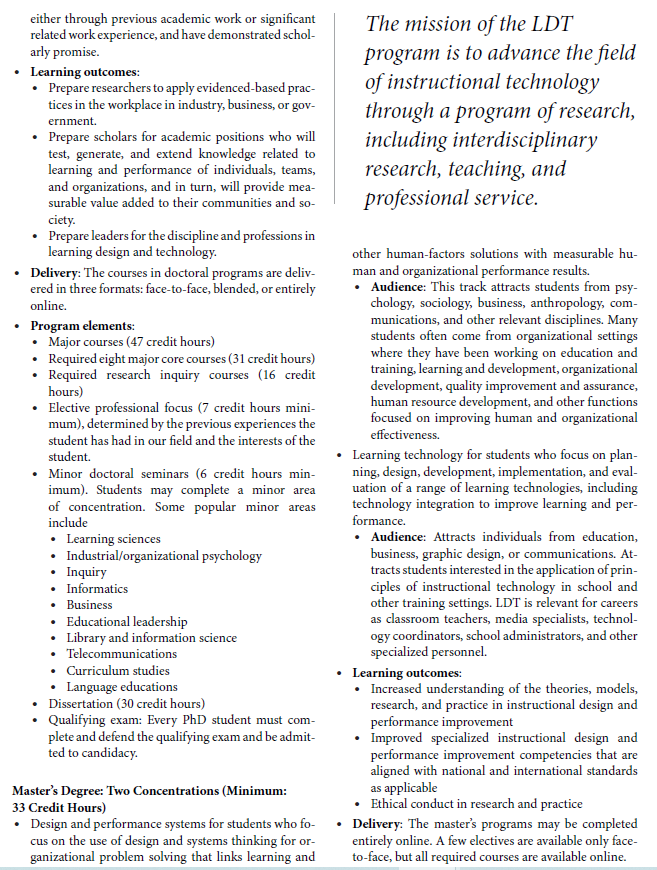
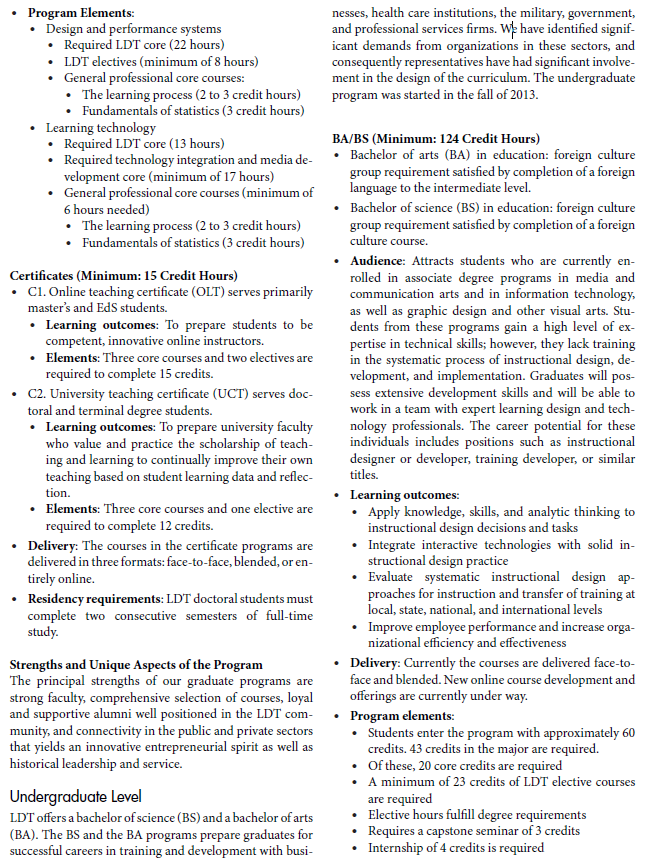
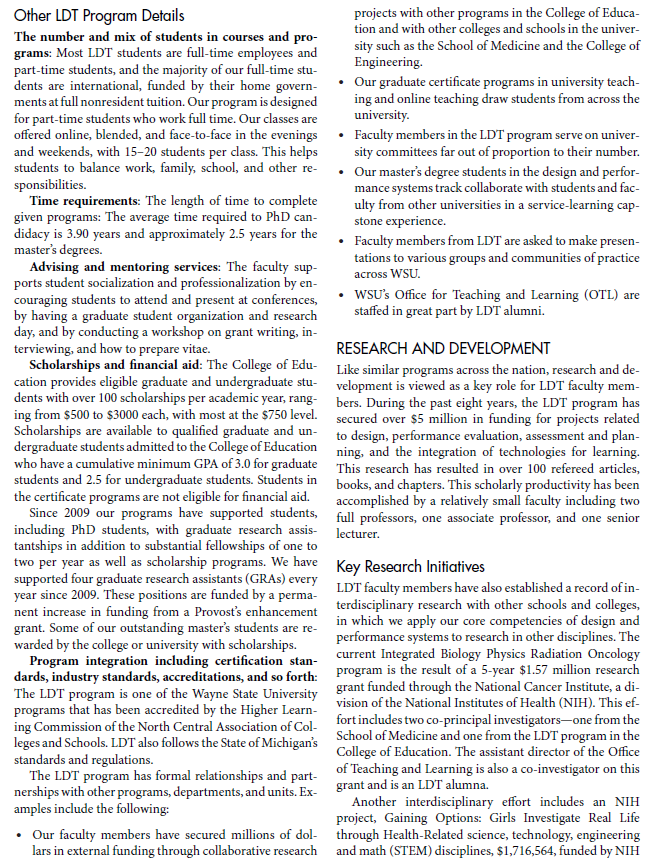
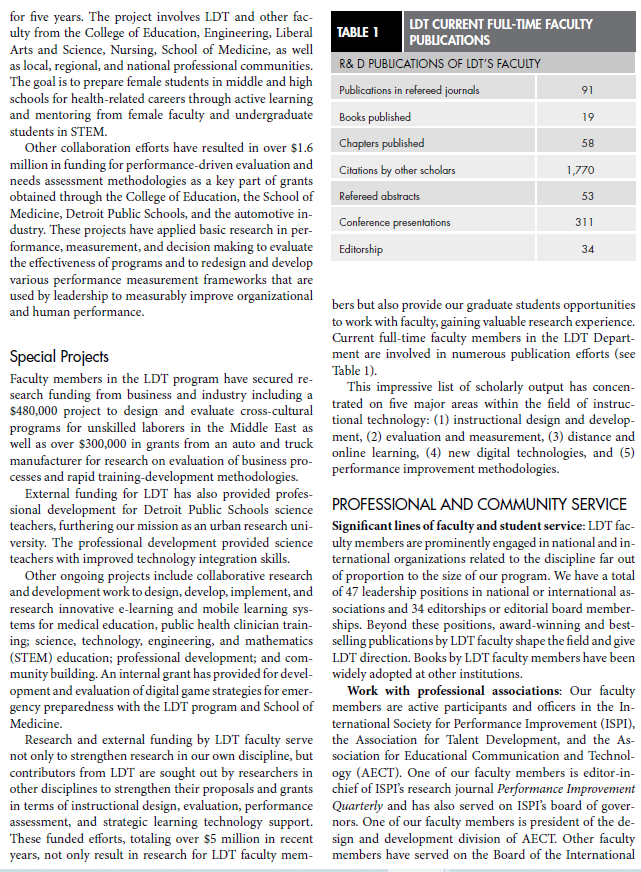
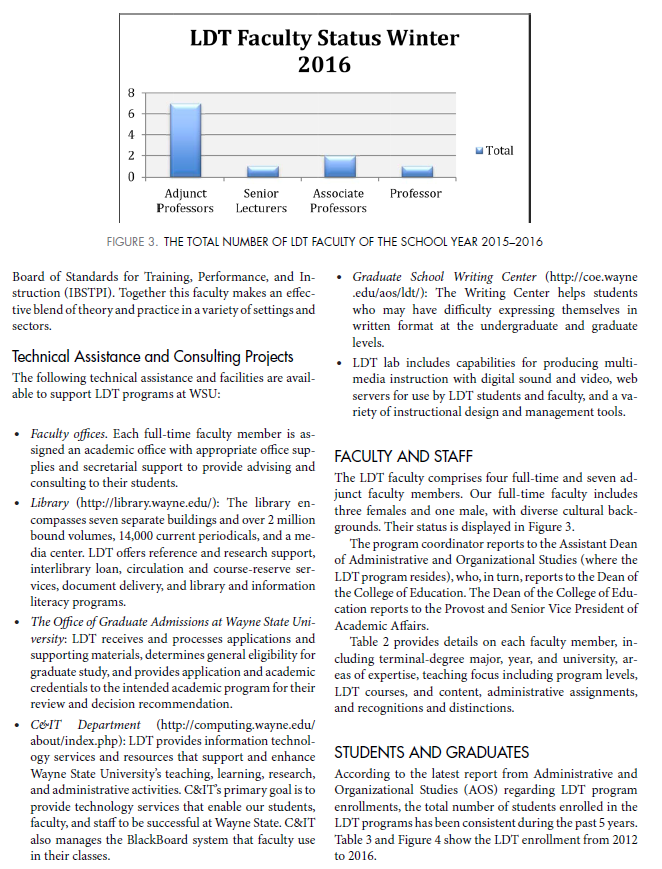
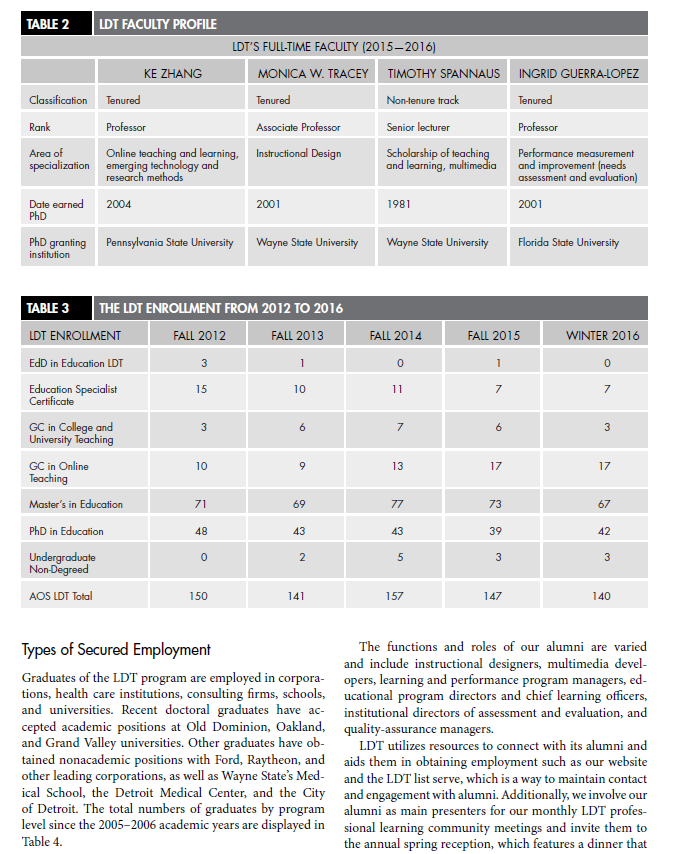
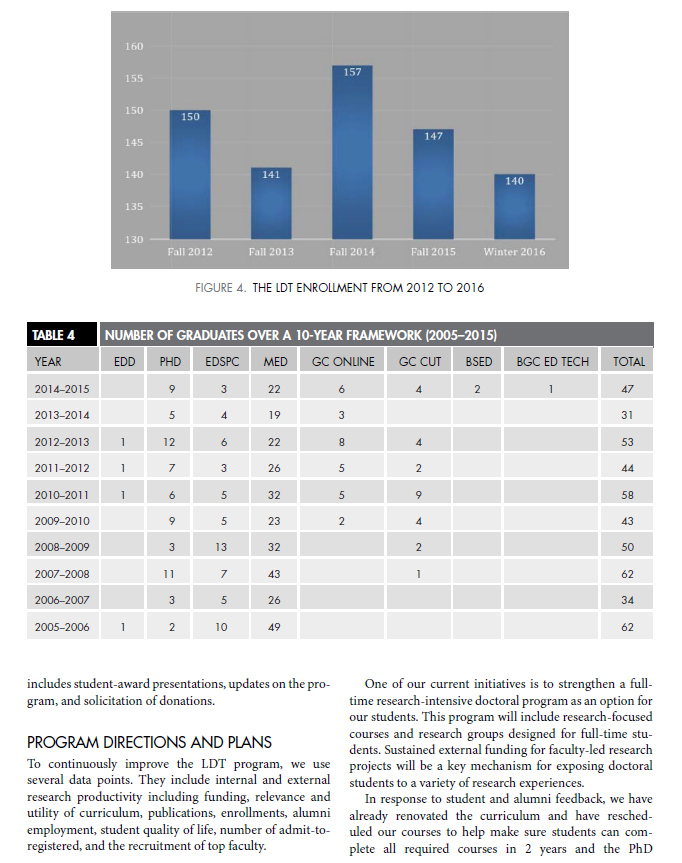
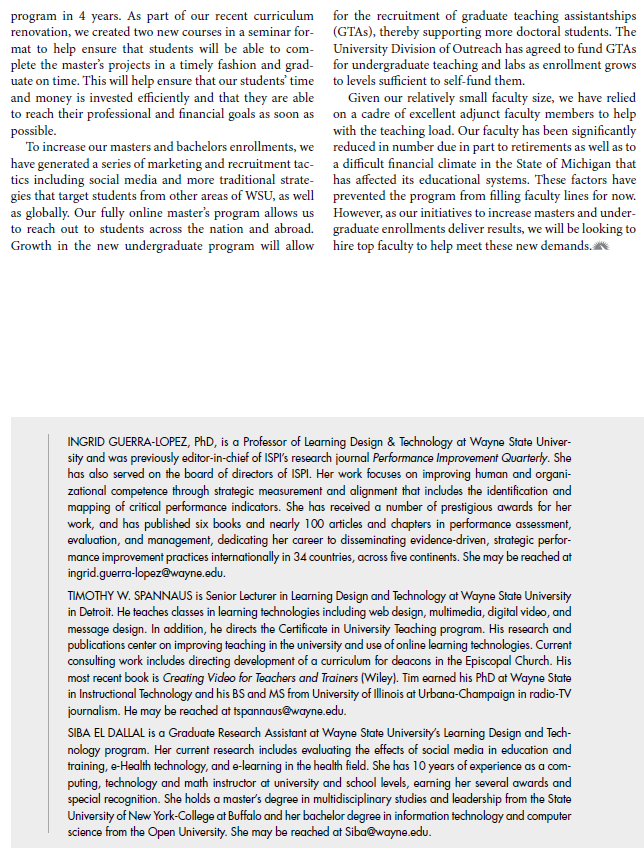
AN ACADEMIC PROGRAM PROFILE: WAYNE STATE UNIVERSITY Ingrid Guerra-Lopez Tim Spannaus Siba Dallal Introduction by Sung "Pil Kang, PhD, and Yeol Huh, PhD, Column Editors Since 1948, the Learning Design and Technology (LDT) program at Wayne State University has been offering degrees. Presently, the DT program offers PhD, EDD, master's, and undergraduate degrees and two certificates. The degrees are delivered using various methods including face-to-face, blended, and online. The program focuses on the application of learning sciences and relevant disciplines to improve performance in organizations. The program has two concentration tracks: design and performance systems and learning technologies. Four full-time and seven adjunct faculty are engaged in various research initiatives and projects with funding in excess of $5 million total. The faculty members serve in leadership roles in several academic and professional associations. In terms of programmatic initiatives, the LDT faculty members have renovated their programs to help make sure students can complete all required courses in 2 years, and the PhD in 4 years. They also are initiating a full-time research intensive program. With capable faculty members and an excellent curriculum, the LDT program at Wayne State University nurtures competent scholars and professionals. -Sung "Pil" Kang, Ph.D. and Yeol Huh, Ph.D.column editors A BRIEF HISTORY OF WAYNE STATE (LDT) program offers courses on the main campus and UNIVERSITY online. WSU's vision is to be a model public research university Wayne State University (WSU) is a premier public urban engaged in an urban community. And LDT's mission is to research university with a history of academic excellence create knowledge and prepare a diverse body of students and opportunity spanning nearly 150 years. Founded in to excel in an increasingly complex and global society (see 1868, WSU offers more than 380 academic programs Figure 1). through 13 colleges and schools to more than 27,000 stu- As one of the nation's 50 largest public universities, dents that come to learn from all over the world. WSU Wayne State affiliates with more than 100 institutions has approximately 2,700 renowned faculty members who worldwide, and holds the Carnegie Foundation's "research offer their students hands-on experiences in state-of-the- university, very high research activity (RU/VH) desig- art laboratories. WSU's main campus is located in mid- nation, a distinction held by only 3.5 percent of institu- town Detroit, Michigan. The main campus has 100 build- tions of higher education in the United States. Since 1915, ings spread over 200 acres. WSU has extension centers WSU has been accredited by the Higher Learning Com- that offer higher education to students throughout South- mission of the North Central Association of Colleges and east Michigan. The Learning Design and Technology Schools, one of six regional accrediting agencies in the AIM HIGHER .Login Q Search CAMPUS CULTURE RESEARCH STUDENTS NEWS & EVENTS ATHLETICS ABOUT ADMISSIONS & AID Faculty Sue Parts Alus Les Ta Visit our campus Explore our programs Become a Warrior SCHOOLS AND COLLEGES 380+ ACADEMIC PROGRAMS SCHELE A TOUR APPUY NOW 4 What's happening on campus FIGURE 1. WAYNE STATE UNIVERSITY United States that provides accreditation at the institu- Needs assessment and analysis tional level to colleges and universities. Design and systems thinking Wayne State is a partner with Michigan State Univer- Evaluation of learning and performance sity and the University of Michigan as part of a univer- sity research corridor, helping create a vibrant state econ- . Performance-support systems omy. WSU plays a significant and increasingly influential Learning design and performance role in Michigan's educational, social, cultural, and eco- Simulations for learning and performance improve- nomic life. LDT also makes a significant contribution to ment Michigan's economic vitality. With annual research expenditures of more than $245 Organizational improvement million, many public and private resources invested in Societal value added WSU yield economic benefits to the state through in- creased employment, local expenditures, gross state prod- LDT focuses on the understanding and application of uct, and tax revenues. WSU is governed by an eight- learning sciences and other relevant disciplines to improve member Board of Governors elected by Michigan voters learning and performance in a variety of contexts and or- and has been led by President M. Roy Wilson, M.D., M.S., ganizations. The program offers two concentration tracks. since June 5, 2013. The design and performance systems concentration fo- cuses on the use of design and systems thinking for orga- LDT PROGRAM IDENTITY nizational problem solving that links learning and other The Learning Design and Technology (LDT) program is a human factors solutions with measurable human and or- part of the College of Education (see Figure 2). Following ganizational performance results. The track attracts stu- is a list of terms used to identify programmatic efforts in dents from psychology, sociology, business, anthropology, one or more aspects of LDT. They include communications, and other relevant disciplines. Many of the students are nontraditional students who may already Learning and performance theory and practice be working in the field and choose to obtain a gradu- ate degree to strengthen their theoretical understanding Human and organizational performance improvement and advance their professional skills. These students of Performance measurement and alignment ten come from organizational settings where they have Design & Performance Systems Learning Design & Technology Administrative and Organizational Studies Learning Technology Educational Leadership College of Education Theoretical and Behavioral Sciences Teacher Education Kinesiology FIGURE 2. LDT PROGRAM LEVEL been working on such functions as education and training, Integrating instruction with other factors that influ- learning and development, organizational development, ence human performance quality improvement and assurance, human resource de- Design and alignment of performance systems velopment, and so forth. The learning technologies concentration focuses on Measurement and evaluation of learning and perfor- mance planning, design, development, implementation, and evaluation of a range of learning technologies. This track Managing change and adopting sustainable innova- attracts many K-12 teachers as well as a wider variety of tions students from different disciplines (e.g., computer science, Leading teams and managing projects engineering, visual design and graphics, and library sci- . Building partnerships and applying a performance ences, among others). An overview of competency dimen- consulting approach sions covered by the LDT program is given here: The mission of the LDT program is to advance the Needs assessment and analysis at various levels from field of instructional technology through a program of re- instructional, to human performance, organizational search, including interdisciplinary research, teaching, and performance, and external societal impact professional service. Our program of applied research and Identification of performance and instructional speci- development in instructional design and performance im- fications and criteria provement contributes to knowledge about design, teach- Understanding and application of a variety of support- ing and learning, assessment, and evaluation. Through ing theories and principles including learning, design, teaching and mentorships we prepare skilled and insight- systems, management, technology support, and inte ful practitioners and researchers. The mission, goals, and gration objectives align with the university's strategic plan in sup- Design of instruction porting growth in research in an urban university and hav- ing a positive external impact. Design of learning and performance environments Selection and design of instructional delivery systems LDT Program History and appropriate techniques The WSU LDT program began in 1948 under the Col- Development of appropriate technologies to enhance lege of Education as an Audiovisual Education program learning and performance when Arthur Stenius, an Associate Professor of Education, developed five audiovisual courses that served as the basis the field. In fact, the 1990s brought many enhancements for a master's degree concentration: Unit 1 1953. Stenius to the instructional technology curriculum, new facili- managed the program area alone, working for the most ties, the expansion of the faculty, and a growing student part with two part-time faculty members. body. In 1956, J. James McPherson introduced into the cur- Research and evaluation have been critical aspects of riculum for the first time the management foundations the Instructional Technology program. Continuing the of the field. The early years of 1948 through 1963 were legacy established in the 1970s, the Instructional Technol- defined both organizationally and conceptually when the ogy faculty conducted a series of research and evaluation program was designated as Audiovisual Education. projects in the early of 1990s with the Ford Motor Com- Beginning in the 1963-64 academic year, the depart- pany and the Chrysler Corporation, including Daimler- ment was renamed Instructional Technology, a change ini- Chrysler and Daimler. Project ALERT partners were the tiated by Robert Kilbourn, who was involved in offer- Henry Ford Community College, Davis Tool and Man- ing a PhD program in instructional technology. At that ufacturing, the Annenberg Foundation, and the Detroit time, Audiovisual Education became a separate depart- Public Schools. Other efforts were funded by the National ment. This change in the department name was accompa- Science Foundation, the U.S. Department of Housing and nied by a radical curriculum change connoted by moving Urban Development, including a project on innovative beyond audiovisual training to a profession with a firm in- workplace literacy, and other private and public organiza- tellectual foundation that focused mainly on three facets: tions. Additionally in the 1990s, the master's project poster (1) the use and production of audiovisual technology, session and outstanding student awards programs were (2) instructional design, and (3) study and practice of the started in order to recognize the work of instructional profession. In 1965, John Childs took over the depart- technology students. A newsletter and annual spring re- ment's responsibilities and contributed to Instructional ception were also started to strengthen ties with alumni Technology's growth. and students. The 1970s was an exciting time and an expansion arena for the department. There was a massive growth in the student body, faculty, and curriculum direction with em LDT ACADEMIC PROGRAMS AND phases on evaluation and instructional design. In addi- REQUIREMENTS tion to introducing the first computer-oriented course, In- The LDT program offers curricula for graduate and now structional Technology made strides in terms of growth as undergraduate programs. a research and development unit. By the end of the 1970s the College of Education was in a state of crisis as the state of Michigan was moving Graduate Level into a severe economic recession. In 1974, Instructional LDT offers three degrees and two certificates at the grad- Technology moved into the Division of Educational Lead- uate level. ership, subsequently changed to the Division of Adminis- trative and Organizational Studies. In order to rebuild the department, Childs, who continued to coordinate the In- Doctoral Degrees (PhD and EdD) (Minimum: 90 Credit Hours) structional Technology program until 1998, worked with transfers Alvin Edelson and Rita Richey on enhancing the Doctor of education degree (EdD) for students who curriculum and rebuilding the facilities. are planning on working in the field primarily as prac- In the 1990s the Instructional Technology faculty up- titioners, are especially interested in developing new graded criteria for doctoral and master's program pro- technological capabilities, and are interested in re- cedures, making the master's and educational specialist search that emphasizes development, evaluation, or programs consist of 36 credit hours in which students descriptive projects. could select from the following areas: (1) instructional Doctor of philosophy degree (PhD) for students who technology applications in K-12 education, (2) perfor- are anticipating an academic career or an area of mance improvement and training, or (3) interactive tech- practice that demands research expertise, mastery of nologies. The evaluation sequence continued to consist theory and conceptual analysis, and research that is of educational product and program evaluation and needs generalizable and has potential for primarily advanc- assessment and program validity with new performance ing the theory in the field. improvement courses added to the program's new ori- Audience: Students who already have a master's de- entation to focus on the management foundations of gree, are knowledgeable and experienced in the field either through previous academic work or significant The mission of the LDT related work experience, and have demonstrated schol- arly promise. program is to advance the field Learning outcomes: Prepare researchers to apply evidenced-based prac- of instructional technology tices in the workplace in industry, business, or gov- through a program of research, ernment. Prepare scholars for academic positions who will including interdisciplinary test, generate, and extend knowledge related to learning and performance of individuals, teams, research, teaching, and and organizations, and in turn, will provide mea- surable value added to their communities and so- professional service. ciety. Prepare leaders for the discipline and professions in learning design and technology. other human-factors solutions with measurable hu- Delivery: The courses in doctoral programs are deliv- man and organizational performance results. ered in three formats: face-to-face, blended, or entirely Audience: This track attracts students from psy- online. chology, sociology, business, anthropology, com- Program elements: munications, and other relevant disciplines. Many Major courses (47 credit hours) students often come from organizational settings Required eight major core courses (31 credit hours) where they have been working on education and Required research inquiry courses (16 credit training, learning and development, organizational hours) development, quality improvement and assurance, Elective professional focus (7 credit hours mini- human resource development, and other functions mum), determined by the previous experiences the focused on improving human and organizational student has had in our field and the interests of the effectiveness. student Learning technology for students who focus on plan- Minor doctoral seminars 6 credit hours min- ning, design, development, implementation, and eval- imum). Students may complete a minor area uation of a range of learning technologies, including of concentration. Some popular minor areas technology integration to improve learning and per- include formance. Learning sciences Audience: Attracts individuals from education, Industrial/organizational psychology business, graphic design, or communications. At- Inquiry tracts students interested in the application of prin- Informatics ciples of instructional technology in school and Business other training settings. LDT is relevant for careers Educational leadership as classroom teachers, media specialists, technol- Library and information science ogy coordinators, school administrators, and other Telecommunications specialized personnel. Curriculum studies Learning outcomes: Language educations Increased understanding of the theories, models, Dissertation (30 credit hours) research, and practice in instructional design and Qualifying exam: Every PhD student must com- performance improvement plete and defend the qualifying exam and be admit- Improved specialized instructional design and ted to candidacy. performance improvement competencies that are aligned with national and international standards Master's Degree: Two Concentrations (Minimum: as applicable 33 Credit Hours) Ethical conduct in research and practice Design and performance systems for students who fo- Delivery: The master's programs may be completed cus on the use of design and systems thinking for or- entirely online. A few electives are available only face- ganizational problem solving that links learning and to-face, but all required courses are available online. Program Elements: nesses, health care institutions, the military, government, Design and performance systems and professional services firms. We have identified signif- Required LDT core (22 hours) icant demands from organizations in these sectors, and LDT electives (minimum of 8 hours) consequently representatives have had significant involve- General professional core courses: ment in the design of the curriculum. The undergraduate The learning process (2 to 3 credit hours) program was started in the fall of 2013. Fundamentals of statistics (3 credit hours) Learning technology Required LDT core (13 hours) BA/BS (Minimum: 124 Credit Hours) Required technology integration and media de Bachelor of arts (BA) in education: foreign culture velopment core (minimum of 17 hours) group requirement satisfied by completion of a foreign General professional core courses (minimum of language to the intermediate level. 6 hours needed) Bachelor of science (BS) in education: foreign culture The learning process (2 to 3 credit hours) group requirement satisfied by completion of a foreign Fundamentals of statistics (3 credit hours) culture course. Audience: Attracts students who are currently en- Certificates (Minimum: 15 Credit Hours) rolled in associate degree programs in media and Cl. Online teaching certificate (OLT) serves primarily communication arts and in information technology, master's and EdS students. as well as graphic design and other visual arts. Stu- Learning outcomes: To prepare students to be dents from these programs gain a high level of ex- competent, innovative online instructors. pertise in technical skills; however, they lack training Elements: Three core courses and two electives are in the systematic process of instructional design, de- required to complete 15 credits. velopment, and implementation. Graduates will pos- C2. University teaching certificate (UCT) serves doc- sess extensive development skills and will be able to toral and terminal degree students. work in a team with expert learning design and tech- Learning outcomes: To prepare university faculty nology professionals. The career potential for these who value and practice the scholarship of teach- individuals includes positions such as instructional ing and learning to continually improve their own designer or developer, training developer, or similar teaching based on student learning data and reflec- titles. tion. Learning outcomes: Elements: Three core courses and one elective are Apply knowledge, skills, and analytic thinking to required to complete 12 credits. instructional design decisions and tasks Delivery: The courses in the certificate programs are Integrate interactive technologies with solid in- delivered in three formats: face-to-face, blended, or en- structional design practice tirely online. Evaluate systematic instructional design ap- Residency requirements: LDT doctoral students must proaches for instruction and transfer of training at complete two consecutive semesters of full-time local, state, national, and international levels study. Improve employee performance and increase orga- nizational efficiency and effectiveness Strengths and Unique Aspects of the Program Delivery: Currently the courses are delivered face-to- The principal strengths of our graduate programs are face and blended. New online course development and strong faculty, comprehensive selection of courses, loyal offerings are currently under way. and supportive alumni well positioned in the LDT com- Program elements: munity, and connectivity in the public and private sectors Students enter the program with approximately 60 that yields an innovative entrepreneurial spirit as well as credits. 43 credits in the major are required. historical leadership and service. Of these, 20 core credits are required A minimum of 23 credits of LDT elective courses Undergraduate Level are required LDT offers a bachelor of science (BS) and a bachelor of arts Elective hours fulfill degree requirements (BA). The BS and the BA programs prepare graduates for Requires a capstone seminar of 3 credits successful careers in training and development with busi- Internship of 4 credits is required Other LDT Program Details projects with other programs in the College of Educa- The number and mix of students in courses and pro- tion and with other colleges and schools in the univer- grams: Most LDT students are full-time employees and sity such as the School of Medicine and the College of part-time students, and the majority of our full-time stu- Engineering. dents are international, funded by their home govern- Our graduate certificate programs in university teach- ments at full nonresident tuition. Our program is designed ing and online teaching draw students from across the for part-time students who work full time. Our classes are university. offered online, blended, and face-to-face in the evenings. Faculty members in the LDT program serve on univer- and weekends, with 15-20 students per class. This helps sity committees far out of proportion to their number. students to balance work, family, school, and other re- . Our master's degree students in the design and perfor- sponsibilities. mance systems track collaborate with students and fac- Time requirements: The length of time to complete ulty from other universities in a service-learning cap- given programs: The average time required to PhD can- stone experience. didacy is 3.90 years and approximately 2.5 years for the Faculty members from LDT are asked to make presen- master's degrees. Advising and mentoring services: The faculty sup- tations to various groups and communities of practice across WSU. ports student socialization and professionalization by en- couraging students to attend and present at conferences, WSU's Office for Teaching and Learning (OTL) are by having a graduate student organization and research staffed in great part by LDT alumni. day, and by conducting a workshop on grant writing, in- terviewing, and how to prepare vitae. RESEARCH AND DEVELOPMENT Scholarships and financial aid: The College of Edu- Like similar programs across the nation, research and de- cation provides eligible graduate and undergraduate stu- velopment is viewed as a key role for LDT faculty mem- dents with over 100 scholarships per academic year, rang-bers. During the past eight years, the LDT program has ing from $500 to $3000 each, with most at the $750 level.secured over $5 million in funding for projects related Scholarships are available to qualified graduate and un- to design, performance evaluation, assessment and plan- dergraduate students admitted to the College of Education ning, and the integration of technologies for learning. who have a cumulative minimum GPA of 3.0 for graduate This research has resulted in over 100 refereed articles, students and 2.5 for undergraduate students. Students in books, and chapters. This scholarly productivity has been the certificate programs are not eligible for financial aid. accomplished by a relatively small faculty including two Since 2009 our programs have supported students, full professors, one associate professor, and one senior including PhD students, with graduate research assis- lecturer. tantships in addition to substantial fellowships of one to two per year as well as scholarship programs. We have Key Research Initiatives supported four graduate research assistants (GRAs) every LDT faculty members have also established a record of in- year since 2009. These positions are funded by a perma. terdisciplinary research with other schools and colleges, nent increase in funding from a Provost's enhancement grant. Some of our outstanding master's students are re- in which we apply our core competencies of design and warded by the college or university with scholarships. performance systems to research in other disciplines. The Program integration including certification stan- current Integrated Biology Physics Radiation Oncology dards, industry standards, accreditations, and so forth: program is the result of a 5-year $1.57 million research The LDT program is one of the Wayne State University grant funded through the National Cancer Institute, a di- programs that has been accredited by the Higher Learn- vision of the National Institutes of Health (NIH). This ef- ing Commission of the North Central Association of Col fort includes two co-principal investigators-one from the leges and Schools. LDT also follows the State of Michigan's School of Medicine and one from the LDT program in the standards and regulations. College of Education. The assistant director of the Office The LDT program has formal relationships and part- of Teaching and Learning is also a co-investigator on this nerships with other programs, departments, and units. Ex- grant and is an LDT alumna. amples include the following: Another interdisciplinary effort includes an NIH project, Gaining Options: Girls Investigate Real Life Our faculty members have secured millions of dol- through Health-Related science, technology, engineering lars in external funding through collaborative research and math (STEM) disciplines, $1,716,564, funded by NIH 91 19 58 53 311 34 for five years. The project involves LDT and other fac- ulty from the College of Education, Engineering, Liberal TABLE 1 LDT CURRENT FULL-TIME FACULTY PUBLICATIONS Arts and Science, Nursing, School of Medicine, as well as local, regional, and national professional communities. R&D PUBLICATIONS OF LDT'S FACULTY The goal is to prepare female students in middle and high Publications in refereed journals schools for health-related careers through active learning and mentoring from female faculty and undergraduate Books published students in STEM Other collaboration efforts have resulted in over $1.6 Chapters published million in funding for performance-driven evaluation and Citations by other scholars 1,770 needs assessment methodologies as a key part of grants obtained through the College of Education, the School of Refereed abstracts Medicine, Detroit Public Schools, and the automotive in- Conference presentations dustry. These projects have applied basic research in per- formance, measurement, and decision making to evaluate Editorship the effectiveness of programs and to redesign and develop various performance measurement frameworks that are used by leadership to measurably improve organizational bers but also provide our graduate students opportunities and human performance. to work with faculty, gaining valuable research experience. Current full-time faculty members in the LDT Depart- Special Projects ment are involved in numerous publication efforts (see Faculty members in the LDT program have secured re- Table 1). search funding from business and industry including a This impressive list of scholarly output has concen- $480,000 project to design and evaluate cross-cultural trated on five major areas within the field of instruc- programs for unskilled laborers in the Middle East as tional technology: (1) instructional design and develop- well as over $300,000 in grants from an auto and truck ment, (2) evaluation and measurement, (3) distance and manufacturer for research on evaluation of business pro- online learning, (4) new digital technologies, and (5) cesses and rapid training-development methodologies. performance improvement methodologies. External funding for LDT has also provided profes- sional development for Detroit Public Schools science PROFESSIONAL AND COMMUNITY SERVICE teachers, furthering our mission as an urban research uni- Significant lines of faculty and student service: LDT fac- versity. The professional development provided science ulty members are prominently engaged in national and in- teachers with improved technology integration skills. ternational organizations related to the discipline far out Other ongoing projects include collaborative research of proportion to the size of our program. We have a total and development work to design, develop, implement, and of 47 leadership positions in national or international as- research innovative e-learning and mobile learning sys-sociations and 34 editorships or editorial board member- tems for medical education, public health clinician train- ships. Beyond these positions, award-winning and best- ing: science, technology, engineering, and mathematics selling publications by LDT faculty shape the field and give (STEM) education; professional development; and com- LDT direction. Books by LDT faculty members have been munity building. An internal grant has provided for devel- widely adopted at other institutions. opment and evaluation of digital game strategies for emer- Work with professional associations: Our faculty gency preparedness with the LDT program and School of members are active participants and officers in the In- Medicine. ternational Society for Performance Improvement (ISPI), Research and external funding by LDT faculty serve the Association for Talent Development, and the As- not only to strengthen research in our own discipline, but sociation for Educational Communication and Technol- contributors from LDT are sought out by researchers in ogy (AECT). One of our faculty members is editor-in- other disciplines to strengthen their proposals and grants chief of ISPI's research journal Performance Improvement in terms of instructional design, evaluation, performance Quarterly and has also served on ISPI's board of gover- assessment, and strategic learning technology support. nors. One of our faculty members is president of the de These funded efforts, totaling over $5 million in recent sign and development division of AECT. Other faculty years, not only result in research for LDT faculty mem- members have served on the Board of the International LDT Faculty Status Winter 2016 8 6 4 2 Total 0 Professor Adjunct Professors Senior Lecturers Associate Professors FIGURE 3. THE TOTAL NUMBER OF LDT FACULTY OF THE SCHOOL YEAR 2015-2016 Board of Standards for Training, Performance, and In- Graduate School Writing Center (http://coe.wayne struction (IBSTPI). Together this faculty makes an effec- .edu/aos/ldt/): The Writing Center helps students tive blend of theory and practice in a variety of settings and who may have difficulty expressing themselves in sectors. written format at the undergraduate and graduate levels. Technical Assistance and Consulting Projects LDT lab includes capabilities for producing multi- The following technical assistance and facilities are avail- media instruction with digital sound and video, web able to support LDT programs at WSU: servers for use by LDT students and faculty, and a va- riety of instructional design and management tools. Faculty offices. Each full-time faculty member is as- signed an academic office with appropriate office sup. FACULTY AND STAFF plies and secretarial support to provide advising and consulting to their students. The LDT faculty comprises four full-time and seven ad- Library (http://library.wayne.edu/): The library en junct faculty members. Our full-time faculty includes compasses seven separate buildings and over 2 million three females and one male, with diverse cultural back- bound volumes , 14,000 current periodicals, and a me grounds. Their status is displayed in Figure 3. dia center. LDT offers reference and research support of Administrative and Organizational Studies (where the The program coordinator reports to the Assistant Dean interlibrary loan, circulation and course-reserve ser- vices, document delivery, and library and information the College of Education. The Dean of the College of Edu- LDT program resides), who, in turn, reports to the Dean of literacy programs. cation reports to the Provost and Senior Vice President of The Office of Graduate Admissions at Wayne State Uni- Academic Affairs. versity: LDT receives and processes applications and Table 2 provides details on each faculty member, in- supporting materials, determines general eligibility for cluding terminal-degree major, year, and university, ar- graduate study, and provides application and academic eas of expertise, teaching focus including program levels, credentials to the intended academic program for their LDT courses, and content, administrative assignments, review and decision recommendation. and recognitions and distinctions. CSIT Department (http://computing.wayne.edu/ about/index.php): LDT provides information technol- ogy services and resources that support and enhance STUDENTS AND GRADUATES Wayne State University's teaching, learning, research, According to the latest report from Administrative and and administrative activities. C&IT's primary goal is to Organizational Studies (AOS) regarding LDT program provide technology services that enable our students, enrollments, the total number of students enrolled in the faculty, and staff to be successful at Wayne State. C&IT LDT programs has been consistent during the past 5 years. also manages the BlackBoard system that faculty use Table 3 and Figure 4 show the LDT enrollment from 2012 in their classes. to 2016. INGRID GUERRA-LOPEZ Tenured TABLE 2 LDT FACULTY PROFILE LDT'S FULL-TIME FACULTY (20152016) KE ZHANG MONICA W. TRACEY TIMOTHY SPANNAUS Classification Tenured Tenured Non-tenure track Rank Professor Associate Professor Senior lecturer Area of Online teaching and learning Instructional Design Scholarship of teaching specialization emerging technology and and learning, multimedia research methods Date earned 2004 2001 1981 PhD PhD granting Pennsylvania State University Wayne State University Wayne State University institution Professor Performance measurement and improvement (needs assessment and evaluation) 2001 Florida State University FALL 2014 FALL 2015 WINTER 2016 0 0 1 11 7 7 6 7 6 3 TABLE 3 THE LDT ENROLLMENT FROM 2012 TO 2016 LDT ENROLLMENT FALL 2012 FALL 2013 EdD in Education LDT 3 1 Education Specialist 15 10 Certificate GC in College and University Teaching GC in Online Teaching Master's in Education 71 PhD in Education 48 Undergraduate 0 2 Non-Degreed AOS LDT Total 150 141 10 9 13 17 17 69 77 73 67 43 43 39 42 5 3 3 157 147 140 Types of Secured Employment The functions and roles of our alumni are varied and include instructional designers, multimedia devel- Graduates of the LDT program are employed in corpora- opers, learning and performance program managers, ed- tions, health care institutions, consulting firms, schools, ucational program directors and chief learning officers, and universities. Recent doctoral graduates have ac- institutional directors of assessment and evaluation, and cepted academic positions at Old Dominion, Oakland, quality assurance managers. and Grand Valley universities. Other graduates have ob- LDT utilizes resources to connect with its alumni and tained nonacademic positions with Ford, Raytheon, and aids them in obtaining employment such as our website other leading corporations, as well as Wayne State's Med- and the LDT list serve, which is a way to maintain contact ical School, the Detroit Medical Center, and the City and engagement with alumni. Additionally, we involve our of Detroit. The total numbers of graduates by program alumni as main presenters for our monthly LDT profes- level since the 2005-2006 academic years are displayed in sional learning community meetings and invite them to Table 4. the annual spring reception, which features a dinner that 160 155 157 150 150 147 145 140 141 140 135 130 Fall 2012 Fall 2013 Fall 2014 Fall 2015 Winter 2016 FIGURE 4. THE LDT ENROLLMENT FROM 2012 TO 2016 NUMBER OF GRADUATES OVER A 10-YEAR FRAMEWORK (2005-2015) EDD PHD EDSPC MED GC ONLINE GC CUT BSED 2 BGC ED TECH TOTAL 9 3 22 6 47 TABLE 4 YEAR 2014-2015 2013-2014 2012-2013 2011-2012 5 4 19 3 31 1 12 6 22 8 4 53 1 7 26 5 2 44 1 6 5 32 5 9 58 9 9 5 23 2. 4 43 3 13 32 2 50 2010-2011 2009-2010 2008-2009 2007-2008 2006-2007 2005-2006 11 7 43 1 62 5 26 34 1 2 10 49 62 includes student-award presentations, updates on the pro- One of our current initiatives is to strengthen a full- gram, and solicitation of donations. time research-intensive doctoral program as an option for our students. This program will include research-focused PROGRAM DIRECTIONS AND PLANS courses and research groups designed for full-time stu- dents. Sustained external funding for faculty-led research To continuously improve the LDT program, we use projects will be a key mechanism for exposing doctoral several data points. They include internal and external students to a variety of research experiences. research productivity including funding, relevance and In response to student and alumni feedback, we have utility of curriculum, publications, enrollments, alumni already renovated the curriculum and have resched- employment, student quality of life, number of admit-to-uled our courses to help make sure students can com- registered, and the recruitment of top faculty. plete all required courses in 2 years and the PhD program in 4 years. As part of our recent curriculum for the recruitment of graduate teaching assistantships renovation, we created two new courses in a seminar for- (GTAs), thereby supporting more doctoral students. The mat to help ensure that students will be able to com- University Division of Outreach has agreed to fund GTAS plete the master's projects in a timely fashion and grad for undergraduate teaching and labs as enrollment grows uate on time. This will help ensure that our students' time to levels sufficient to self-fund them. and money is invested efficiently and that they are able Given our relatively small faculty size, we have relied to reach their professional and financial goals as soon as on a cadre of excellent adjunct faculty members to help possible. with the teaching load. Our faculty has been significantly To increase our masters and bachelors enrollments, we reduced in number due in part to retirements as well as to have generated a series of marketing and recruitment tac- a difficult financial climate in the State of Michigan that tics including social media and more traditional strate- has affected its educational systems. These factors have gies that target students from other areas of WSU, as well prevented the program from filling faculty lines for now. as globally. Our fully online master's program allows us However, as our initiatives to increase masters and under- to reach out to students across the nation and abroad. graduate enrollments deliver results, we will be looking to Growth in the new undergraduate program will allow hire top faculty to help meet these new demands. INGRID GUERRA-LOPEZ, PhD, is a Professor of Learning Design & Technology at Wayne State Univer- sity and was previously editor-in-chief of ISPI's research journal Performance Improvement Quarterly. She has also served on the board of directors of ISPI. Her work focuses on improving human and organi- zational competence through strategic measurement and alignment that includes the identification and mapping of critical performance indicators. She has received a number of prestigious awards for her work, and has published six books and nearly 100 articles and chapters in performance assessment, evaluation, and management, dedicating her career to disseminating evidence-driven, strategic perfor- mance improvement practices internationally in 34 countries, across five continents. She may be reached at ingrid.guerra-lopez@wayne.edu. TIMOTHY W. SPANNAUS is Senior Lecturer in Learning Design and Technology at Wayne State University in Detroit. He teaches classes in learning technologies including web design, multimedia, digital video, and message design. In addition, he directs the Certificate in University Teaching program. His research and publications center on improving teaching in the university and use of online learning technologies. Current consulting work includes directing development of a curriculum for deacons in the Episcopal Church. His most recent book is Creating Video for Teachers and Trainers (Wiley). Tim earned his PhD at Wayne State in Instructional Technology and his BS and MS from University of Illinois at Urbana-Champaign in radio-TV journalism. He may be reached at tspannaus@wayne.edu. SIBA EL DALLAL is a Graduate Research Assistant at Wayne State University's Learning Design and Tech- nology program. Her current research includes evaluating the effects of social media in education and training, e-Health technology, and e-learning in the health field. She has 10 years of experience as a com- puting, technology and math instructor at university and school levels, eaming her several awards and special recognition. She holds a master's degree in multidisciplinary studies and leadership from the State University of New York-College at Buffalo and her bachelor degree in information technology and computer science from the Open University. She may be reached at Siba@wayne.eduStep by Step Solution
There are 3 Steps involved in it
1 Expert Approved Answer
Step: 1 Unlock

Question Has Been Solved by an Expert!
Get step-by-step solutions from verified subject matter experts
Step: 2 Unlock
Step: 3 Unlock
 Study Help