Question: Super Skateboard Builders (SSB) Controls Case Study Organization Process notes Master Data Maria, Martha and Shana all have access to update master data, including employee,
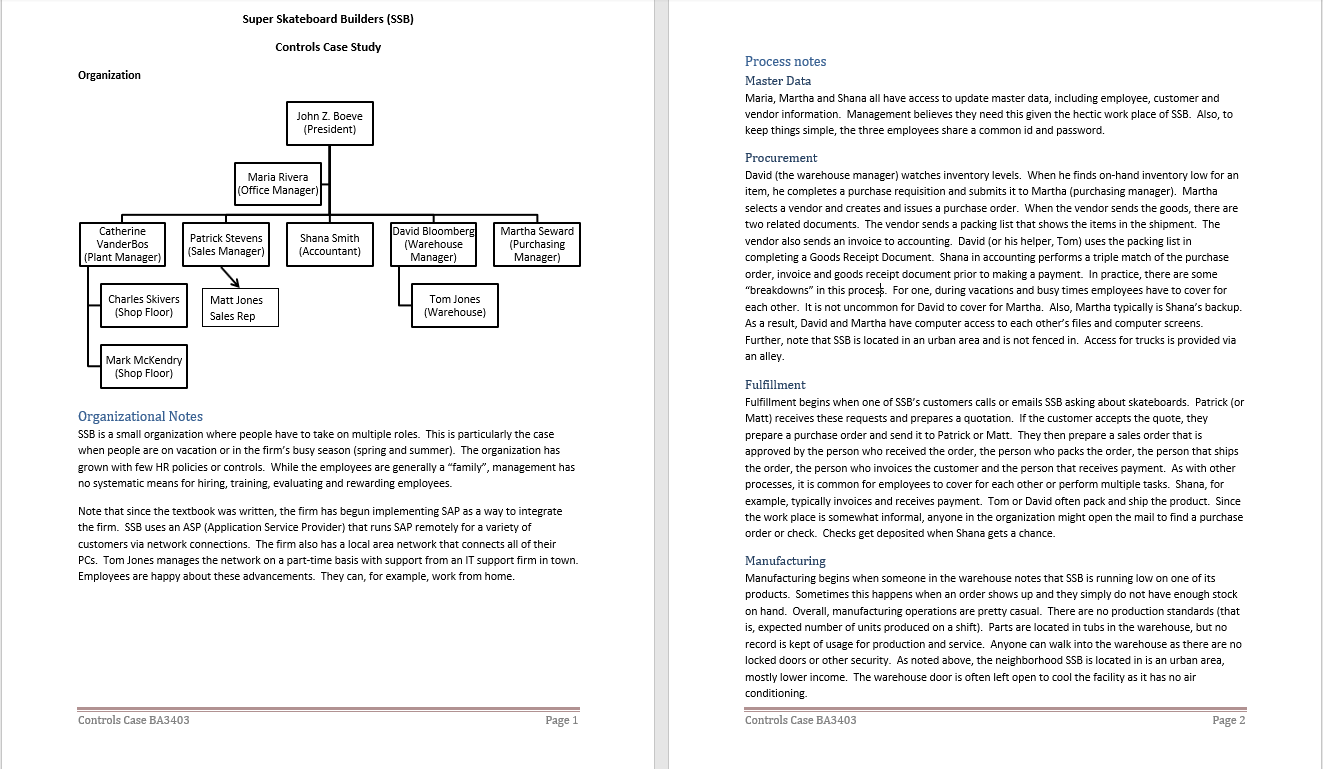
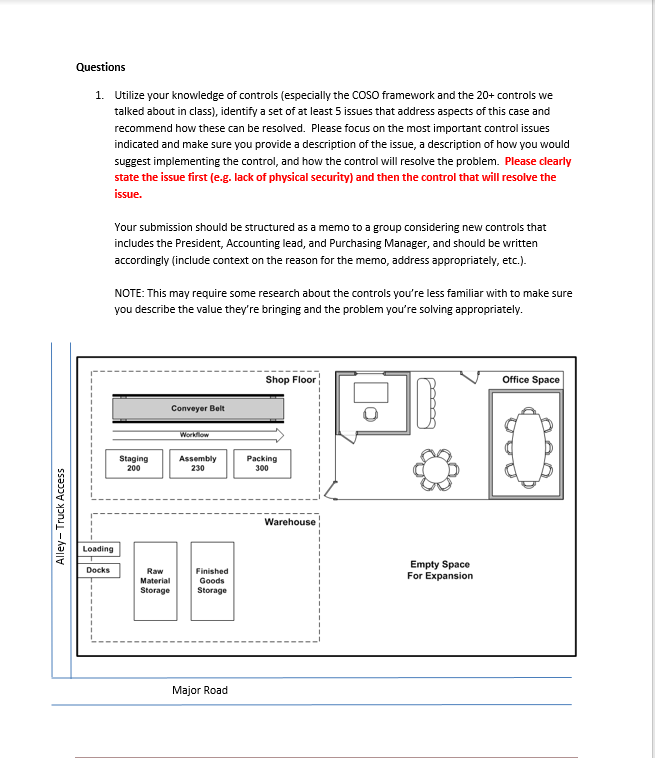
Super Skateboard Builders (SSB) Controls Case Study Organization Process notes Master Data Maria, Martha and Shana all have access to update master data, including employee, customer and vendor information. Management believes they need this given the hectic work place of SSB. Also, to keep things simple, the three employees share a common id and password. John Z. Boeve (President) Maria Rivera (Office Manager) Catherine VanderBos (Plant Manager) Patrick Stevens (Sales Manager) Shana Smith (Accountant) David Bloomberg (Warehouse Manager) Martha Seward (Purchasing Manager) Procurement David (the warehouse manager) watches inventory levels. When he finds on-hand inventory low for an item, he completes a purchase requisition and submits it to Martha (purchasing manager). Martha selects a vendor and creates and issues a purchase order. When the vendor sends the goods, there are two related documents. The vendor sends a packing list that shows the items in the shipment. The vendor also sends an invoice to accounting. David (or his helper, Tom) uses the packing list in completing a Goods Receipt Document. Shana in accounting performs a triple match of the purchase order, invoice and goods receipt document prior to making a payment. In practice, there are some "breakdowns in this process. For one, during vacations and busy times employees have to cover for each other. It is not uncommon for David to cover for Martha. Also, Martha typically is Shana's backup. As a result, David and Martha have computer access to each other's files and computer screens. Further, note that SSB is located in an urban area and is not fenced in. Access for trucks is provided via an alley Charles Skivers (Shop Floor) Matt Jones Sales Rep Tom Jones (Warehouse) Mark McKendry (Shop Floor) Organizational Notes SSB is a small organization where people have to take on multiple roles. This is particularly the case when people are on vacation or in the firm's busy season (spring and summer). The organization has grown with few HR policies or controls. While the employees are generally a "family", management has no systematic means for hiring, training, evaluating and rewarding employees. Fulfillment Fulfillment begins when one of SSB's customers calls or emails SSB asking about skateboards. Patrick (or Matt) receives these requests and prepares a quotation. If the customer accepts the quote, they prepare a purchase order and send it to Patrick or Matt. They then prepare a sales order that is approved by the person who received the order, the person who packs the order, the person that ships the order, the person who invoices the customer and the person that receives payment. As with other processes, it is common for employees to cover for each other or perform multiple tasks. Shana, for example, typically invoices and receives payment. Tom or David often pack and ship the product. Since the work place is somewhat informal, anyone in the organization might open the mail to find a purchase order or check. Checks get deposited when Shana gets a chance. Note that since the textbook was written, the firm has begun implementing SAP as a way to integrate the firm. SSB uses an ASP (Application Service Provider) that runs SAP remotely for a variety of customers via network connections. The firm also has a local area network that connects all of their PCs. Tom Jones manages the network on a part-time basis with support from an IT support firm in town. Employees are happy about these advancements. They can, for example, work from home. Manufacturing Manufacturing begins when someone in the warehouse notes that SSB is running low on one of its products. Sometimes this happens when an order shows up and they simply do not have enough stock on hand. Overall, manufacturing operations are pretty casual. There are no production standards (that is, expected number of units produced on a shift). Parts are located in tubs in the warehouse, but no record is kept of usage for production and service. Anyone can walk into the warehouse as there are no locked doors or other security. As noted above, the neighborhood SSB is located in is an urban area, mostly lower income. The warehouse door is often left open to cool the facility as it has no air conditioning Controls Case BA3403 Page 1 Controls Case BA3403 Page 2 Questions 1. Utilize your knowledge of controls (especially the COSO framework and the 20+ controls we talked about in class), identify a set of at least 5 issues that address aspects of this case and recommend how these can be resolved. Please focus on the most important control issues indicated and make sure you provide a description of the issue, a description of how you would suggest implementing the control, and how the control will resolve the problem. Please clearly state the issue first (e.g. lack of physical security) and then the control that will resolve the issue. Your submission should be structured as a memo to a group considering new controls that includes the President, Accounting lead, and Purchasing Manager, and should be written accordingly (include context on the reason for the memo, address appropriately, etc.). NOTE: This may require some research about the controls you're less familiar with to make sure you describe the value they're bringing and the problem you're solving appropriately. Shop Floor Office Space Conveyer Belt Workflow Staging 200 Assembly 230 Packing 300 to Alley-Truck Access Warehouse Loading Docks Raw Material Storage Finished Goods Storage Empty Space For Expansion Major Road









 Study Help