







Question: Supplemental Problem. Pepperdine's Center for Sustainability (CFS) published a recent paper in which multiattribute decision analysis techniques were used to help the CFS prioritize a
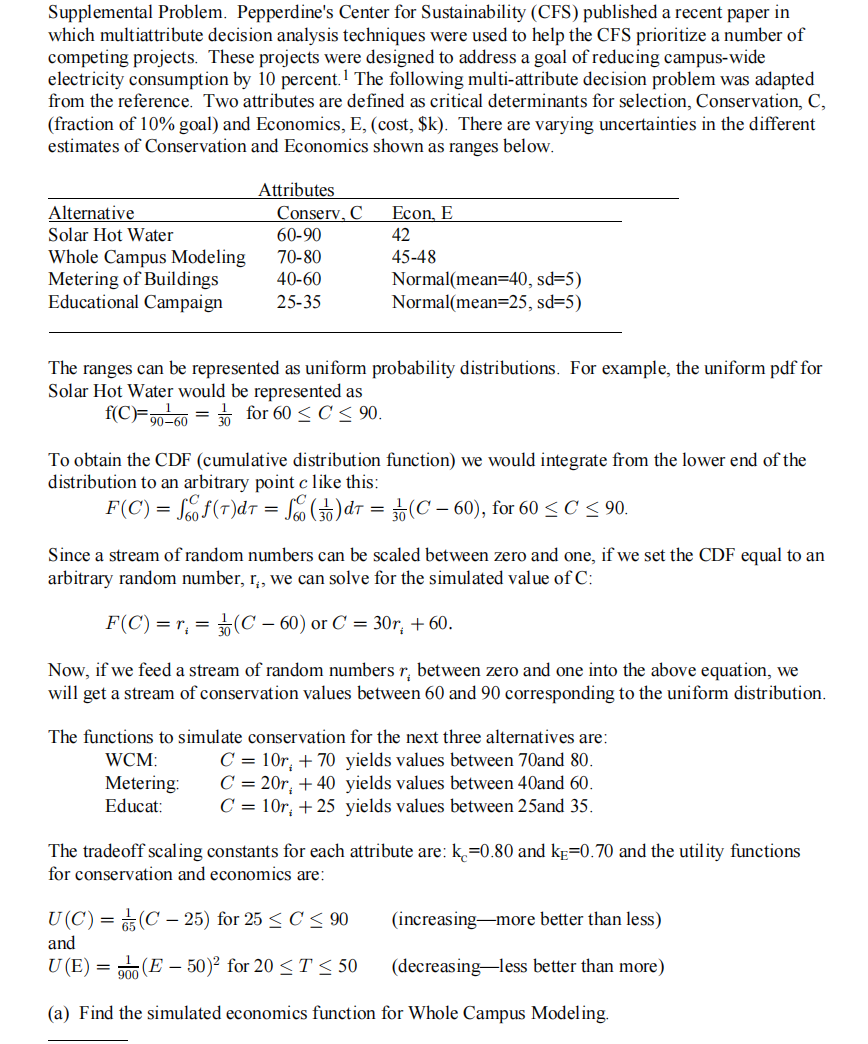
Supplemental Problem. Pepperdine's Center for Sustainability (CFS) published a recent paper in which multiattribute decision analysis techniques were used to help the CFS prioritize a number of competing projects. These projects were designed to address a goal of reducing campus-wide electricity consumption by 10 percent. 1 The following multi-attribute decision problem was adapted from the reference. Two attributes are defined as critical determinants for selection, Conservation, C, (fraction of 10% goal) and Economics, E, (cost, \$k). There are varying uncertainties in the different estimates of Conservation and Economics shown as ranges below. The ranges can be represented as uniform probability distributions. For example, the uniform pdf for Solar Hot Water would be represented as f(C)=90601=301for60C90. To obtain the CDF (cumulative distribution function) we would integrate from the lower end of the distribution to an arbitrary point c like this: F(C)=60Cf()d=60C(301)d=301(C60),for60C90. Since a stream of random numbers can be scaled between zero and one, if we set the CDF equal to an arbitrary random number, ri, we can solve for the simulated value of C : F(C)=ri=301(C60)orC=30ri+60. Now, if we feed a stream of random numbers ri between zero and one into the above equation, we will get a stream of conservation values between 60 and 90 corresponding to the uniform distribution. The functions to simulate conservation for the next three alternatives are: WCM: C=10ri+70 yields values between 70 and 80 . Metering: C=20ri+40 yields values between 40 and 60 . Educat: C=10ri+25 yields values between 25 and 35 . The tradeoff scaling constants for each attribute are: kC=0.80 and kE=0.70 and the utility functions for conservation and economics are: U(C)=651(C25)for25C90andU(E)=9001(E50)2for20T50(increasing-morebetterthanless)(decreasinglessbetterthanmore) (a) Find the simulated economics function for Whole Campus Modeling
Step by Step Solution
There are 3 Steps involved in it

Get step-by-step solutions from verified subject matter experts
 Study Help