Question: SUPPLY CHAIN CONNECTIONS CUSTOMER-INTRODUCED VARIABILITY IN SERVICES In her article Breaking the Trade-off between Efficiency and Service, Professor Frances Frei of the Harvard Business School
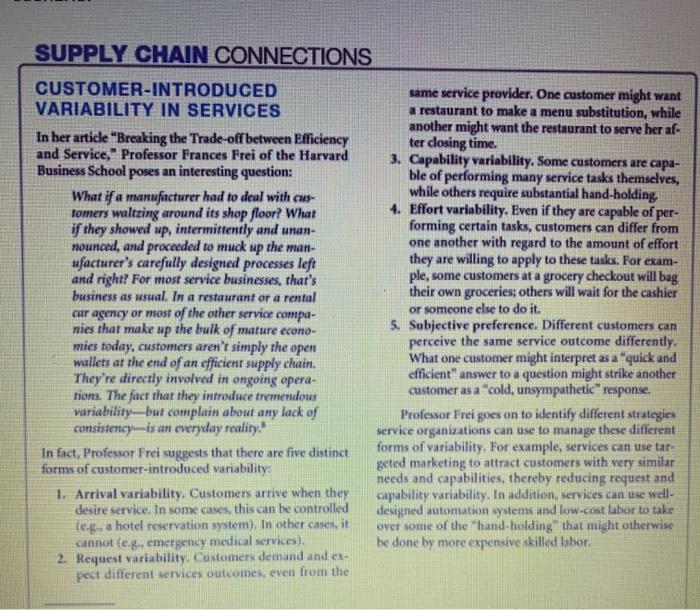
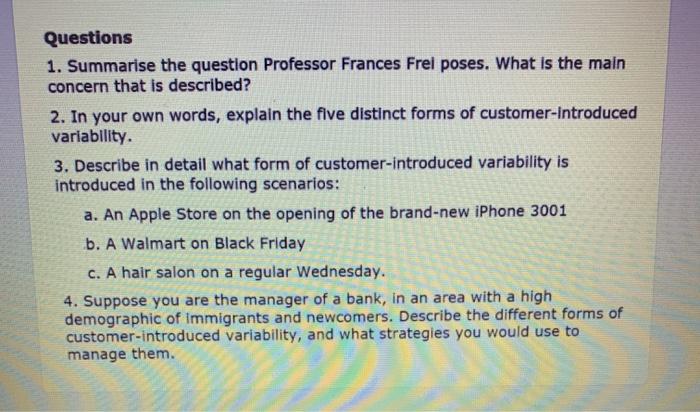
SUPPLY CHAIN CONNECTIONS CUSTOMER-INTRODUCED VARIABILITY IN SERVICES In her article "Breaking the Trade-off between Efficiency and Service," Professor Frances Frei of the Harvard Business School poses an interesting question: What if a manufacturer had to deal with cus- tomers waltzing around its shop floor? What if they showed up, intermittently and unan- nounced, and proceeded to muck up the man ufacturer's carefully designed processes left and right? For most service businesses, that's business as usual. In a restaurant or a rental car agency or most of the other service compa- nies that make up the bulk of mature econo- mies today, customers aren't simply the open wallets at the end of an efficient supply chain. They're directly involved in ongoing opera- tions. The fact that they introduce tremendous variability--but complain about any lack of consistency is an everyday reality In fact, Professor Frei suggests that there are five distinct forms of customer-introduced variability: 1. Arrival variability. Customers arrive when they desire service. In some cases, this can be controlled "(eg, a hotel reservation system). In other cases, it cannot (e.g., emergency medical services). 2. Request variability. Customers demand and ex- pect different services outcomes, even from the same service provider. One customer might want a restaurant to make a menu substitution, while another might want the restaurant to serve her af- ter closing time. 3. Capability variability. Some customers are capa- ble of performing many service tasks themselves, while others require substantial hand-holding, 4. Effort variability. Even if they are capable of per- forming certain tasks, customers can differ from one another with regard to the amount of effort they are willing to apply to these tasks. For exam- ple, some customers at a grocery checkout will bag their own groceries; others will wait for the cashier or someone else to do it. 5. Subjective preference. Different customers can perceive the same service outcome differently. What one customer might interpret as a "quick and efficient" answer to a question might strike another customer as a "cold, unsympathetic" response. Professor Frei goes on to identify different strategies service organizations can use to manage these different forms of variability. For example, services can use tar- geted marketing to attract customers with very similar needs and capabilities, thereby reducing request and capability variability. In addition, services can use well- designed automation systems and low-cost labor to take over some of the "hand-holding that might otherwise be done by more expensive skilled labor. Questions 1. Summarise the question Professor Frances Frel poses. What is the main concern that is described? 2. In your own words, explain the five distinct forms of customer-Introduced variability. 3. Describe in detail what form of customer-introduced variability is introduced in the following scenarios: a. An Apple Store on the opening of the brand-new iPhone 3001 b. A Walmart on Black Friday c. A hair salon on a regular Wednesday. 4. Suppose you are the manager of a bank, in an area with a high demographic of Immigrants and newcomers. Describe the different forms of customer-introduced variability, and what strategies you would use to manage them









 Study Help