Question: Supply Chain Finance at Procter & Gamble Learning Objectives: This case was written for the first-year corporate finance course at Harvard Business School to teach
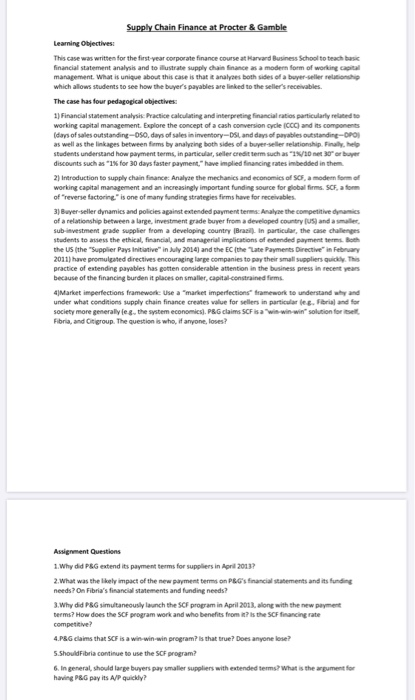
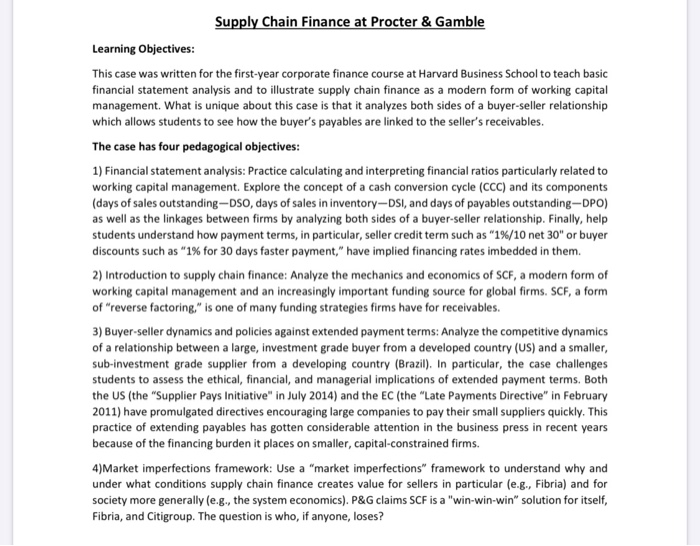
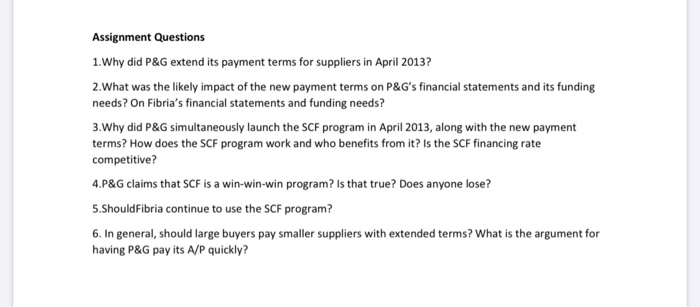
Supply Chain Finance at Procter & Gamble Learning Objectives: This case was written for the first-year corporate finance course at Harvard Business School to teach basic financial statement analysis and to illustrate supply chain finance as a modern form of working at management. What is unique about this case is that it analyzes both sides of a buyer- lerreth which allows students to see how the buyer's payables are linked to the seller's receivables. The case has four pedagogical objectives 1) Financial statement analysis. Practice calculating and interpreting financial ratios particularly related to working capital management. Explore the concept of a cash conversion cycle ICCC) and its components Idays of sales outstanding-oso. days of sales in inventory-DSL and days of payables outstanding-OPO as well as the linkages between firms by analyzing both sides of a buyen-seller relationship. Finally.help students understand how payment terms, in particular,seller credit term such as "18/10 et 30 or buyer discounts such as "1% for 30 days faster payment." have implied financing rates imbedded in them 2) Introduction to supply chain finance Analyze the mechanics and economies of SCF, a modern forma working capital management and an increasingly important funding source for global firms. SCF, a form of "reverve factoring is one of many funding strategies firms have for receivables 3) Buyer-seller dynamics and policies against extended payment terms Analyze the competitive dynamics of a relationship between a large, investment grade buyer from a developed country (US) and a smaller sub investment grade supplier from a developing country Ball in particular, the case challenges students to assess the ethical, financial and managerial implications of extended payment term. Both the US (the "Supplier Pays initiative in July 2014) and the EC (the late Payments Directive in February 2011) have promulgated directives encouraging large companies to pay their small suppliers quickly. This practice of extending payables has gotten considerable attention in the business press in recent years because of the financing burden it places on smaller, capital-constrained firms. 4Market imperfections framework Use a market imperfections framework to understand why and under what conditions supply chain finance creates value for sellers in particulare. Fibriland for society more generally eg. the system economics, PBG claims SCF wiwin win solution for Fibria, and Citigroup. The question is who, if anyone, loses? Assignment Questions 1. Why did PSG extend its payment terms for suppliers in April 2013? 2. What was the likely impact of the new payment terms on PBG's financial statements and its funding needs? On Fibria's financial statements and funding needs? 3. Why did PRG simultaneously launch the SCF program in April 2013. along with the new payment terms? How does the SCF program work and who benefits from the SCF financing rate competitive? 4.P&G claims that SCF is a win-win-win program is that true? Does anyone lose? 5.ShouldFibria continue to use the SCF program? 6. In general, should large buyers pay smaller suppliers with extended terms? What is the argument for having P&G pay its A/P quickly? Supply Chain Finance at Procter & Gamble Learning Objectives: This case was written for the first-year corporate finance course at Harvard Business School to teach basic financial statement analysis and to illustrate supply chain finance as a modern form of working capital management. What is unique about this case is that it analyzes both sides of a buyer-seller relationship which allows students to see how the buyer's payables are linked to the seller's receivables. The case has four pedagogical objectives: 1) Financial statement analysis: Practice calculating and interpreting financial ratios particularly related to working capital management. Explore the concept of a cash conversion cycle (CCC) and its components (days of sales outstanding-DSO, days of sales in inventory-DSI, and days of payables outstanding-DPO) as well as the linkages between firms by analyzing both sides of a buyer-seller relationship. Finally, help students understand how payment terms, in particular, seller credit term such as "1%/10 net 30" or buyer discounts such as "1% for 30 days faster payment," have implied financing rates imbedded in them. 2) Introduction to supply chain finance: Analyze the mechanics and economics of SCF, a modern form of working capital management and an increasingly important funding source for global firms. SCF, a form of "reverse factoring." is one of many funding strategies firms have for receivables. 3) Buyer-seller dynamics and policies against extended payment terms: Analyze the competitive dynamics of a relationship between a large, investment grade buyer from a developed country (US) and a smaller, sub-investment grade supplier from a developing country (Brazil). In particular, the case challenges students to assess the ethical, financial, and managerial implications of extended payment terms. Both the US (the "Supplier Pays Initiative" in July 2014) and the EC (the "Late Payments Directive" in February 2011) have promulgated directives encouraging large companies to pay their small suppliers quickly. This practice of extending payables has gotten considerable attention in the business press in recent years because of the financing burden it places on smaller, capital-constrained firms. 4)Market imperfections framework: Use a "market imperfections" framework to understand why and under what conditions supply chain finance creates value for sellers in particular (e.g., Fibria) and for society more generally (eg, the system economics). P&G claims SCF is a "win-win-win" solution for itself, Fibria, and Citigroup. The question is who, if anyone, loses? Assignment Questions 1. Why did P&G extend its payment terms for suppliers in April 2013? 2. What was the likely impact of the new payment terms on P&G's financial statements and its funding needs? On Fibria's financial statements and funding needs? 3. Why did P&G simultaneously launch the SCF program in April 2013, along with the new payment terms? How does the SCF program work and who benefits from it? Is the SCF financing rate competitive? 4.P&G claims that SCF is a win-win-win program? is that true? Does anyone lose? 5.ShouldFibria continue to use the SCF program? 6. In general, should large buyers pay smaller suppliers with extended terms? What is the argument for having P&G pay its A/P quickly? Supply Chain Finance at Procter & Gamble Learning Objectives: This case was written for the first-year corporate finance course at Harvard Business School to teach basic financial statement analysis and to illustrate supply chain finance as a modern form of working at management. What is unique about this case is that it analyzes both sides of a buyer- lerreth which allows students to see how the buyer's payables are linked to the seller's receivables. The case has four pedagogical objectives 1) Financial statement analysis. Practice calculating and interpreting financial ratios particularly related to working capital management. Explore the concept of a cash conversion cycle ICCC) and its components Idays of sales outstanding-oso. days of sales in inventory-DSL and days of payables outstanding-OPO as well as the linkages between firms by analyzing both sides of a buyen-seller relationship. Finally.help students understand how payment terms, in particular,seller credit term such as "18/10 et 30 or buyer discounts such as "1% for 30 days faster payment." have implied financing rates imbedded in them 2) Introduction to supply chain finance Analyze the mechanics and economies of SCF, a modern forma working capital management and an increasingly important funding source for global firms. SCF, a form of "reverve factoring is one of many funding strategies firms have for receivables 3) Buyer-seller dynamics and policies against extended payment terms Analyze the competitive dynamics of a relationship between a large, investment grade buyer from a developed country (US) and a smaller sub investment grade supplier from a developing country Ball in particular, the case challenges students to assess the ethical, financial and managerial implications of extended payment term. Both the US (the "Supplier Pays initiative in July 2014) and the EC (the late Payments Directive in February 2011) have promulgated directives encouraging large companies to pay their small suppliers quickly. This practice of extending payables has gotten considerable attention in the business press in recent years because of the financing burden it places on smaller, capital-constrained firms. 4Market imperfections framework Use a market imperfections framework to understand why and under what conditions supply chain finance creates value for sellers in particulare. Fibriland for society more generally eg. the system economics, PBG claims SCF wiwin win solution for Fibria, and Citigroup. The question is who, if anyone, loses? Assignment Questions 1. Why did PSG extend its payment terms for suppliers in April 2013? 2. What was the likely impact of the new payment terms on PBG's financial statements and its funding needs? On Fibria's financial statements and funding needs? 3. Why did PRG simultaneously launch the SCF program in April 2013. along with the new payment terms? How does the SCF program work and who benefits from the SCF financing rate competitive? 4.P&G claims that SCF is a win-win-win program is that true? Does anyone lose? 5.ShouldFibria continue to use the SCF program? 6. In general, should large buyers pay smaller suppliers with extended terms? What is the argument for having P&G pay its A/P quickly? Supply Chain Finance at Procter & Gamble Learning Objectives: This case was written for the first-year corporate finance course at Harvard Business School to teach basic financial statement analysis and to illustrate supply chain finance as a modern form of working capital management. What is unique about this case is that it analyzes both sides of a buyer-seller relationship which allows students to see how the buyer's payables are linked to the seller's receivables. The case has four pedagogical objectives: 1) Financial statement analysis: Practice calculating and interpreting financial ratios particularly related to working capital management. Explore the concept of a cash conversion cycle (CCC) and its components (days of sales outstanding-DSO, days of sales in inventory-DSI, and days of payables outstanding-DPO) as well as the linkages between firms by analyzing both sides of a buyer-seller relationship. Finally, help students understand how payment terms, in particular, seller credit term such as "1%/10 net 30" or buyer discounts such as "1% for 30 days faster payment," have implied financing rates imbedded in them. 2) Introduction to supply chain finance: Analyze the mechanics and economics of SCF, a modern form of working capital management and an increasingly important funding source for global firms. SCF, a form of "reverse factoring." is one of many funding strategies firms have for receivables. 3) Buyer-seller dynamics and policies against extended payment terms: Analyze the competitive dynamics of a relationship between a large, investment grade buyer from a developed country (US) and a smaller, sub-investment grade supplier from a developing country (Brazil). In particular, the case challenges students to assess the ethical, financial, and managerial implications of extended payment terms. Both the US (the "Supplier Pays Initiative" in July 2014) and the EC (the "Late Payments Directive" in February 2011) have promulgated directives encouraging large companies to pay their small suppliers quickly. This practice of extending payables has gotten considerable attention in the business press in recent years because of the financing burden it places on smaller, capital-constrained firms. 4)Market imperfections framework: Use a "market imperfections" framework to understand why and under what conditions supply chain finance creates value for sellers in particular (e.g., Fibria) and for society more generally (eg, the system economics). P&G claims SCF is a "win-win-win" solution for itself, Fibria, and Citigroup. The question is who, if anyone, loses? Assignment Questions 1. Why did P&G extend its payment terms for suppliers in April 2013? 2. What was the likely impact of the new payment terms on P&G's financial statements and its funding needs? On Fibria's financial statements and funding needs? 3. Why did P&G simultaneously launch the SCF program in April 2013, along with the new payment terms? How does the SCF program work and who benefits from it? Is the SCF financing rate competitive? 4.P&G claims that SCF is a win-win-win program? is that true? Does anyone lose? 5.ShouldFibria continue to use the SCF program? 6. In general, should large buyers pay smaller suppliers with extended terms? What is the argument for having P&G pay its A/P quickly









 Study Help