







Question: Suppose A = (an) = (a, A2, A3, ...) is an increasing sequence of positive integers. A number c is called A-expressible if c
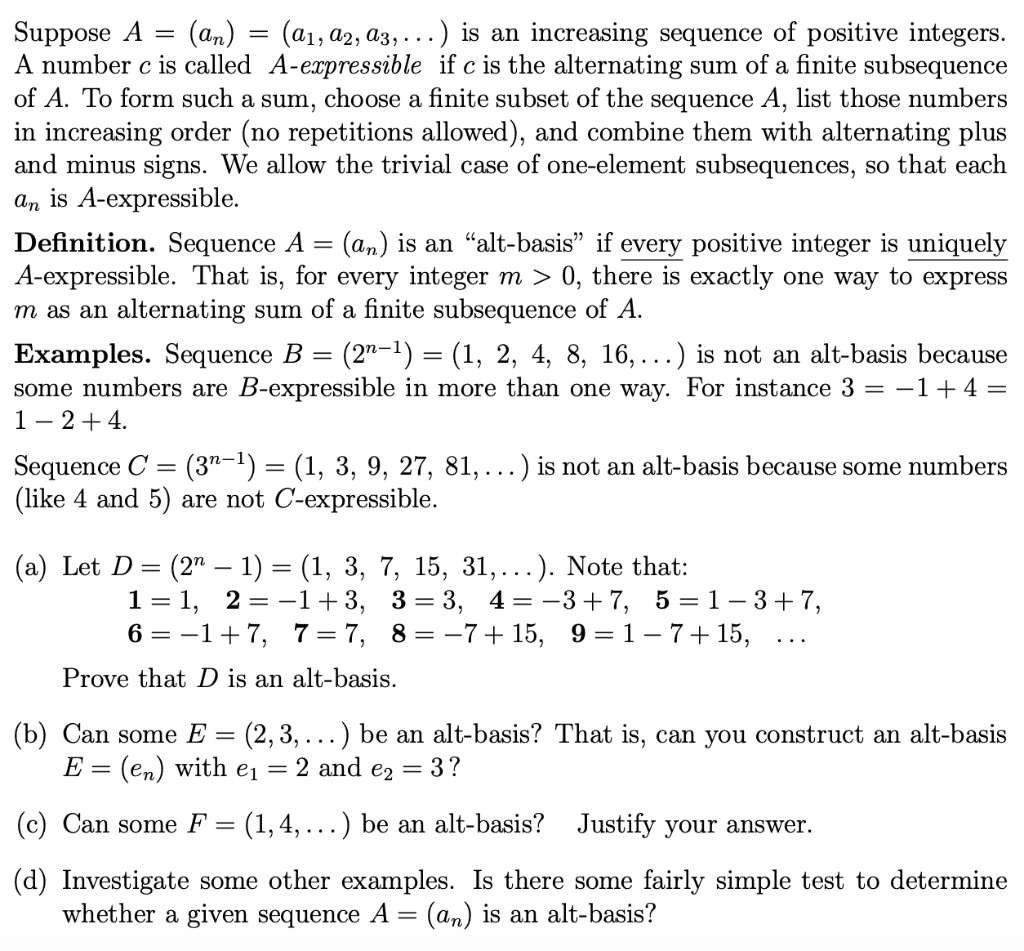
Suppose A = (an) = (a, A2, A3, ...) is an increasing sequence of positive integers. A number c is called A-expressible if c is the alternating sum of a finite subsequence of A. To form such a sum, choose a finite subset of the sequence A, list those numbers in increasing order (no repetitions allowed), and combine them with alternating plus and minus signs. We allow the trivial case of one-element subsequences, so that each an is A-expressible. Definition. Sequence A = (an) is an "alt-basis" if every positive integer is uniquely A-expressible. That is, for every integer m > 0, there is exactly one way to express m as an alternating sum of a finite subsequence of A. Examples. Sequence B = (2n-) = (1, 2, 4, 8, 16,...) is not an alt-basis because some numbers are B-expressible in more than one way. For instance 3 = 1+4= 1-2 +4. Sequence C = (3) = (1, 3, 9, 27, 81, ...) is not an alt-basis because some numbers (like 4 and 5) are not C-expressible. (a) Let D = (2n 1) = (1, 3, 7, 15, 31,...). Note that: 1=1, 2 = 1+3, 3=3, 4= 3+7, 5=1-3+7, 6 = 1+7, 7= 7, 8=7+15, 9=1-7 +15, Prove that D is an alt-basis. (b) Can some E = = (2, 3, ...) be an alt-basis? That is, can you construct an alt-basis E = (en) with e = 2 and e = 3? (1,4,...) be an alt-basis? Justify your answer. (d) Investigate some other examples. Is there some fairly simple test to determine whether a given sequence A (an) is an alt-basis? = (c) Can some F =
Step by Step Solution
3.51 Rating (151 Votes )
There are 3 Steps involved in it
To tackle the problem we need to address each part methodically a Prove that D 2n 1 1 3 7 15 31 ldots is an altbasis Step 1 Understanding Alternating ... View full answer

Get step-by-step solutions from verified subject matter experts
 Study Help