







Question: Suppose A is a square matrix, and let A, A2, ..., A be distinct eigenvalues of A, with corresponding eigenvectors V1, V2, ... Vk.
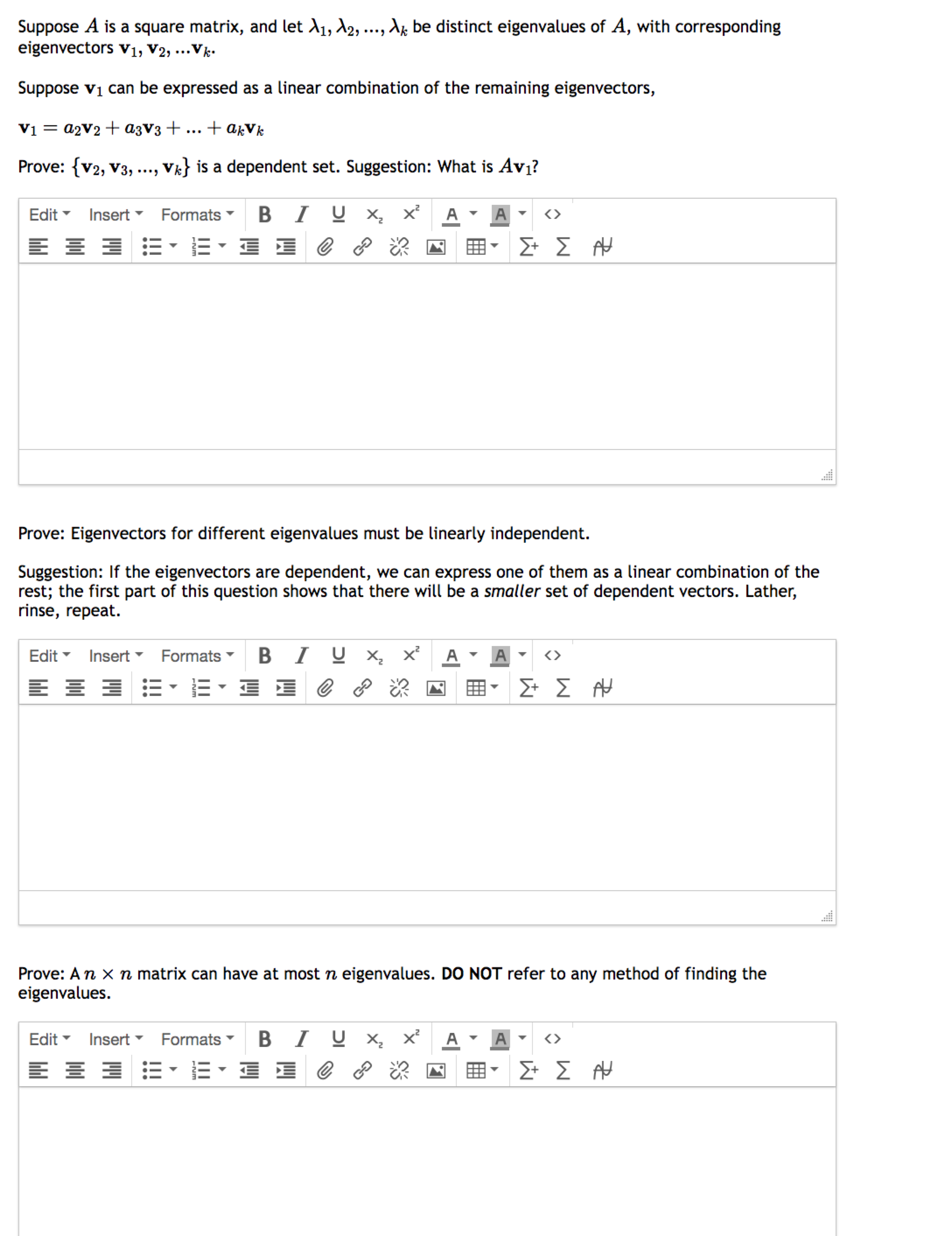
Suppose A is a square matrix, and let A, A2, ..., A be distinct eigenvalues of A, with corresponding eigenvectors V1, V2, ... Vk. Suppose v can be expressed as a linear combination of the remaining eigenvectors, V1 = A2V + A3V3 + + akvk Prove: {V2, V3, ..., Vk} is a dependent set. Suggestion: What is Av? Edit Insert Formats === 2 BIU x A A e Prove: Eigenvectors for different eigenvalues must be linearly independent. Suggestion: If the eigenvectors are dependent, we can express one of them as a linear combination of the rest; the first part of this question shows that there will be a smaller set of dependent vectors. Lather, rinse, repeat. Edit Insert Formats B I U X X A = = E II e A + Edit Insert Formats BIU X X A A == E Prove: An x n matrix can have at most n eigenvalues. DO NOT refer to any method of finding the eigenvalues. + At 3+3 iin.
Step by Step Solution
There are 3 Steps involved in it

Get step-by-step solutions from verified subject matter experts
 Study Help