







Question: Suppose a program segment consists of a purely sequential part which takes 25 cycles to execute, and an iterated loop which takes 100 cycles per
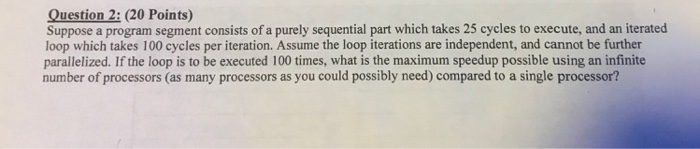
Question 2: (20 Points) Suppose a program segment consists of a purely sequential part which takes 25 cycles to execute, and an iterated loop which takes 100 cycles per iteration. Assume the loop iterations are independent, and cannot be further parallelized. If the loop is to be executed 100 times, what is the maximum speedup possible using an infinite number of processors (as many processors as you could possibly need) compared to a single processor? Question 2: (20 Points) Suppose a program segment consists of a purely sequential part which takes 25 cycles to execute, and an iterated loop which takes 100 cycles per iteration. Assume the loop iterations are independent, and cannot be further parallelized. If the loop is to be executed 100 times, what is the maximum speedup possible using an infinite number of processors (as many processors as you could possibly need) compared to a single processor
Step by Step Solution
There are 3 Steps involved in it

Get step-by-step solutions from verified subject matter experts
 Study Help