







Question: Suppose a worker's skill is captured by his efficiency units of labor. The distribution of efficiency units in the population is such that worker 1
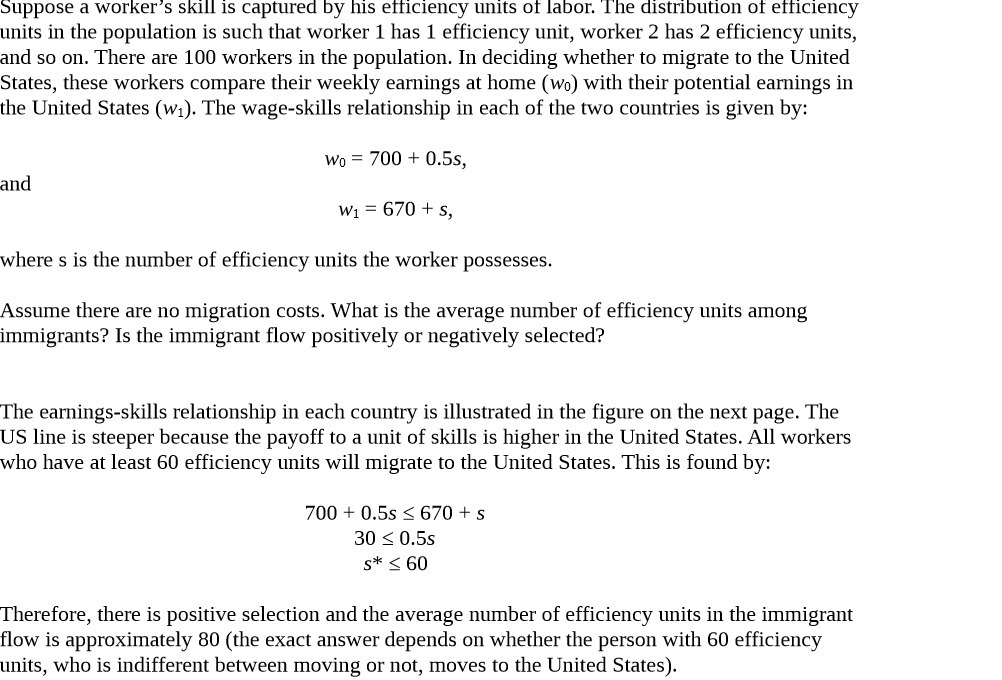
Suppose a worker's skill is captured by his efficiency units of labor. The distribution of efficiency units in the population is such that worker 1 has 1 efficiency unit, worker 2 has 2 efficiency units, and so on. There are 100 workers in the population. In deciding whether to migrate to the United States, these workers compare their weekly earnings at home (We) with their potential earnings in the United States (W1). The wage-skills relationship in each of the two countries is given by: We = 700 + 0.55, and M = 670 + s, where s is the number of efficiency units the worker possesses. Assume there are no migration costs. What is the average number of efficiency units among immigrants? Is the immigrant flow positively or negatively selected? The earnings-skills relationship in each country is illustrated in the gure on the next page. The US line is steeper because the payoff to a unit of skills is higher in the United States. All workers who have at least 60 efficiency units will migrate to the United States. This is found by: 700 + 0.55 S 670 + s 30 S 0.55 5* S 50 Therefore, there is positive selection and the average number of efficiency units in the immigrant flow is approximately 80 (the exact answer depends on whether the person with 50 efciency units, who is indifferent between moving or not, moves to the United States)
Step by Step Solution
There are 3 Steps involved in it

Get step-by-step solutions from verified subject matter experts
 Study Help