







Question: 1. Suppose a worker's utility function is u(c, l) = ln c + (1 a) In where: a. c is consumption b. is leisure
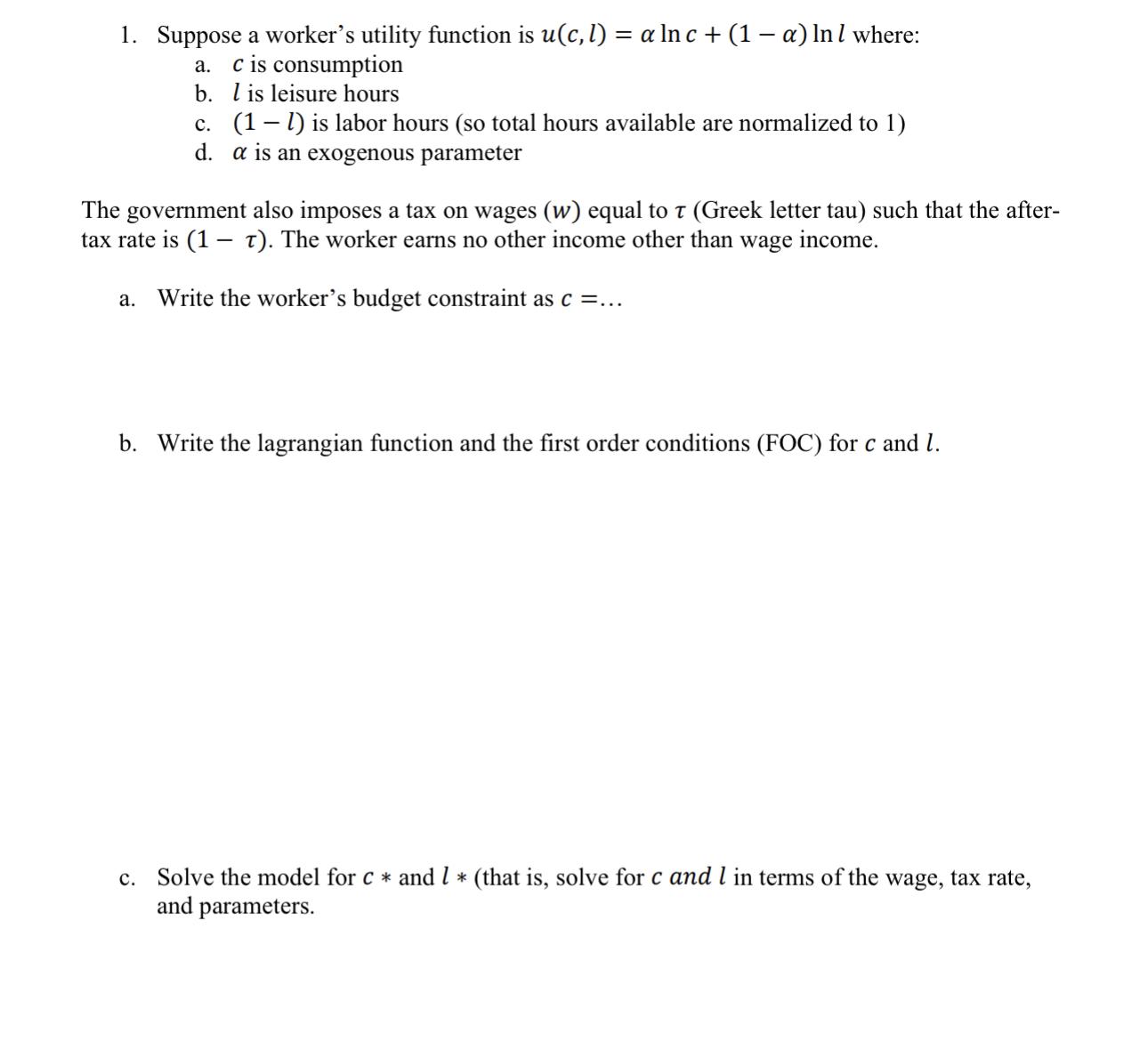
1. Suppose a worker's utility function is u(c, l) = ln c + (1 a) In where: a. c is consumption b. is leisure hours c. (1) is labor hours (so total hours available are normalized to 1) d. a is an exogenous parameter The government also imposes a tax on wages (w) equal to 7 (Greek letter tau) such that the after- tax rate is (17). The worker earns no other income other than wage income. a. Write the worker's budget constraint as c =... b. Write the lagrangian function and the first order conditions (FOC) for c and l. c. Solve the model for c * and l * (that is, solve for c and I in terms of the wage, tax rate, and parameters.
Step by Step Solution
There are 3 Steps involved in it

Get step-by-step solutions from verified subject matter experts
 Study Help