







Question: Suppose after running a breadth-first search on a directed graph starting from node i we found that index j of the seen array was False.
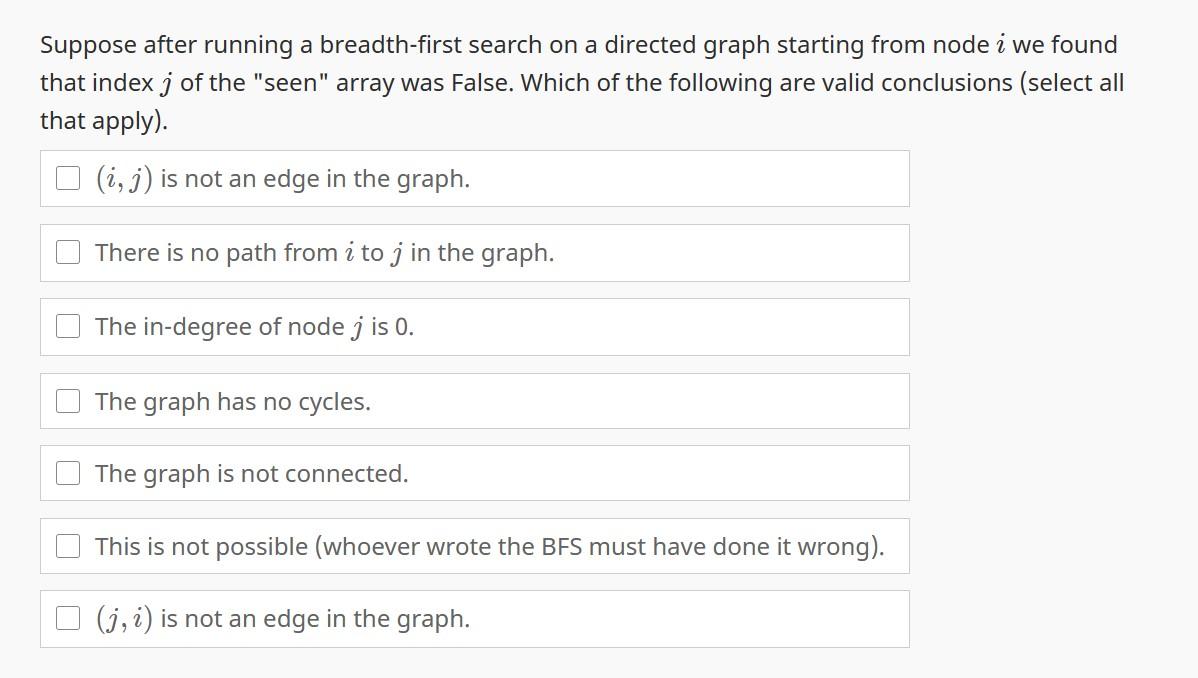
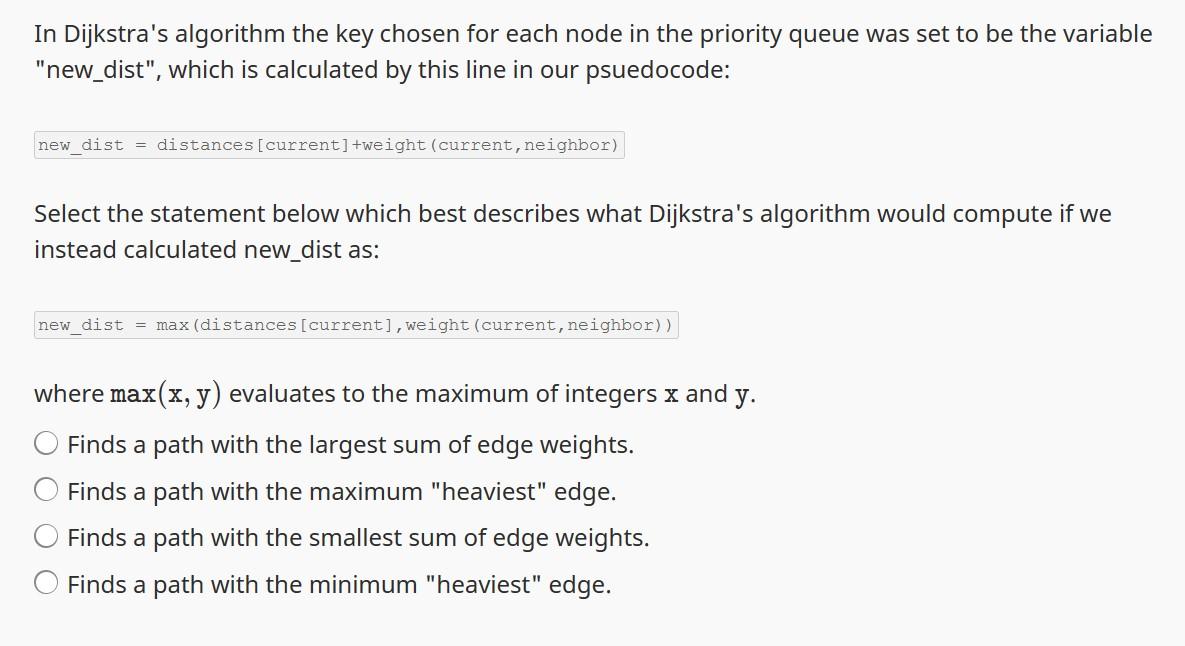
Suppose after running a breadth-first search on a directed graph starting from node i we found that index j of the "seen" array was False. Which of the following are valid conclusions (select all that apply). (i,j) is not an edge in the graph. There is no path from i to j in the graph. The in-degree of node j is 0 . The graph has no cycles. The graph is not connected. (j,i) is not an edge in the graph. In Dijkstra's algorithm the key chosen for each node in the priority queue was set to be the variable "new_dist", which is calculated by this line in our psuedocode: Select the statement below which best describes what Dijkstra's algorithm would compute if we instead calculated new_dist as: where max(x,y) evaluates to the maximum of integers x and y. Finds a path with the largest sum of edge weights. Finds a path with the maximum "heaviest" edge. Finds a path with the smallest sum of edge weights. Finds a path with the minimum "heaviest" edge
Step by Step Solution
There are 3 Steps involved in it

Get step-by-step solutions from verified subject matter experts
 Study Help