







Question: Suppose an individual has a preference represented by the utility function U(X, X) = X + InX. The individual consumes two goods, X, and
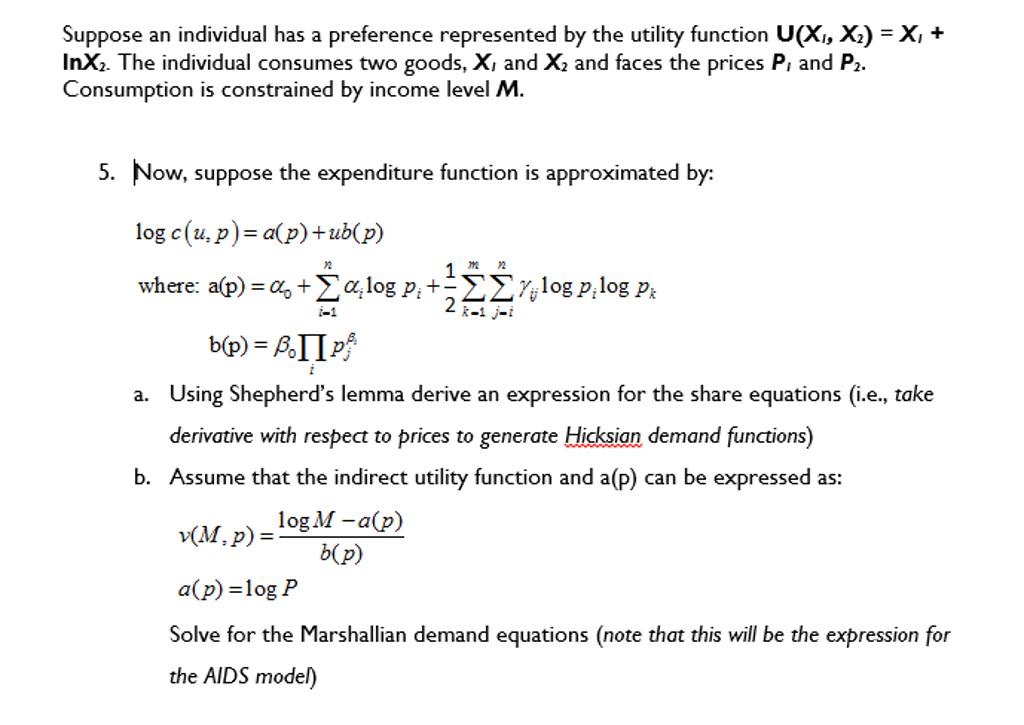
Suppose an individual has a preference represented by the utility function U(X, X) = X + InX. The individual consumes two goods, X, and X and faces the prices P, and P2. Consumption is constrained by income level M. 5. Now, suppose the expenditure function is approximated by: log c(u, p)= a(p) + ub(p) 1 m where: a(p) = a + alog p + Zlog pilog P Pi 2 k-1 j-i 22 b(p) = P.P i v(M, p) = a. Using Shepherd's lemma derive an expression for the share equations (i.e., take derivative with respect to prices to generate Hicksian demand functions) b. Assume that the indirect utility function and a(p) can be expressed as: 22 log M-a(p) b(p) a(p) = log P Solve for the Marshallian demand equations (note that this will be the expression for the AIDS model)
Step by Step Solution
3.51 Rating (158 Votes )
There are 3 Steps involved in it

Get step-by-step solutions from verified subject matter experts
 Study Help