



Question: Suppose an individual has a single period utility function represented by: U zihi Suppose further that the individual is deciding what to eat for dinner.
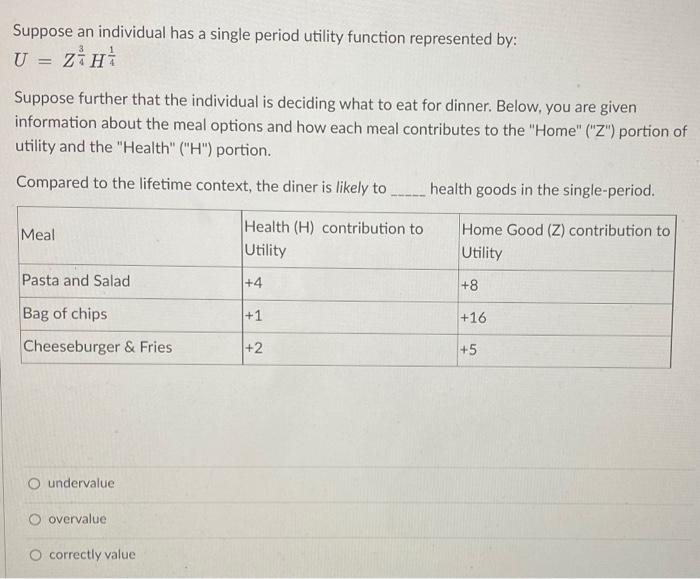
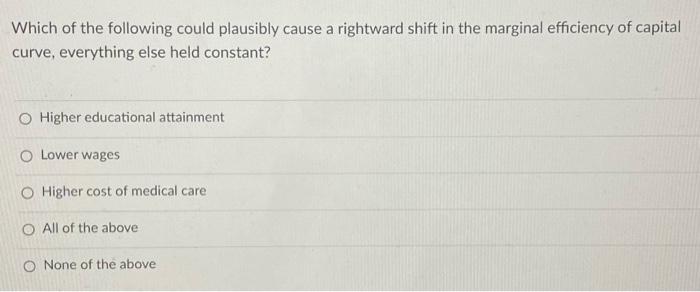
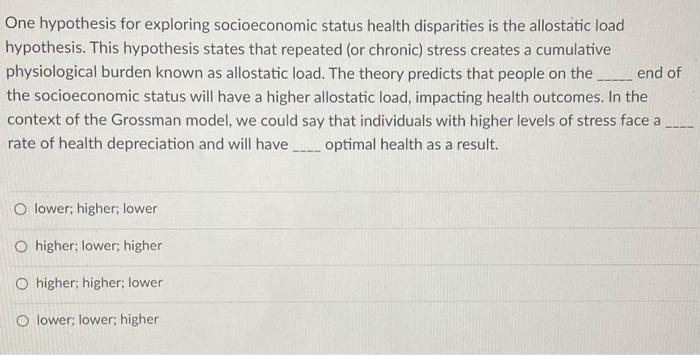
Suppose an individual has a single period utility function represented by: U zihi Suppose further that the individual is deciding what to eat for dinner. Below, you are given information about the meal options and how each meal contributes to the "Home" ("Z") portion of utility and the "Health" ("H") portion. Compared to the lifetime context, the diner is likely to health goods in the single-period. Meal Health (H) contribution to Utility Home Good (Z) contribution to Utility Pasta and Salad +4 +8 +1 +16 Bag of chips Cheeseburger & Fries +2 +5 O undervalue overvalue O correctly value Which of the following could plausibly cause a rightward shift in the marginal efficiency of capital curve, everything else held constant? O Higher educational attainment O Lower wages O Higher cost of medical care O All of the above O None of the above One hypothesis for exploring socioeconomic status health disparities is the allostatic load hypothesis. This hypothesis states that repeated (or chronic) stress creates a cumulative physiological burden known as allostatic load. The theory predicts that people on the end of the socioeconomic status will have a higher allostatic load, impacting health outcomes. In the context of the Grossman model, we could say that individuals with higher levels of stress face a rate of health depreciation and will have ___ optimal health as a result. O lower; higher; lower O higher; lower; higher O higher; higher; lower O lower; lower; higher
Step by Step Solution
There are 3 Steps involved in it

Get step-by-step solutions from verified subject matter experts