







Question: Suppose an individual has the following utility function defined over wealth: u(w) = w. The individual has an initial wealth level of $20,000. a. The
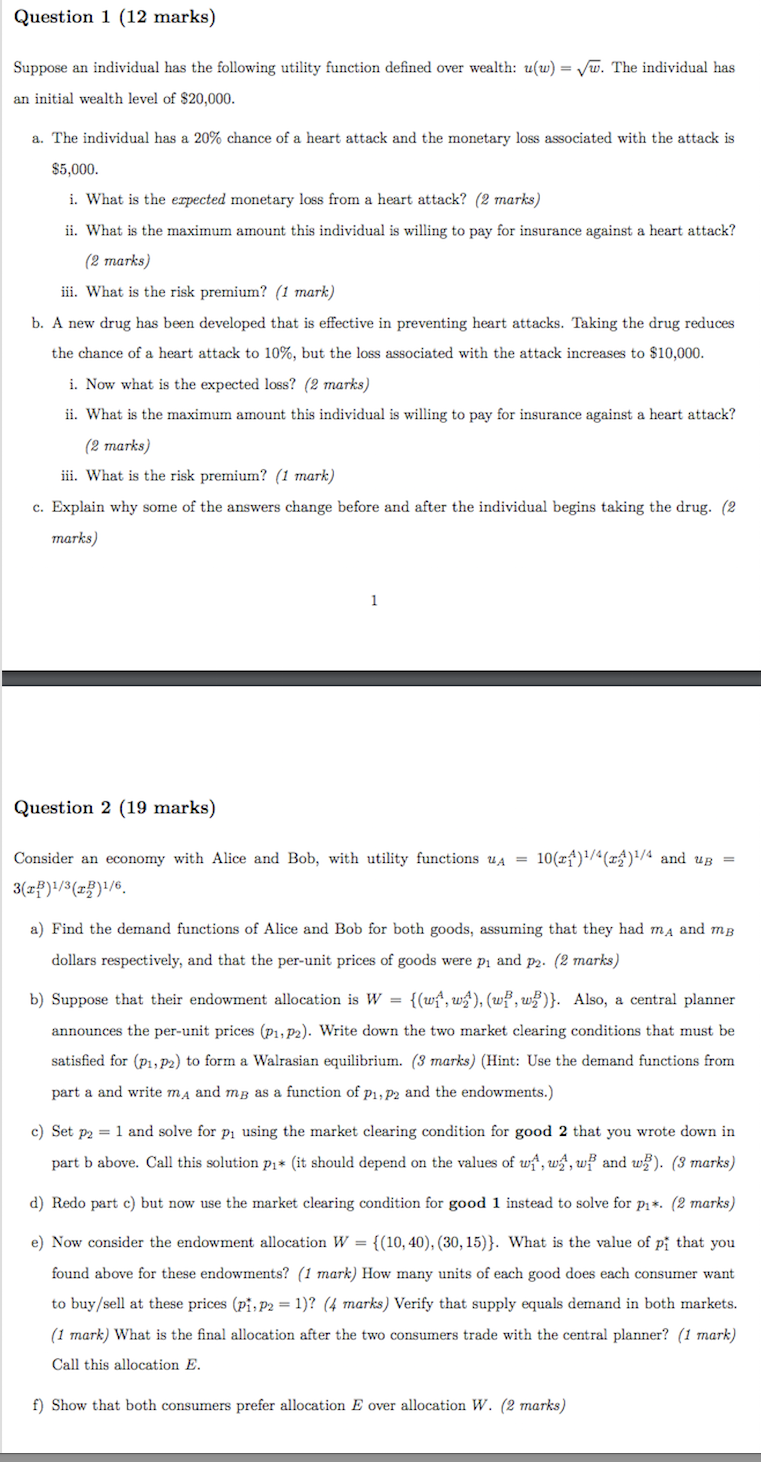
Suppose an individual has the following utility function defined over wealth: u(w) = w. The individual has an initial wealth level of $20,000. a. The individual has a 20% chance of a heart attack and the monetary loss associated with the attack is $5,000. i. What is the expected monetary loss from a heart attack? (2 marks) ii. What is the maximum amount this individual is willing to pay for insurance against a heart attack? (2 marks) iii. What is the risk premium? (1 mark) b. A new drug has been developed that is effective in preventing heart attacks. Taking the drug reduces the chance of a heart attack to 10%, but the loss associated with the attack increases to $10,000. i. Now what is the expected loss? (2 marks) ii. What is the maximum amount this individual is willing to pay for insurance against a heart attack? (2 marks) iii. What is the risk premium? (1 mark) c. Explain why some of the answers change before and after the individual begins taking the drug. (2 marks) 1 Question 2 (19 marks) Consider an economy with Alice and Bob, with utility functions uA = 10(x A 1 ) 1/4 (x A 2 ) 1/4 and uB = 3(x B 1 ) 1/3 (x B 2 ) 1/6 . a) Find the demand functions of Alice and Bob for both goods, assuming that they had mA and mB dollars respectively, and that the per-unit prices of goods were p1 and p2. (2 marks) b) Suppose that their endowment allocation is W = {(w A 1 , wA 2 ),(w B 1 , wB 2 )}. Also, a central planner announces the per-unit prices (p1, p2). Write down the two market clearing conditions that must be satisfied for (p1, p2) to form a Walrasian equilibrium. (3 marks) (Hint: Use the demand functions from part a and write mA and mB as a function of p1, p2 and the endowments.) c) Set p2 = 1 and solve for p1 using the market clearing condition for good 2 that you wrote down in part b above. Call this solution p1 (it should depend on the values of w A 1 , wA 2 , wB 1 and w B 2 ). (3 marks) d) Redo part c) but now use the market clearing condition for good 1 instead to solve for p1. (2 marks) e) Now consider the endowment allocation W = {(10, 40),(30, 15)}. What is the value of p 1 that you found above for these endowments? (1 mark) How many units of each good does each consumer want to buy/sell at these prices (p 1 , p2 = 1)? (4 marks) Verify that supply equals demand in both markets. (1 mark) What is the final allocation after the two consumers trade with the central planner? (1 mark) Call this allocation E. f) Show that both consumers prefer allocation E over allocation W. (2 marks
Question 1 (12 marks) Suppose an individual has the following utility function defined over wealth: u(w) = \w. The individual has an initial wealth level of $20,000. a. The individual has a 20% chance of a heart attack and the monetary loss associated with the attack is $5,000. i. What is the erpected monetary loss from a heart attack? (2 marks) ii. What is the maximum amount this individual is willing to pay for insurance against a heart attack? (2 marks) iii. What is the risk premium? (1 mark) b. A new drug has been developed that is effective in preventing heart attacks. Taking the drug reduces the chance of a heart attack to 10%, but the loss associated with the attack increases to $10,000. i. Now what is the expected loss? (2 marks) ii. What is the maximum amount this individual is willing to pay for insurance against a heart attack? (2 marks) iii. What is the risk premium? (1 mark) c. Explain why some of the answers change before and after the individual begins taking the drug. (2 marks) Question 2 (19 marks) Consider an economy with Alice and Bob, with utility functions uA = 10(21)1/(24)1/4 and us = 3(25)1/3()1/6 a) Find the demand functions of Alice and Bob for both goods, assuming that they had mA and me dollars respectively, and that the per-unit prices of goods were p and P2. (2 marks) b) Suppose that their endowment allocation is W = {(w1, 4), ( w w })}. Also, a central planner announces the per-unit prices (P1, P2). Write down the two market clearing conditions that must be satisfied for (P1, P2) to form a Walrasian equilibrium. (3 marks) (Hint: Use the demand functions from part a and write mA and me as a function of P1, P2 and the endowments.) c) Set P2 = 1 and solve for P using the market clearing condition for good 2 that you wrote down in part b above. Call this solution P1* (it should depend on the values of w1, w, w and w). (3 marks) d) Redo part c) but now use the market clearing condition for good 1 instead to solve for P1*. (2 marks) e) Now consider the endowment allocation W = {(10,40), (30,15)}. What is the value of pi that you found above for these endowments? (1 mark) How many units of each good does each consumer want to buy sell at these prices (Pi P2 = 1)? (4 marks) Verify that supply equals demand in both markets. (1 mark) What is the final allocation after the two consumers trade with the central planner? (1 mark) Call this allocation E. f) Show that both consumers prefer allocation E over allocation W. (2 marks) Question 1 (12 marks) Suppose an individual has the following utility function defined over wealth: u(w) = \w. The individual has an initial wealth level of $20,000. a. The individual has a 20% chance of a heart attack and the monetary loss associated with the attack is $5,000. i. What is the erpected monetary loss from a heart attack? (2 marks) ii. What is the maximum amount this individual is willing to pay for insurance against a heart attack? (2 marks) iii. What is the risk premium? (1 mark) b. A new drug has been developed that is effective in preventing heart attacks. Taking the drug reduces the chance of a heart attack to 10%, but the loss associated with the attack increases to $10,000. i. Now what is the expected loss? (2 marks) ii. What is the maximum amount this individual is willing to pay for insurance against a heart attack? (2 marks) iii. What is the risk premium? (1 mark) c. Explain why some of the answers change before and after the individual begins taking the drug. (2 marks) Question 2 (19 marks) Consider an economy with Alice and Bob, with utility functions uA = 10(21)1/(24)1/4 and us = 3(25)1/3()1/6 a) Find the demand functions of Alice and Bob for both goods, assuming that they had mA and me dollars respectively, and that the per-unit prices of goods were p and P2. (2 marks) b) Suppose that their endowment allocation is W = {(w1, 4), ( w w })}. Also, a central planner announces the per-unit prices (P1, P2). Write down the two market clearing conditions that must be satisfied for (P1, P2) to form a Walrasian equilibrium. (3 marks) (Hint: Use the demand functions from part a and write mA and me as a function of P1, P2 and the endowments.) c) Set P2 = 1 and solve for P using the market clearing condition for good 2 that you wrote down in part b above. Call this solution P1* (it should depend on the values of w1, w, w and w). (3 marks) d) Redo part c) but now use the market clearing condition for good 1 instead to solve for P1*. (2 marks) e) Now consider the endowment allocation W = {(10,40), (30,15)}. What is the value of pi that you found above for these endowments? (1 mark) How many units of each good does each consumer want to buy sell at these prices (Pi P2 = 1)? (4 marks) Verify that supply equals demand in both markets. (1 mark) What is the final allocation after the two consumers trade with the central planner? (1 mark) Call this allocation E. f) Show that both consumers prefer allocation E over allocation W. (2 marks)
Step by Step Solution
There are 3 Steps involved in it

Get step-by-step solutions from verified subject matter experts
 Study Help