







Question: Suppose at birth, every human being is given a fixed number of heartbeats, and once these heartbeats are used up , life ends. How should
Suppose at birth, every human being is given a fixed number of heartbeats, and
once these heartbeats are used up life ends. How should one optimally use these
heartbeats to have a life as long as possible? It is tempting to suggest that one is
better off staying in bed and resting, to maintain a low heartbeat. However, the
science of good health does point to the fact that a trained heart beats more slowly
when the person is at rest. On this note, consistent exercising is not a bad idea.
Suppose that the untrained heart beats times per minute when a person is at rest,
and during exercise it beats times per minute. If a person exercises the fraction
of its time, the average heartbeats per minute is as follows:
To determine an appropriate function we can impose a requirement that
should be close to for small which means that hardly any exercise is done.
When approaches we assume to be close to meaning the person is well
conditioned. Let's assume a simple model for to be:
tion No continues on page
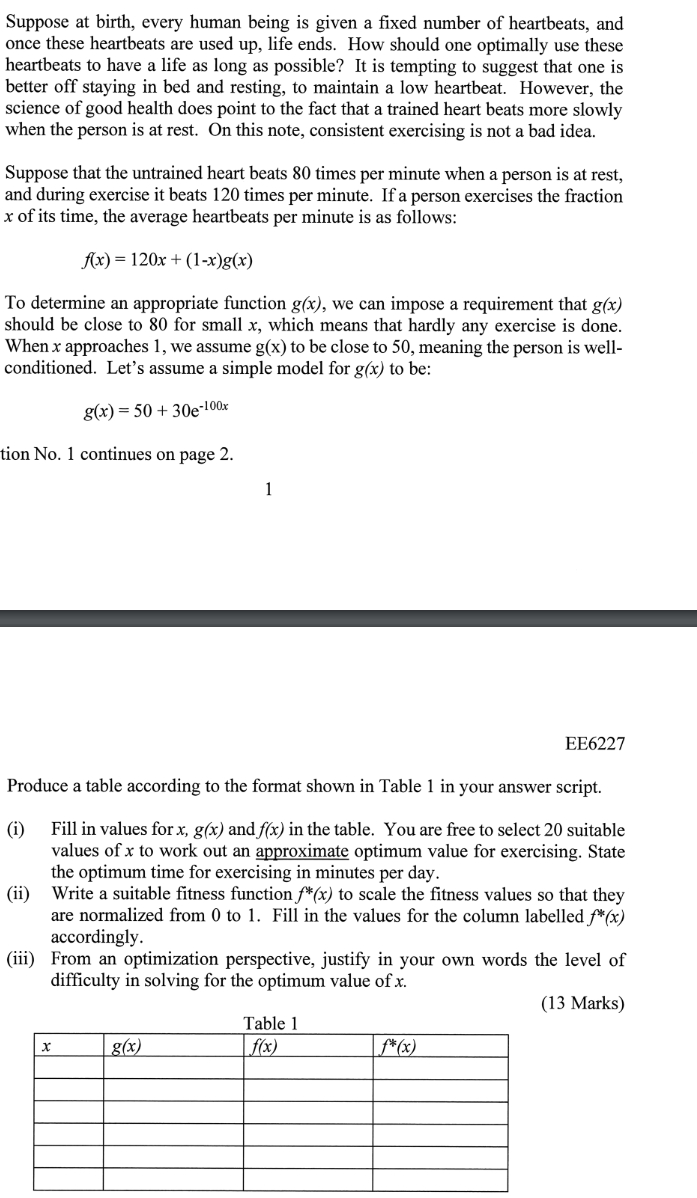
Produce a table according to the format shown in Table in your answer script.
i Fill in values for and in the table. You are free to select suitable
values of to work out an approximate optimum value for exercising. State
the optimum time for exercising in minutes per day.
ii Write a suitable fitness function to scale the fitness values so that they
are normalized from to Fill in the values for the column labelled
accordingly.
iii From an optimization perspective, justify in your own words the level of
difficulty in solving for the optimum value of
Marks
Table
Step by Step Solution
There are 3 Steps involved in it
1 Expert Approved Answer
Step: 1 Unlock

Question Has Been Solved by an Expert!
Get step-by-step solutions from verified subject matter experts
Step: 2 Unlock
Step: 3 Unlock
 Study Help