







Question: Suppose B = {b1, .., bn} if a basis for a vector space V, x is in V, and P = [b1 ... bn]. Which
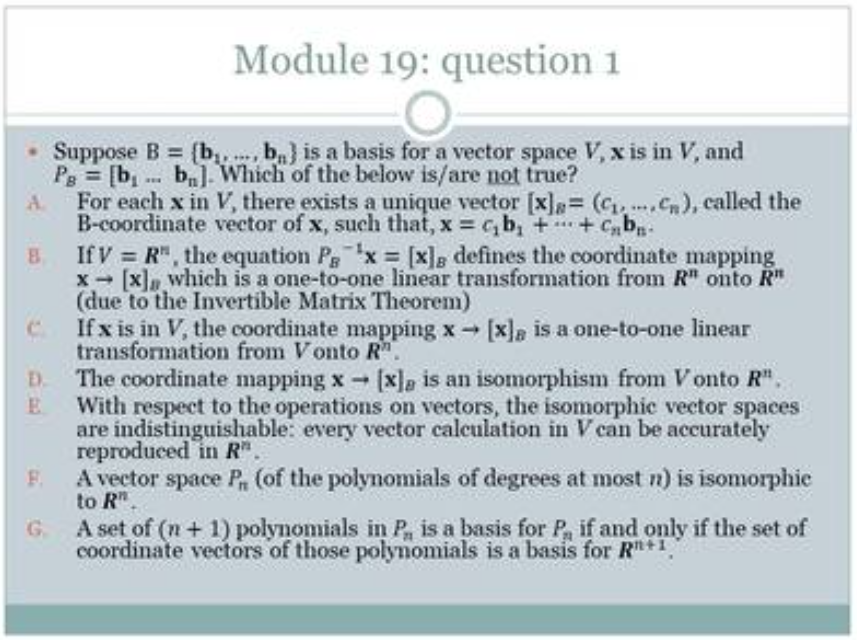
Suppose B = {b1, .., bn} if a basis for a vector space V, x is in V, and P = [b1 ... bn]. Which of the below is/are not true?
![space V, x is in V, and P = [b1 ... bn].](https://dsd5zvtm8ll6.cloudfront.net/si.experts.images/questions/2024/10/670a2d1e2e29d_158670a2d1e0d9f2.jpg)
Module 19: question 1 . Suppose B = (b, . ..., b.) is a basis for a vector space V, x is in V, and PB = [b, ... ba]. Which of the below is/ are not true? A For each x in V, there exists a unique vector [X],= (C,, ....Cn), called the B-coordinate vector of x, such that, x = q,b, to+ Cab. If V = R" , the equation PB 'x = [X]s defines the coordinate mapping x - [x]n which is a one-to-one linear transformation from R" onto R" (due to the Invertible Matrix Theorem) If x is in V, the coordinate mapping x - [x], is a one-to-one linear transformation from Vonto R". EX The coordinate mapping x - [x], is an isomorphism from Vonto R" With respect to the operations on vectors, the isomorphic vector spaces are indistinguishable: every vector calculation in V can be accurately reproduced in R". A vector space P. (of the polynomials of degrees at most n) is isomorphic to R. G. A set of (n + 1) polynomials in P., is a basis for P. if and only if the set of coordinate vectors of those polynomials is a basis for Riti\f
Step by Step Solution
There are 3 Steps involved in it

Get step-by-step solutions from verified subject matter experts
 Study Help