



Question: Suppose in a Solow model, we have the following parameter values: n = 0, s = 0.2, a = 0.33. There is no growth in
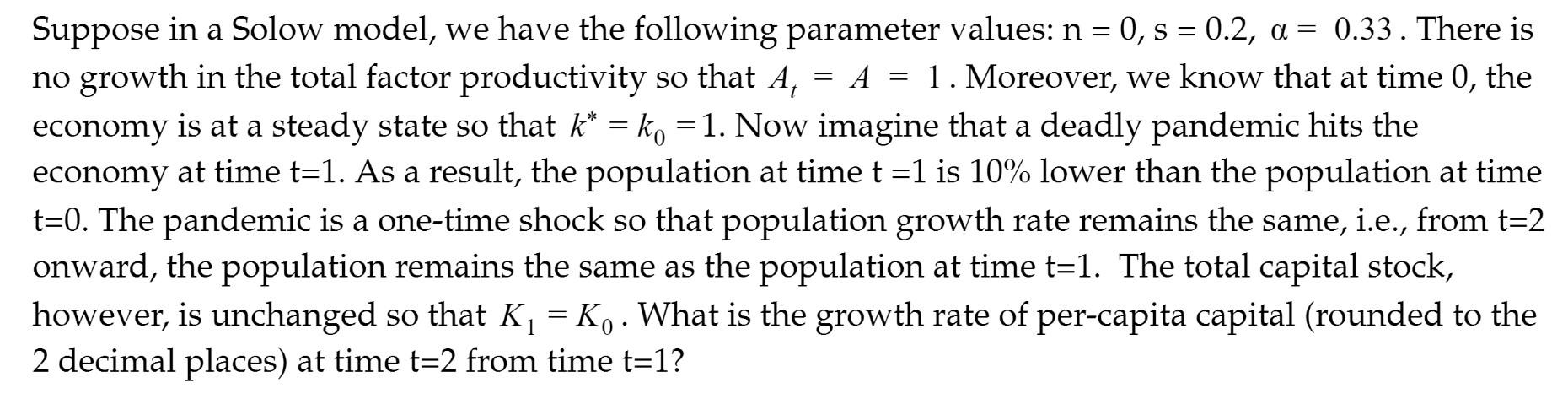
Suppose in a Solow model, we have the following parameter values: n = 0, s = 0.2, a = 0.33. There is no growth in the total factor productivity so that A, = A = 1. Moreover, we know that at time 0, the economy is at a steady state so that k* = ko = 1. Now imagine that a deadly pandemic hits the economy at time t=1. As a result, the population at time t =1 is 10% lower than the population at time t=0. The pandemic is a one-time shock so that population growth rate remains the same, i.e., from t=2 onward, the population remains the same as the population at time t=1. The total capital stock, however, is unchanged so that K = K. What is the growth rate of per-capita capital (rounded to the 2 decimal places) at time t=2 from time t=1? Suppose in a Solow model, we have the following parameter values: n = 0, s = 0.2, a = 0.33. There is no growth in the total factor productivity so that A, = A = 1. Moreover, we know that at time 0, the economy is at a steady state so that k* = ko = 1. Now imagine that a deadly pandemic hits the economy at time t=1. As a result, the population at time t =1 is 10% lower than the population at time t=0. The pandemic is a one-time shock so that population growth rate remains the same, i.e., from t=2 onward, the population remains the same as the population at time t=1. The total capital stock, however, is unchanged so that K = K. What is the growth rate of per-capita capital (rounded to the 2 decimal places) at time t=2 from time t=1
Step by Step Solution
There are 3 Steps involved in it

Get step-by-step solutions from verified subject matter experts