







Question: Suppose Jorge has two random variables, X and Y, where x = 3, 4, 5, 6, 7 and y = 2, 3, 4, 5,
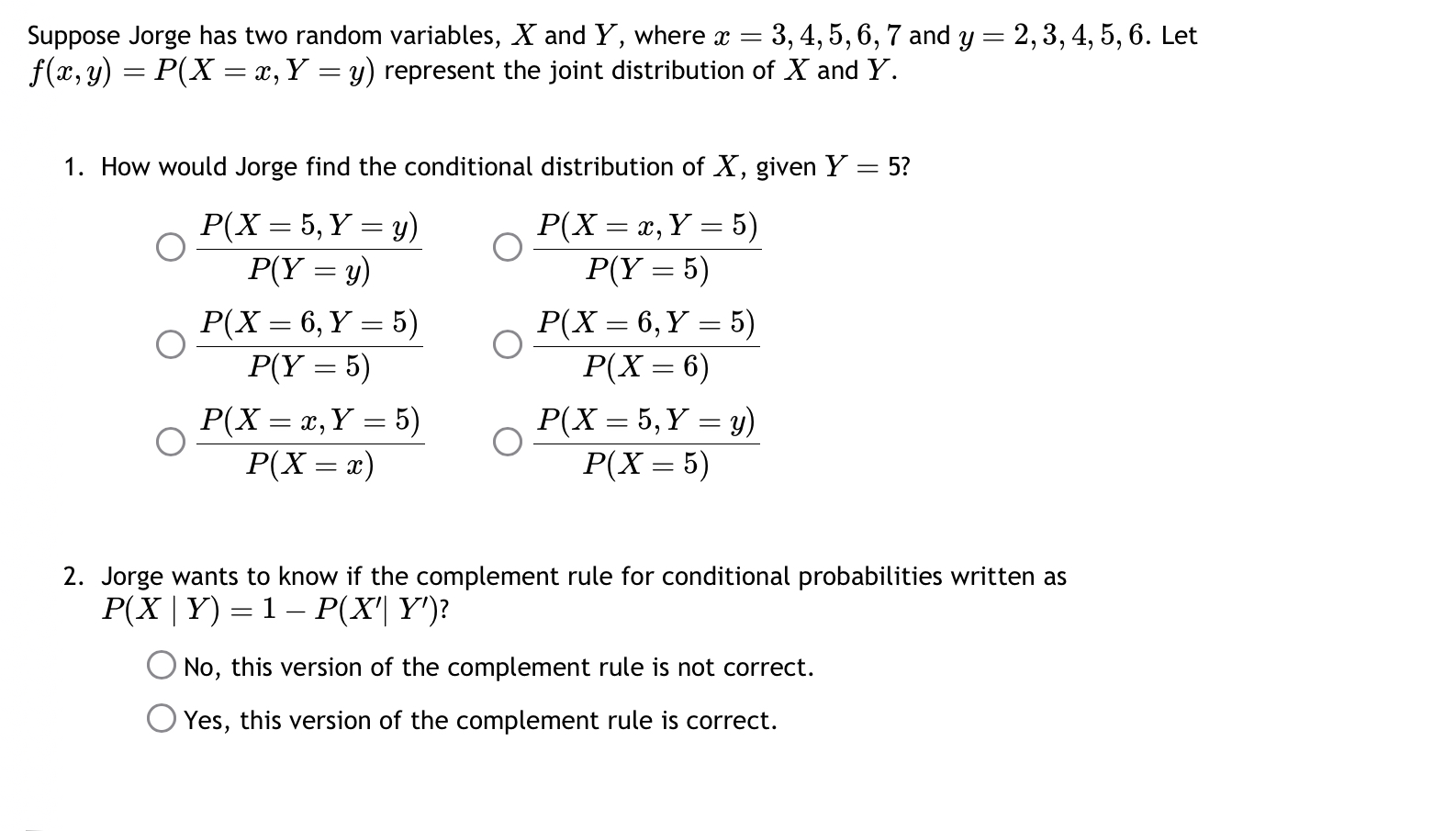
Suppose Jorge has two random variables, X and Y, where x = 3, 4, 5, 6, 7 and y = 2, 3, 4, 5, 6. Let f(x, y) = P(X = x, Y = y) represent the joint distribution of X and Y. 1. How would Jorge find the conditional distribution of X, given Y = 5? P(X = 5, Y = y) P(Y = y) P(X = 6, Y = 5) P(Y = 5) P(X=x,Y=5) P(X = x) P(X = x,Y= 5) P(Y = 5) P(X = 6, Y = 5) P(X = 6) P(X = 5, Y = y) P(X = 5) 2. Jorge wants to know if the complement rule for conditional probabilities written as P(X | Y) = 1 P(X'| Y')? No, this version of the complement rule is not correct. Yes, this version of the complement rule is correct.
Step by Step Solution
There are 3 Steps involved in it

Get step-by-step solutions from verified subject matter experts
 Study Help