







Question: Suppose that A = {2, 4, 6}, B = {2, 6}, C = {4, 6}, and D = {4, 6, 8}. Determine which of these
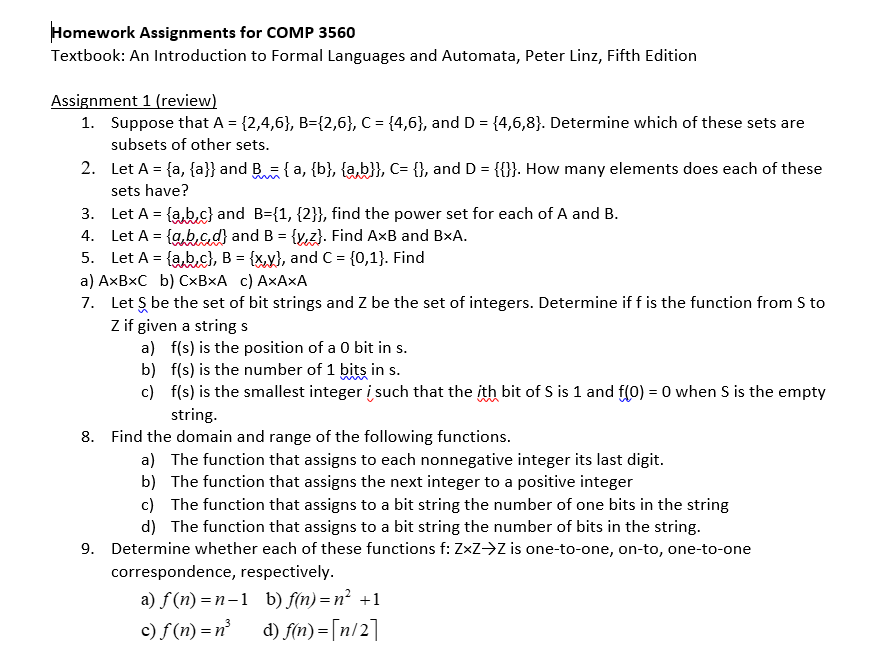
Suppose that A = {2, 4, 6}, B = {2, 6}, C = {4, 6}, and D = {4, 6, 8}. Determine which of these sets are subsets of other sets. Let A = {a, {a}} and { a, {b}, {a, b}}, C= {}, and D = {{}}. How many elements does each of these sets have? Let A = {a, b, c} and B={1, {2}}, find the power set for each of A and B. Let A = {a, b, c, d} and B = {y, z}. Find A times B and B times A. Let A = {a, b, c}, B = {x, y} and c = {0, 1}. Find a) A times B times C b) C times B times bA c) A times A times A Let S be the set of bit strings and Z be the set of integers. Determine if f is the function from S to Z if given a string s a) f (s) is the position of a 0 bit in s. b) f (s) is the number of 1 bits in s. c) f (s) is the smallest integer i such that the i th bit of S is 1 and f (0) = 0 when S is the empty string. Find the domain and range of the following functions. a) The function that assigns to each nonnegative integer its last digit. b) The function that assigns the next integer to a positive integer c) The function that assigns to a bit string the number of one bits in the string d) The function that assigns to a bit string the number of bits in the string. Determine whether each of these functions f: Z7. Z rightarrow Z is one-to-one, on-to, one-to-one correspondence, respectively. a) f (n) = n -1 b) f (n) = n^2 + 1 c) f (n) = n^3 d) f (n) = [n/2]
Step by Step Solution
There are 3 Steps involved in it

Get step-by-step solutions from verified subject matter experts
 Study Help