







Question: Suppose that a certain catalyst is prepared by immersing a sheet of porous material in a solution that contains the catalytic agent, thereby depositing it
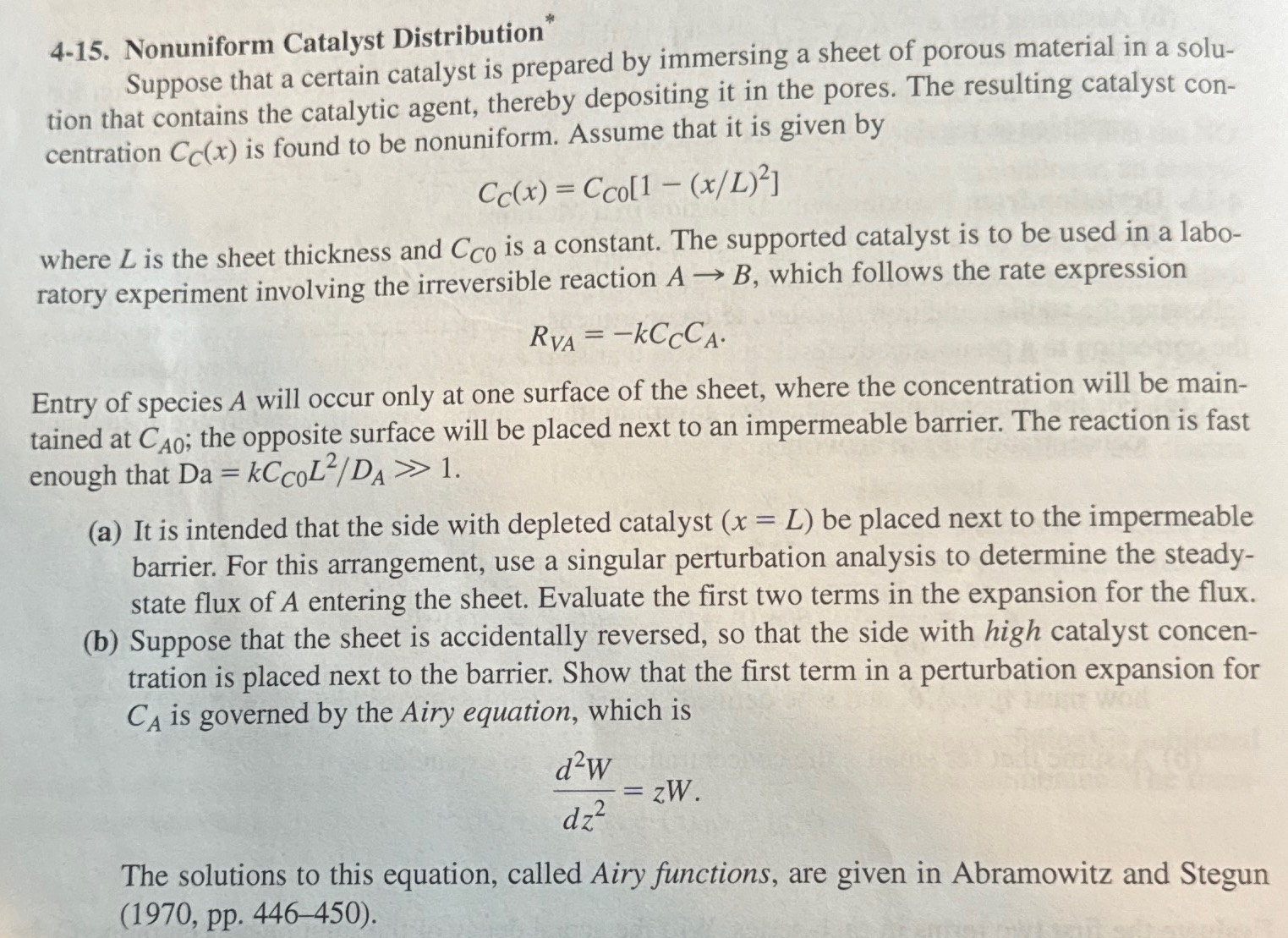
Suppose that a certain catalyst is prepared by immersing a sheet of porous material in a solution that contains the catalytic agent, thereby depositing it in the pores. The resulting catalyst concentration is found to be nonuniform. Assume that it is given by
where is the sheet thickness and is a constant. The supported catalyst is to be used in a laboratory experiment involving the irreversible reaction which follows the rate expression
Entry of species A will occur only at one surface of the sheet, where the concentration will be maintained at ; the opposite surface will be placed next to an impermeable barrier. The reaction is fast enough that
a It is intended that the side with depleted catalyst be placed next to the impermeable barrier. For this arrangement, use a singular perturbation analysis to determine the steadystate flux of A entering the sheet. Evaluate the first two terms in the expansion for the flux.
b Suppose that the sheet is accidentally reversed, so that the side with high catalyst concentration is placed next to the barrier. Show that the first term in a perturbation expansion for is governed by the Airy equation, which is
The solutions to this equation, called Airy functions, are given in Abramowitz and Stegun pp
Boundary Condition : Boundary Condition : Governing equation is where and is the gradient. Therefore, the governing equation is k So in nondimensionalized form, we have and n where n is the greek letter eta. Therefore, DaSo the new BCs are and Now E is the greek letter epsilon. So Esince Da Then E
For part b only set up the problem until the stage where you get the Airy ODE f where k is a constant. You do not need to solve that equation, but you should be able to derive it up to that point.
Step by Step Solution
There are 3 Steps involved in it
1 Expert Approved Answer
Step: 1 Unlock

Question Has Been Solved by an Expert!
Get step-by-step solutions from verified subject matter experts
Step: 2 Unlock
Step: 3 Unlock
 Study Help