







Question: Suppose that a consumer has preferences defined over the consumption set R2 = {(x1, x2) x = [0, 0), x2 = [0, )}. In
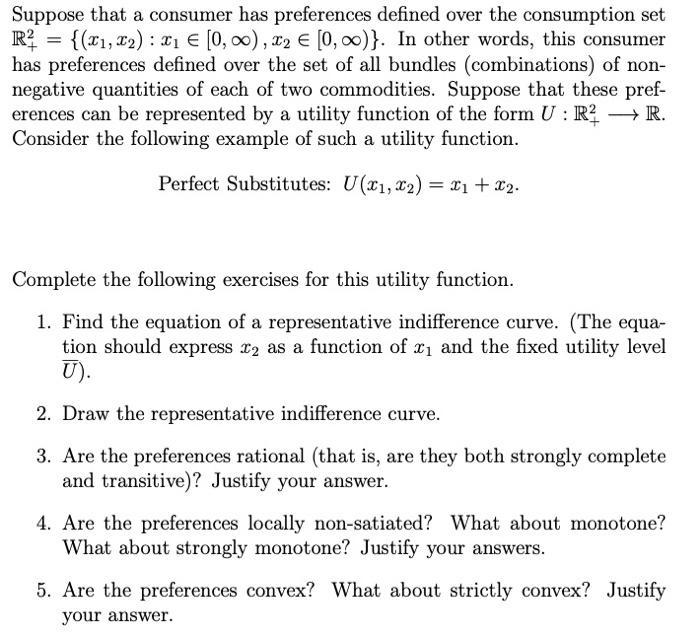
Suppose that a consumer has preferences defined over the consumption set R2 = {(x1, x2) x = [0, 0), x2 = [0, )}. In other words, this consumer has preferences defined over the set of all bundles (combinations) of non- negative quantities of each of two commodities. Suppose that these pref- erences can be represented by a utility function of the form U: R2 R. Consider the following example of such a utility function. Perfect Substitutes: U(x1, x2) = x1 + x2. Complete the following exercises for this utility function. 1. Find the equation of a representative indifference curve. (The equa- tion should express 2 as a function of x and the fixed utility level U). 2. Draw the representative indifference curve. 3. Are the preferences rational (that is, are they both strongly complete and transitive)? Justify your answer. 4. Are the preferences locally non-satiated? What about monotone? What about strongly monotone? Justify your answers. 5. Are the preferences convex? What about strictly convex? Justify your answer.
Step by Step Solution
There are 3 Steps involved in it

Get step-by-step solutions from verified subject matter experts
 Study Help