







Question: Suppose that a rm has the following production function: F (K,L) = AKiLi. If capital rents for $25 per unit per hour, labor can be
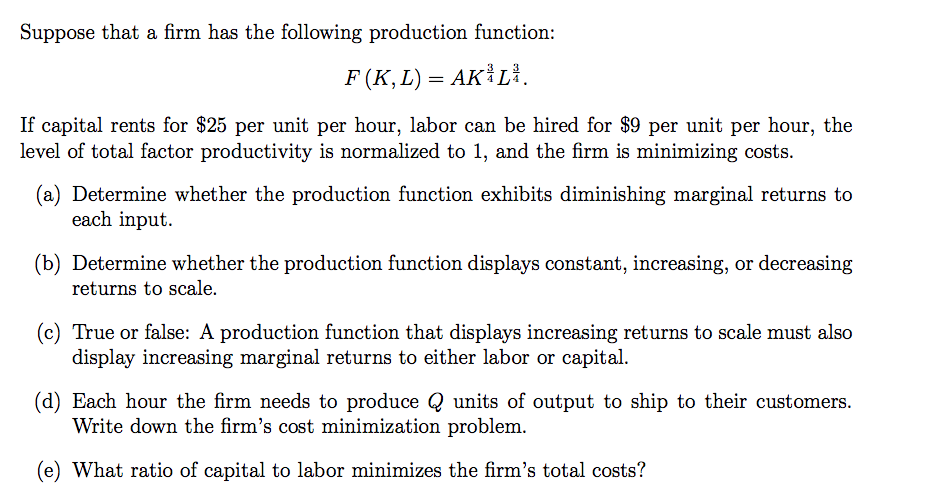
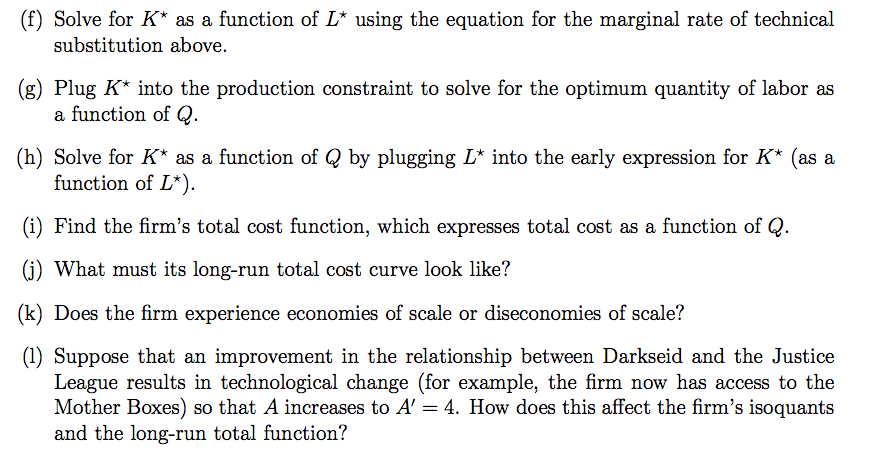
Suppose that a rm has the following production function: F (K,L) = AKiLi. If capital rents for $25 per unit per hour, labor can be hired for $9 per unit per hour, the level of total factor productivity is normalized to 1, and the rm is minimizing costs. (a) Determine whether the production function exhibits diminishing marginal returns to each input. (b) Determine whether the production function displays constant, increasing, or decreasing returns to scale. (c) True or false: A production function that displays increasing returns to scale must also display increasing marginal returns to either labor or capital. (d) Each hour the rm needs to produce Q units of output to ship to their customers. Write down the rm's cost minimization problem. (e) What ratio of capital to labor minimizes the rm's total costs? (f) Solve for K* as a function of L" using the equation for the marginal rate of technical substitution above. (g) Plug K" into the production constraint to solve for the optimum quantity).r of labor as a function of Q. (h) Solve for K* as a function of Q by plugging L" into the earl}.r expression for K" (as a function of If\"). (i) Find the rm's total cost function, which expresses total cost as a function of Q. (j) What must its long-run total cost curve look like? (k) Does the rm experience economies of scale or diseconomies of scale? (1) Suppose that an improvement in the relationship between Darkseid and the Justice League results in technological change (for example, the rm now has access to the Mother Boxes) so that A increases to A\" = 4. How does this affect the rm's isoquants and the long-run total function
Step by Step Solution
There are 3 Steps involved in it

Get step-by-step solutions from verified subject matter experts
 Study Help