







Question: Suppose that Alex is a diligent hard - working first - year college student. One Saturday, he decides to start the day by working through
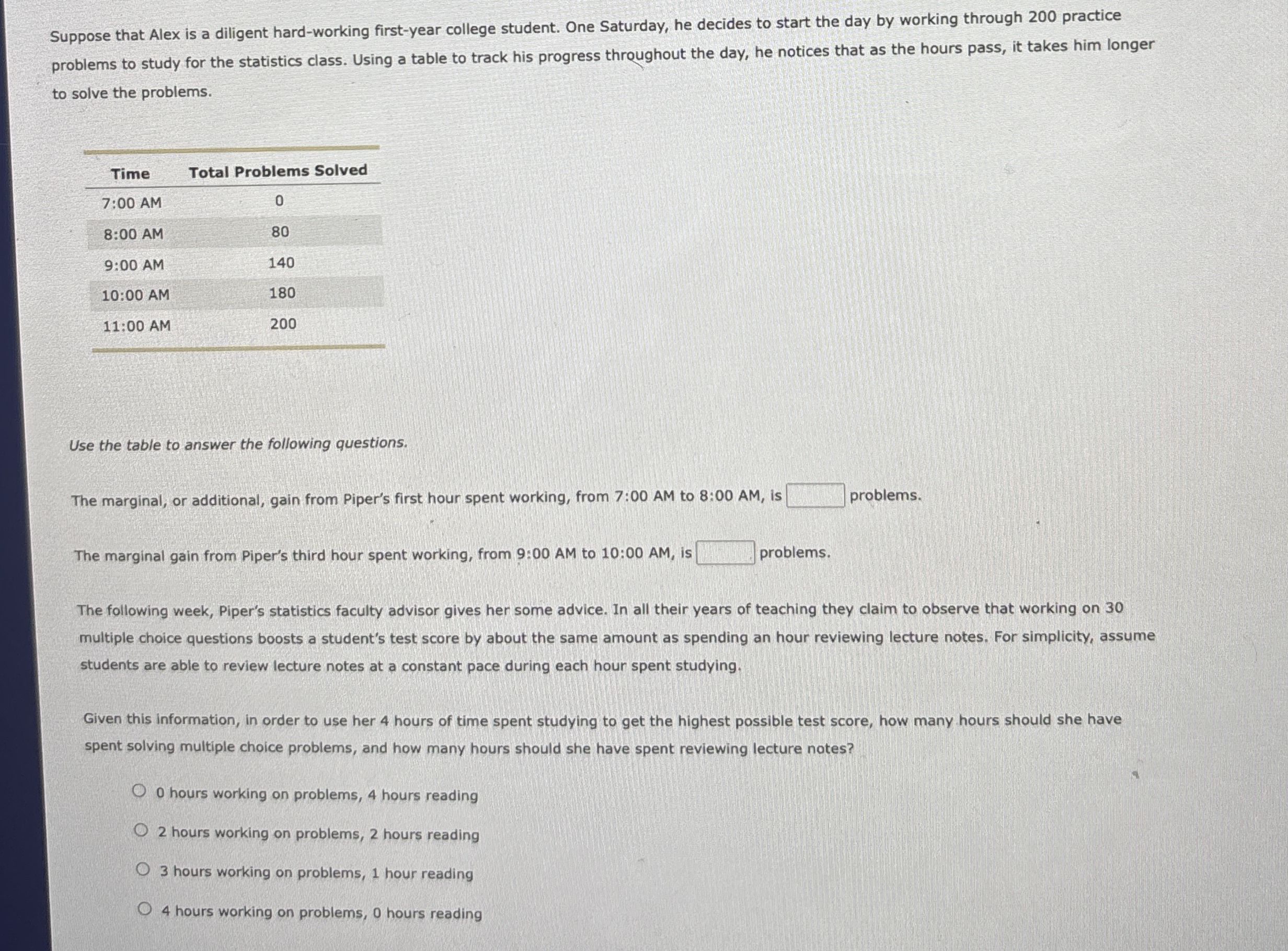
Suppose that Alex is a diligent hardworking firstyear college student. One Saturday, he decides to start the day by working through practice problems to study for the statistics class. Using a table to track his progress throughout the day, he notices that as the hours pass, it takes him longer to solve the problems.
tableTimeTotal Problems Solved: AM: AM: AM: AM: AM
Use the table to answer the following questions.
The marginal, or additional, gain from Piper's first hour spent working, from : AM to : AM is problems.
The marginal gain from Piper's third hour spent working, from : AM to : AM is problems.
The following week, Piper's statistics faculty advisor gives her some advice. In all their years of teaching they claim to observe that working on multiple choice questions boosts a student's test score by about the same amount as spending an hour reviewing lecture notes. For simplicity, assume students are able to review lecture notes at a constant pace during each hour spent studying.
Given this information, in order to use her hours of time spent studying to get the highest possible test score, how many hours should she have spent solving multiple choice problems, and how many hours should she have spent reviewing lecture notes?
hours working on problems, hours reading
hours working on problems, hours reading
hours working on problems, hour reading
hours working on problems, hours reading
Step by Step Solution
There are 3 Steps involved in it
1 Expert Approved Answer
Step: 1 Unlock

Question Has Been Solved by an Expert!
Get step-by-step solutions from verified subject matter experts
Step: 2 Unlock
Step: 3 Unlock
 Study Help