







Question: Suppose that an individual's utility function for consumption, C, and leisure, L, is given by U(C,L) = C10.5 [0.5 This person is constrained by two
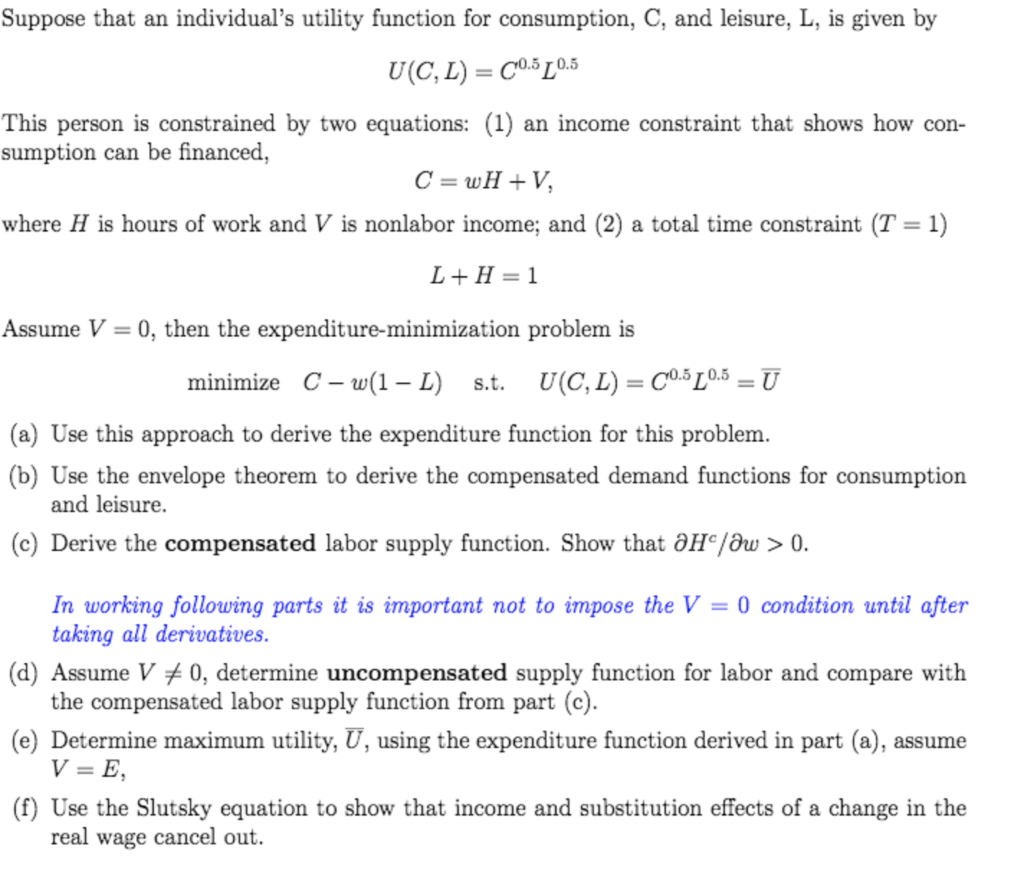
Suppose that an individual's utility function for consumption, C, and leisure, L, is given by U(C,L) = C10.5 [0.5 This person is constrained by two equations: (1) an income constraint that shows how con- sumption can be financed, C=wH+V, where H is hours of work and V is nonlabor income; and (2) a total time constraint (T = 1) L+H=1 Assume V = 0, then the expenditure minimization problem is minimize C-W(1 L) s.t. U(C, L) = C10.5 10.5 = U (a) Use this approach to derive the expenditure function for this problem. (b) Use the envelope theorem to derive the compensated demand functions for consumption and leisure. (C) Derive the compensated labor supply function. Show that a H aw > 0. In working following parts it is important not to impose the V = 0) condition until after taking all derivatives. (d) Assume V +0, determine uncompensated supply function for labor and compare with the compensated labor supply function from part (c). (e) Determine maximum utility, U, using the expenditure function derived in part (a), assume V = E, (f) Use the Slutsky equation to show that income and substitution effects of a change in the real wage cancel out. Suppose that an individual's utility function for consumption, C, and leisure, L, is given by U(C,L) = C10.5 [0.5 This person is constrained by two equations: (1) an income constraint that shows how con- sumption can be financed, C=wH+V, where H is hours of work and V is nonlabor income; and (2) a total time constraint (T = 1) L+H=1 Assume V = 0, then the expenditure minimization problem is minimize C-W(1 L) s.t. U(C, L) = C10.5 10.5 = U (a) Use this approach to derive the expenditure function for this problem. (b) Use the envelope theorem to derive the compensated demand functions for consumption and leisure. (C) Derive the compensated labor supply function. Show that a H aw > 0. In working following parts it is important not to impose the V = 0) condition until after taking all derivatives. (d) Assume V +0, determine uncompensated supply function for labor and compare with the compensated labor supply function from part (c). (e) Determine maximum utility, U, using the expenditure function derived in part (a), assume V = E, (f) Use the Slutsky equation to show that income and substitution effects of a change in the real wage cancel out
Step by Step Solution
There are 3 Steps involved in it

Get step-by-step solutions from verified subject matter experts
 Study Help