







Question: Suppose that f is a function given as f () = V-x - 2. Simplify the expression f(x + h). f (x + h) =
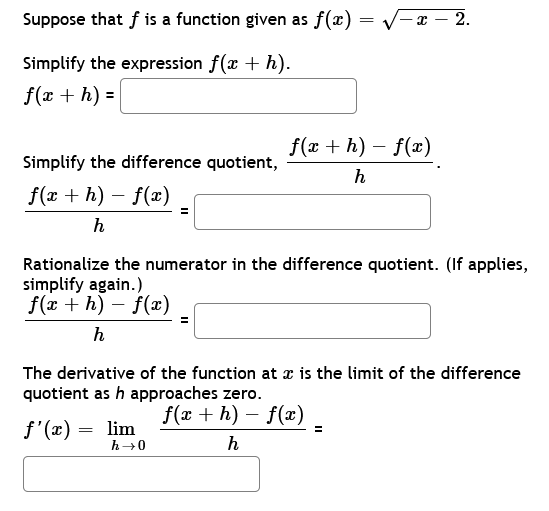
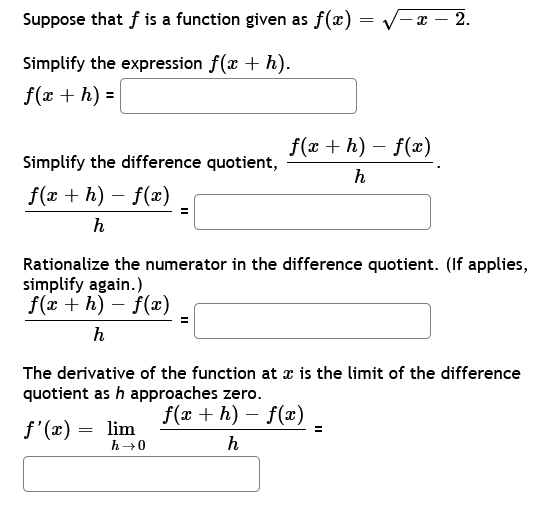
Suppose that f is a function given as f () = V-x - 2. Simplify the expression f(x + h). f (x + h) = f(x th) - f(x) Simplify the difference quotient, h f(x th) - f(x) h Rationalize the numerator in the difference quotient. (If applies, simplify again.) f(x th) - f(x) h The derivative of the function at a is the limit of the difference quotient as h approaches zero. f'(z) = lim f(x + h) - f(x) _ h-0 h
Step by Step Solution
There are 3 Steps involved in it
1 Expert Approved Answer
Step: 1 Unlock

Question Has Been Solved by an Expert!
Get step-by-step solutions from verified subject matter experts
Step: 2 Unlock
Step: 3 Unlock
 Study Help