



Question: Suppose that Kittle Co, a U.S.-based MNC that both purchases supplies from Canada and sells exports in Canada, is seeking to measure the economic exposure
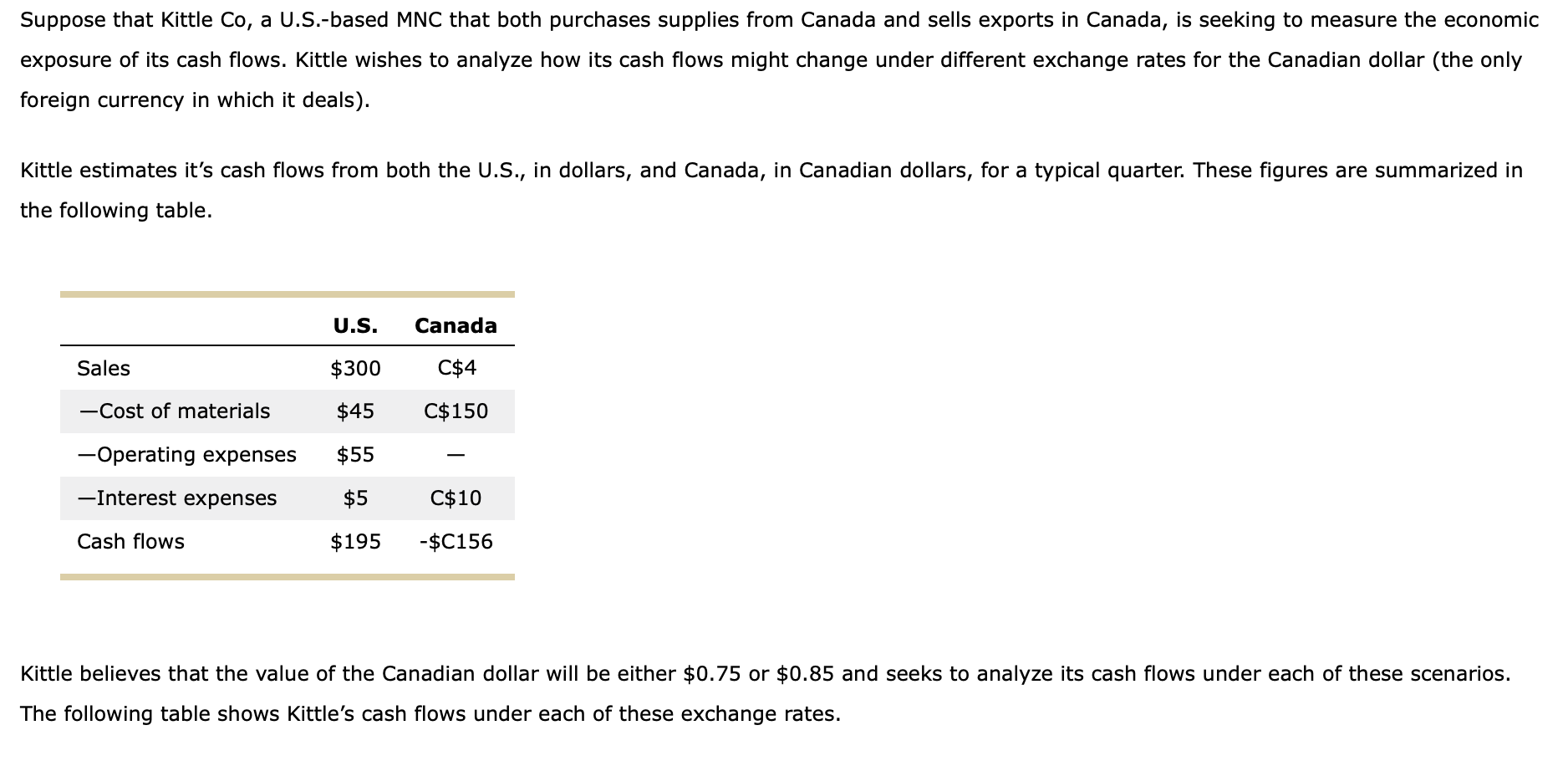
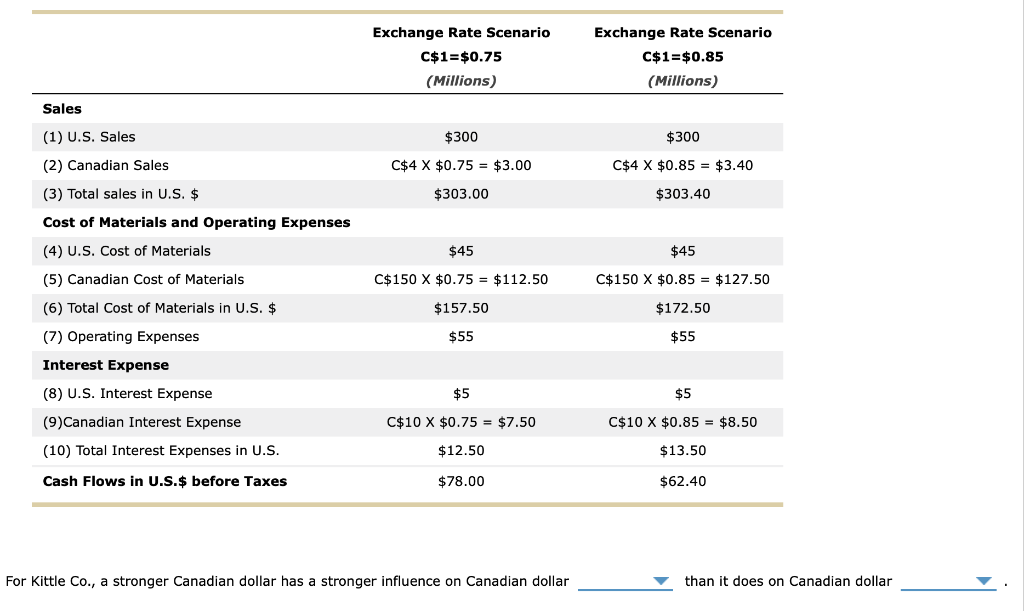
Suppose that Kittle Co, a U.S.-based MNC that both purchases supplies from Canada and sells exports in Canada, is seeking to measure the economic exposure of its cash flows. Kittle wishes to analyze how its cash flows might change under different exchange rates for the Canadian dollar (the only foreign currency in which it deals). Kittle estimates it's cash flows from both the U.S., in dollars, and Canada, in Canadian dollars, for a typical quarter. These figures are summarized in the following table. U.S. Canada Sales $300 C$4 -Cost of materials $45 C$150 -Operating expenses $55 -Interest expenses $5 C$10 Cash flows $195 -$C156 Kittle believes that the value of the Canadian dollar will be either $0.75 or $0.85 and seeks to analyze its cash flows under each of these scenarios. The following table shows Kittle's cash flows under each of these exchange rates. Exchange Rate Scenario C$1=$0.75 (Millions) Exchange Rate Scenario C$1=$0.85 (Millions) Sales (1) U.S. Sales $300 $300 (2) Canadian Sales C$4 X $0.75 = $3.00 C$4 X $0.85 = $3.40 $303.00 $303.40 (3) Total sales in U.S. $ Cost of Materials and Operating Expenses (4) U.S. Cost of Materials $45 $45 C$150 X $0.75 = $112.50 C$150 X $0.85 = $127.50 $157.50 $172.50 $55 $55 (5) Canadian Cost of Materials (6) Total Cost of Materials in U.S. $ (7) Operating Expenses Interest Expense (8) U.S. Interest Expense (9) Canadian Interest Expense (10) Total Interest Expenses in U.S. $5 C$10 X $0.75 = $7.50 C$10 X $0.85 = $8.50 $12.50 $13.50 Cash Flows in U.S.$ before Taxes $78.00 $62.40 For Kittle Co., a stronger Canadian dollar has a stronger influence on Canadian dollar than it does on Canadian dollar Suppose that Kittle Co, a U.S.-based MNC that both purchases supplies from Canada and sells exports in Canada, is seeking to measure the economic exposure of its cash flows. Kittle wishes to analyze how its cash flows might change under different exchange rates for the Canadian dollar (the only foreign currency in which it deals). Kittle estimates it's cash flows from both the U.S., in dollars, and Canada, in Canadian dollars, for a typical quarter. These figures are summarized in the following table. U.S. Canada Sales $300 C$4 -Cost of materials $45 C$150 -Operating expenses $55 -Interest expenses $5 C$10 Cash flows $195 -$C156 Kittle believes that the value of the Canadian dollar will be either $0.75 or $0.85 and seeks to analyze its cash flows under each of these scenarios. The following table shows Kittle's cash flows under each of these exchange rates. Exchange Rate Scenario C$1=$0.75 (Millions) Exchange Rate Scenario C$1=$0.85 (Millions) Sales (1) U.S. Sales $300 $300 (2) Canadian Sales C$4 X $0.75 = $3.00 C$4 X $0.85 = $3.40 $303.00 $303.40 (3) Total sales in U.S. $ Cost of Materials and Operating Expenses (4) U.S. Cost of Materials $45 $45 C$150 X $0.75 = $112.50 C$150 X $0.85 = $127.50 $157.50 $172.50 $55 $55 (5) Canadian Cost of Materials (6) Total Cost of Materials in U.S. $ (7) Operating Expenses Interest Expense (8) U.S. Interest Expense (9) Canadian Interest Expense (10) Total Interest Expenses in U.S. $5 C$10 X $0.75 = $7.50 C$10 X $0.85 = $8.50 $12.50 $13.50 Cash Flows in U.S.$ before Taxes $78.00 $62.40 For Kittle Co., a stronger Canadian dollar has a stronger influence on Canadian dollar than it does on Canadian dollar
Step by Step Solution
There are 3 Steps involved in it

Get step-by-step solutions from verified subject matter experts