







Question: Suppose that the selective repeat protocol is used. The sequence number space is {0,1,2,3). Assume that the sender window size is N=3. At the
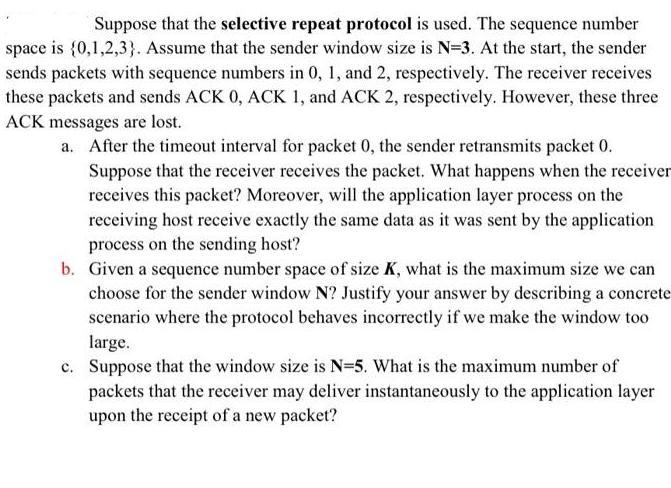
Suppose that the selective repeat protocol is used. The sequence number space is {0,1,2,3). Assume that the sender window size is N=3. At the start, the sender sends packets with sequence numbers in 0, 1, and 2, respectively. The receiver receives these packets and sends ACK 0, ACK 1, and ACK 2, respectively. However, these three ACK messages are lost. a. After the timeout interval for packet 0, the sender retransmits packet 0. Suppose that the receiver receives the packet. What happens when the receiver receives this packet? Moreover, will the application layer process on the receiving host receive exactly the same data as it was sent by the application process on the sending host? b. Given a sequence number space of size K, what is the maximum size we can choose for the sender window N? Justify your answer by describing a concrete scenario where the protocol behaves incorrectly if we make the window too large. c. Suppose that the window size is N=5. What is the maximum number of packets that the receiver may deliver instantaneously to the application layer upon the receipt of a new packet?
Step by Step Solution
There are 3 Steps involved in it
Solution a When the sender retransmits packet 0 and the receiver receives it the receiver will recog... View full answer

Get step-by-step solutions from verified subject matter experts
 Study Help