







Question: Suppose that there are panel data for T = 2 time periods for a randomized controlled experiment, where the first observation (t = 1) is
Suppose that there are panel data for T = 2 time periods for a randomized controlled experiment, where the first observation (t = 1) is taken before the experiment and the second observation (t = 2) is for the post treatment period. Suppose that the treatment is binary, that is, Xit = 1 if the i th individual is in the treatment group and t = 2, and Xit = 0 otherwise. Further, suppose that the treatment effect can be modeled using the specification Yit = i + 1Xit + uit where i are individual specific effects with a mean of zero and a variance of 2 and uit is an error term, where uit is homoskedastic, cov(ui1, ui2) = 0, and cov(uit, i) = 0 for all i. Let bdif ferences 1 denote the differences estimator, that is, the OLS estimator in a regression of Yi2 on Xi2 with an intercept, and let bdif fsindif fs 1 denote the differences-in-differences estimator, that is, the estimator of 1 based on the OLS regression of Yi = Yi2 Yi1 against Xi = Xi2 Xi1 and an intercept. Note: it is fine to simply replace the arrows (s) in parts a and b with equal signs. In other words, you do not need to prove consistency of anything since the formula in Appendix 5.1 has already done that for you. 1 (a) Show that nvar bdif ferences 1 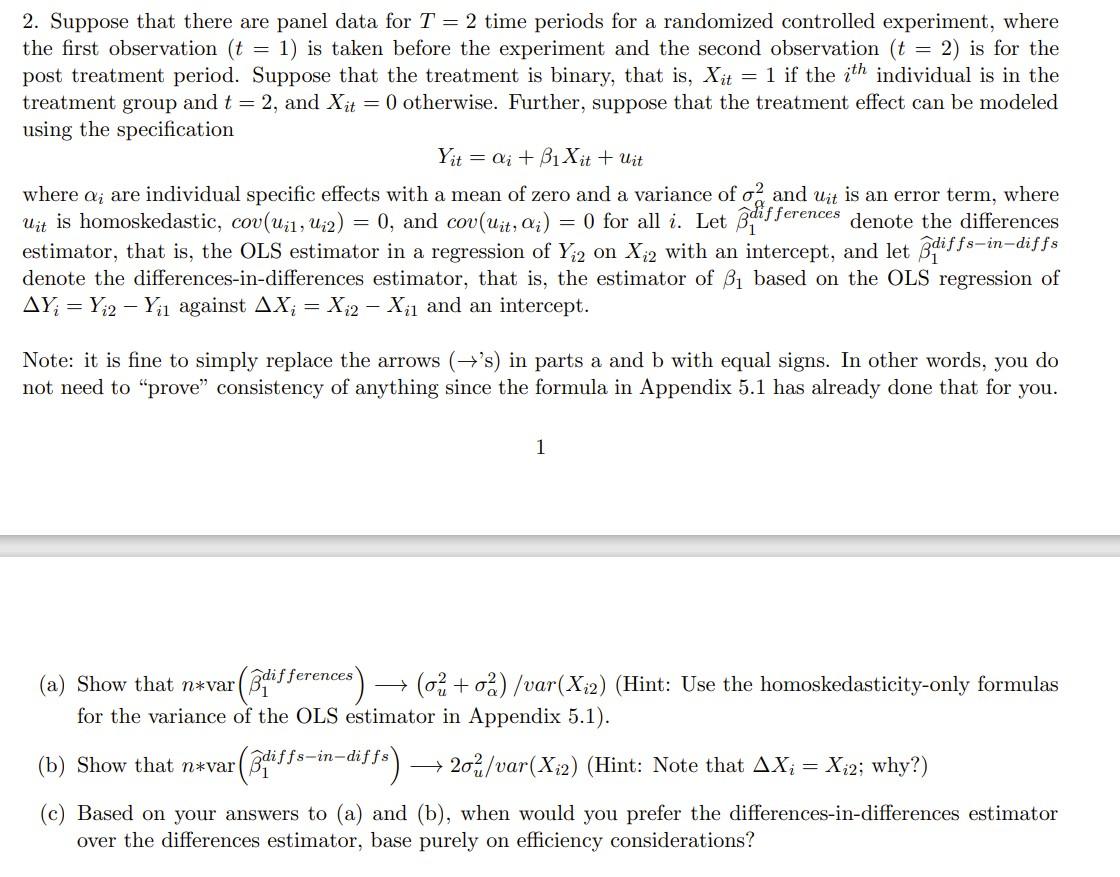
= 2. Suppose that there are panel data for T = 2 time periods for a randomized controlled experiment, where the first observation (t 1) is taken before the experiment and the second observation (t = 2) is for the post treatment period. Suppose that the treatment is binary, that is, Xit = 1 if the ith individual is in the treatment group and t = 2, and Xit = 0 otherwise. Further, suppose that the treatment effect can be modeled using the specification Yitai + B1 Xit + Uit = where a; are individual specific effects with a mean of zero and a variance of o and uit is an error term, where uit is homoskedastic, cov(u1, uz2) 0, and cov(uit, ai) = 0 for all i. Let diffe differences denote the differences estimator, that is, the OLS estimator in a regression of Y2 on X2 with an intercept, and let diffs-in-diffs denote the differences-in-differences estimator, that is, the estimator of 3 based on the OLS regression of AY = Y2 - Y1 against AX; = X2 X1 and an intercept. Note: it is fine to simply replace the arrows ('s) in parts a and b with equal signs. In other words, you do not need to "prove" consistency of anything since the formula in Appendix 5.1 has already done that for you. 1 Show that n*var differences (0+0) /var(X2) (Hint: Use the homoskedasticity-only formulas for the variance of the OLS estimator in Appendix 5.1). (diffe (b) Show that n*var (zdiffs- diffs) 202/var (X2) (Hint: Note that AX = X2; why?) fs-in-diffs (c) Based on your answers to (a) and (b), when would you prefer the differences-in-differences estimator over the differences estimator, base purely on efficiency considerations? = 2. Suppose that there are panel data for T = 2 time periods for a randomized controlled experiment, where the first observation (t 1) is taken before the experiment and the second observation (t = 2) is for the post treatment period. Suppose that the treatment is binary, that is, Xit = 1 if the ith individual is in the treatment group and t = 2, and Xit = 0 otherwise. Further, suppose that the treatment effect can be modeled using the specification Yitai + B1 Xit + Uit = where a; are individual specific effects with a mean of zero and a variance of o and uit is an error term, where uit is homoskedastic, cov(u1, uz2) 0, and cov(uit, ai) = 0 for all i. Let diffe differences denote the differences estimator, that is, the OLS estimator in a regression of Y2 on X2 with an intercept, and let diffs-in-diffs denote the differences-in-differences estimator, that is, the estimator of 3 based on the OLS regression of AY = Y2 - Y1 against AX; = X2 X1 and an intercept. Note: it is fine to simply replace the arrows ('s) in parts a and b with equal signs. In other words, you do not need to "prove" consistency of anything since the formula in Appendix 5.1 has already done that for you. 1 Show that n*var differences (0+0) /var(X2) (Hint: Use the homoskedasticity-only formulas for the variance of the OLS estimator in Appendix 5.1). (diffe (b) Show that n*var (zdiffs- diffs) 202/var (X2) (Hint: Note that AX = X2; why?) fs-in-diffs (c) Based on your answers to (a) and (b), when would you prefer the differences-in-differences estimator over the differences estimator, base purely on efficiency considerations
Step by Step Solution
There are 3 Steps involved in it

Get step-by-step solutions from verified subject matter experts
 Study Help