







Question: Suppose that we generalize the set-covering problem so that each set S_i in the family F has an associated weight w_i and the weight of
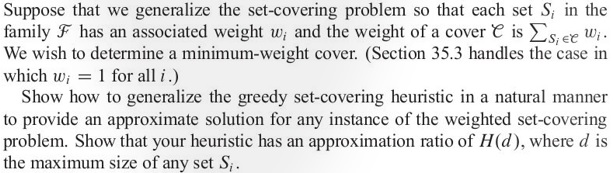
Suppose that we generalize the set-covering problem so that each set S_i in the family F has an associated weight w_i and the weight of a cover is sigma_S_i Element w_i. We wish to determine a minimum-weight cover. (Section 35.3 handles the case in which w_i = 1 for all i.) Show how to generalize the greedy set-covering heuristic in a natural manner to provide an approximate solution for any instance of the weighted set-covering problem. Show that your heuristic has an approximation ratio of H(d), where d is the maximum size of any set S_i. Suppose that we generalize the set-covering problem so that each set S_i in the family F has an associated weight w_i and the weight of a cover is sigma_S_i Element w_i. We wish to determine a minimum-weight cover. (Section 35.3 handles the case in which w_i = 1 for all i.) Show how to generalize the greedy set-covering heuristic in a natural manner to provide an approximate solution for any instance of the weighted set-covering problem. Show that your heuristic has an approximation ratio of H(d), where d is the maximum size of any set S_i
Step by Step Solution
There are 3 Steps involved in it

Get step-by-step solutions from verified subject matter experts
 Study Help