





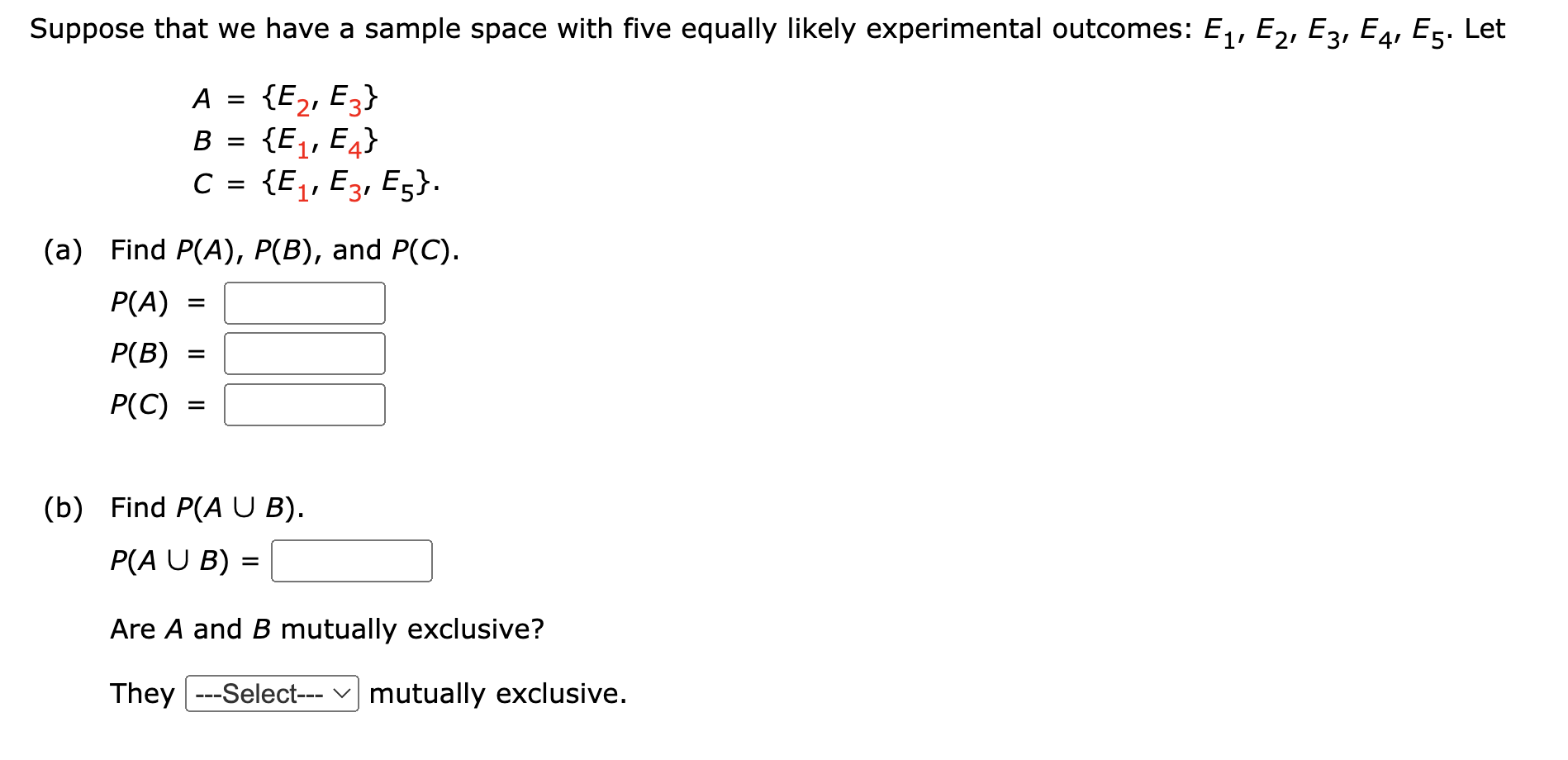
Question: Suppose that we have a sample space with five equally likely experimental outcomes: E1,E2,E3,E4,E5. Let A={E2,E3}B={E1,E4}C={E1,E3,E5}. (a) Find P(A),P(B), and P(C). P(A)=P(B)=P(C)= (b) Find P(AB).
Suppose that we have a sample space with fiveSuppose that we have a sample space with fiveSuppose that we have a sample space with five

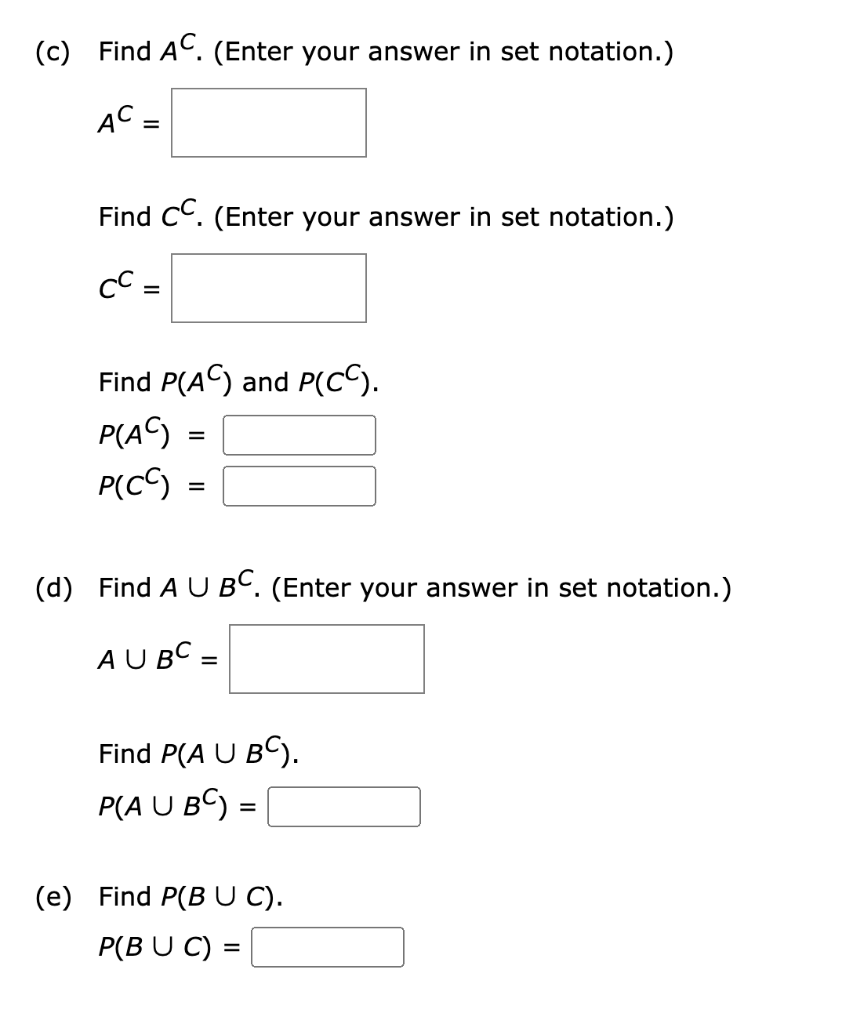
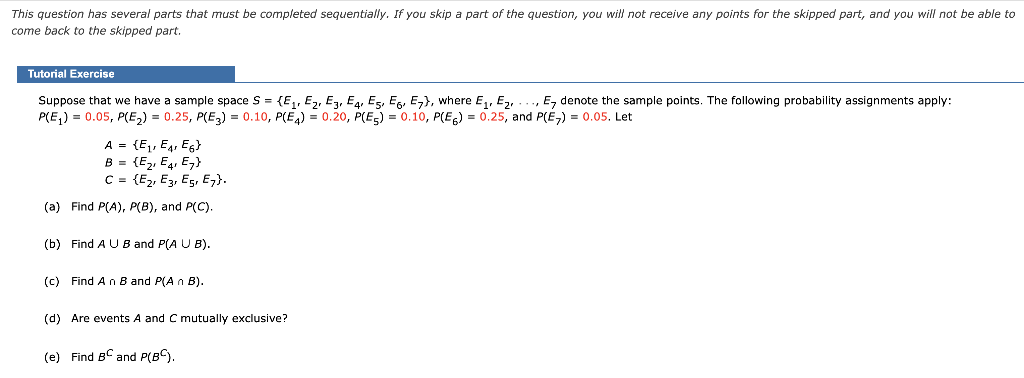
Suppose that we have a sample space with five equally likely experimental outcomes: E1,E2,E3,E4,E5. Let A={E2,E3}B={E1,E4}C={E1,E3,E5}. (a) Find P(A),P(B), and P(C). P(A)=P(B)=P(C)= (b) Find P(AB). P(AB)= Are A and B mutually exclusive? They mutually exclusive. (c) Find AC. (Enter your answer in set notation.) AC= Find CC. (Enter your answer in set notation.) CC= Find P(AC) and P(CC). P(AC)= P(CC)= (d) Find ABC. (Enter your answer in set notation.) ABC= Find P(ABC). P(ABC)= (e) Find P(BC). P(BC)= This question has several parts that must be completed sequentially. If you skip a part of the question, you will not receive any points for the skipped part, and you will not be able t come back to the skipped part. Tutorial Exercise Suppose that we have a sample space S={E1,E2,E3,E4,E5,E6,E7}, where E1,E2,, E7 denote the sample points. The following probability assignments apply: P(E1)=0.05,P(E2)=0.25,P(E3)=0.10,P(E4)=0.20,P(E5)=0.10,P(E6)=0.25, and P(E7)=0.05. Let A={E1,E4,E6}B={E2E4,E7}C={E2,E3,E5,E7}. (a) Find P(A),P(B), and P(C) (b) Find AB and P(AB). (c) Find AB and P(AB). (d) Are events A and C mutually exclusive? (e) Find BC and P(BC)
Step by Step Solution

There are 3 Steps involved in it

1 Expert Approved Answer
Step: 1 Unlock blur-text-image

Question Has Been Solved by an Expert!

Get step-by-step solutions from verified subject matter experts

Step: 2 Unlock
Step: 3 Unlock

Students Have Also Explored These Related General Management Questions!