







Question: Suppose that we have a stack S that supports the following operations PUSH (S, x), which pushes an element x on top of the stack
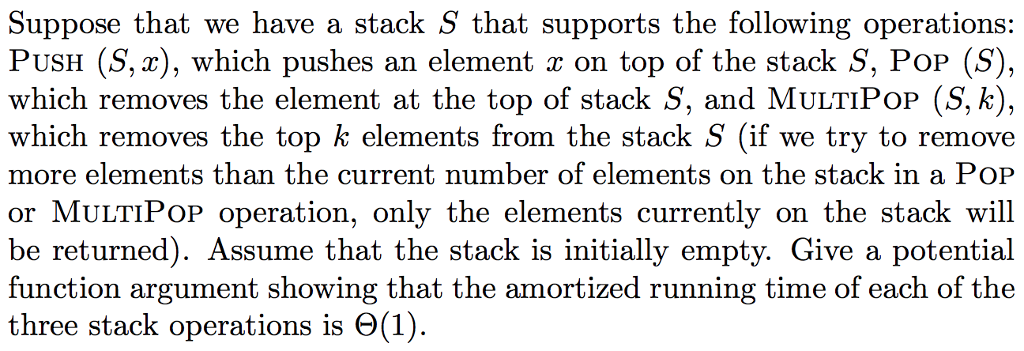
Suppose that we have a stack S that supports the following operations PUSH (S, x), which pushes an element x on top of the stack S, PoP (S), which removes the element at the top of stack S, and MuLTIPoP (S, k), which removes the top k elements from the stack S (if we try to remove more elements than the current number of elements on the stack in a Pop or MULTIPoP operation, only the elements currently on the stack will be returned). Assume that the stack is initially empty. Give a potential function argument showing that the amortized running time of each of the three stack operations is (1) Suppose that we have a stack S that supports the following operations PUSH (S, x), which pushes an element x on top of the stack S, PoP (S), which removes the element at the top of stack S, and MuLTIPoP (S, k), which removes the top k elements from the stack S (if we try to remove more elements than the current number of elements on the stack in a Pop or MULTIPoP operation, only the elements currently on the stack will be returned). Assume that the stack is initially empty. Give a potential function argument showing that the amortized running time of each of the three stack operations is (1)
Step by Step Solution
There are 3 Steps involved in it

Get step-by-step solutions from verified subject matter experts
 Study Help