



Question: Suppose that when you turn 25 , you are single and are in a 22% bracket for federal income tax and a 5% bracket for
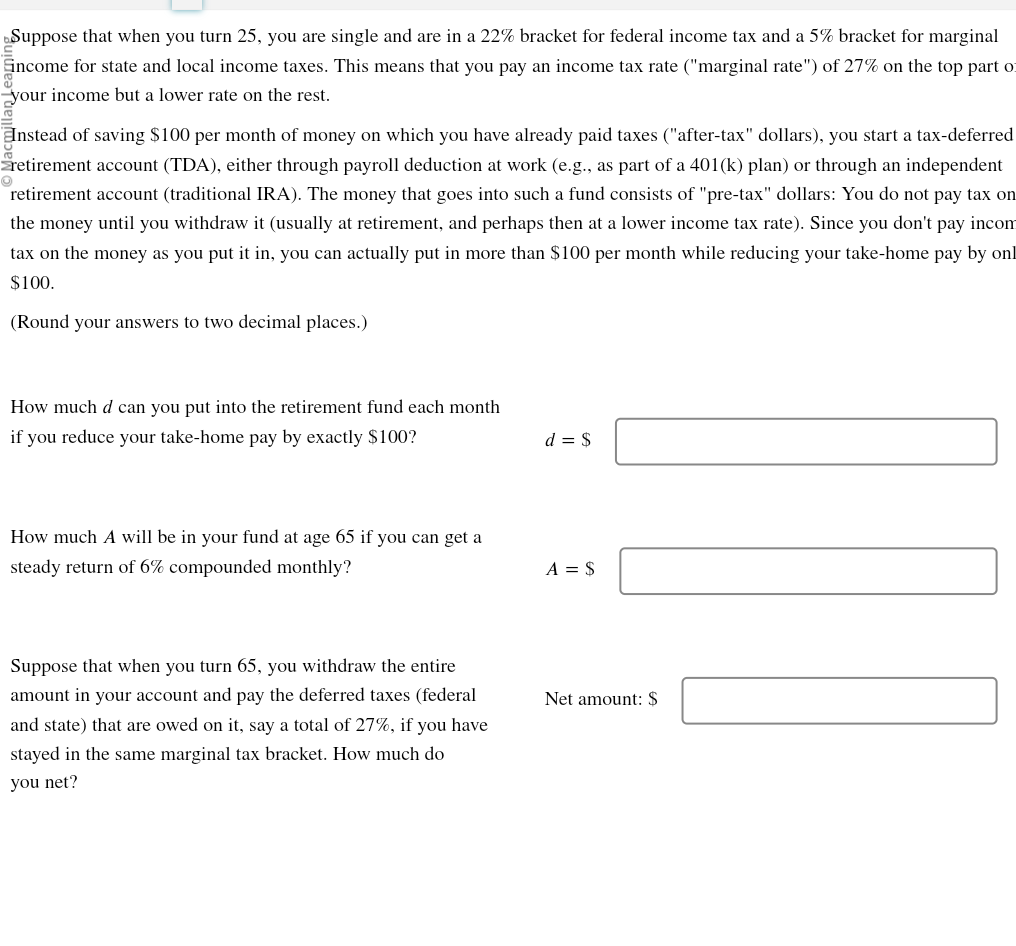
Suppose that when you turn 25 , you are single and are in a 22% bracket for federal income tax and a 5% bracket for marginal your income but a lower rate on the rest. I Henstead of saving $100 per month of money on which you have already paid taxes ("after-tax" dollars), you start a tax-deferred retirement account (TDA), either through payroll deduction at work (e.g., as part of a 401(k) plan) or through an independent retirement account (traditional IRA). The money that goes into such a fund consists of "pre-tax" dollars: You do not pay tax on the money until you withdraw it (usually at retirement, and perhaps then at a lower income tax rate). Since you don't pay incon tax on the money as you put it in, you can actually put in more than $100 per month while reducing your take-home pay by on. $100. (Round your answers to two decimal places.) How much d can you put into the retirement fund each month if you reduce your take-home pay by exactly $100 ? d=$ How much A will be in your fund at age 65 if you can get a steady return of 6% compounded monthly? A=$ Suppose that when you turn 65 , you withdraw the entire amount in your account and pay the deferred taxes (federal Net amount: $ and state) that are owed on it, say a total of 27%, if you have stayed in the same marginal tax bracket. How much do you net
Step by Step Solution
There are 3 Steps involved in it

Get step-by-step solutions from verified subject matter experts