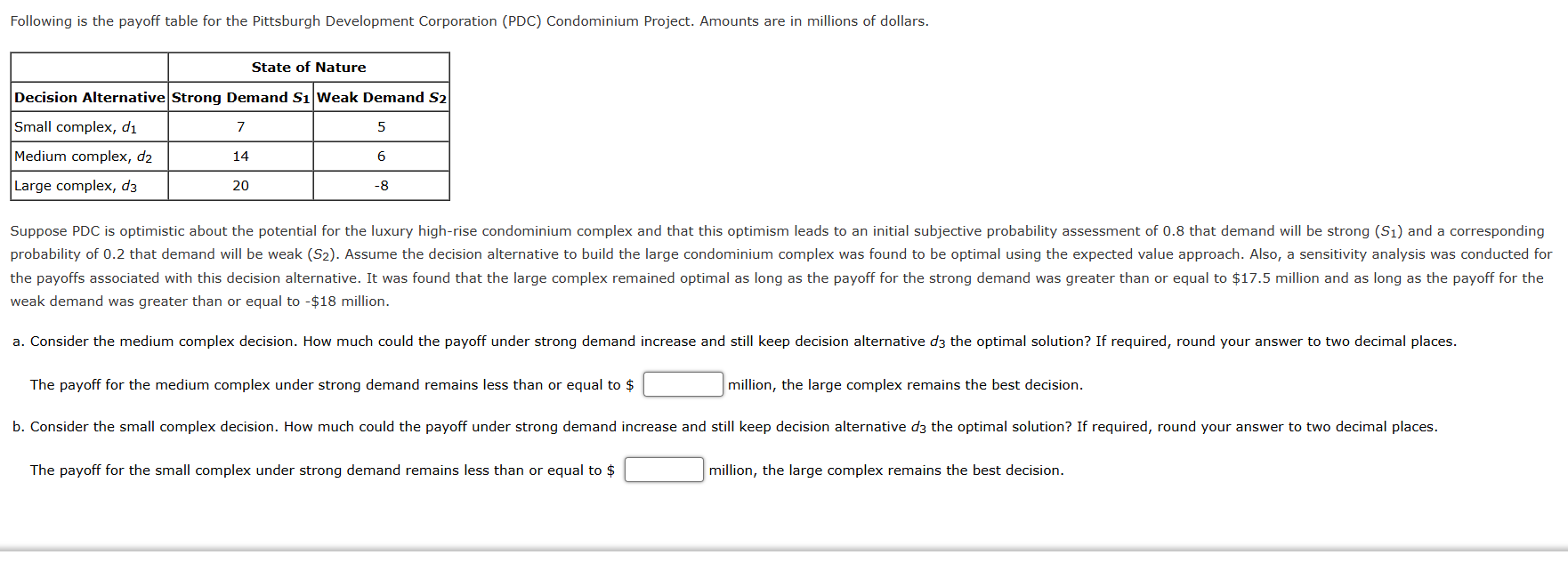
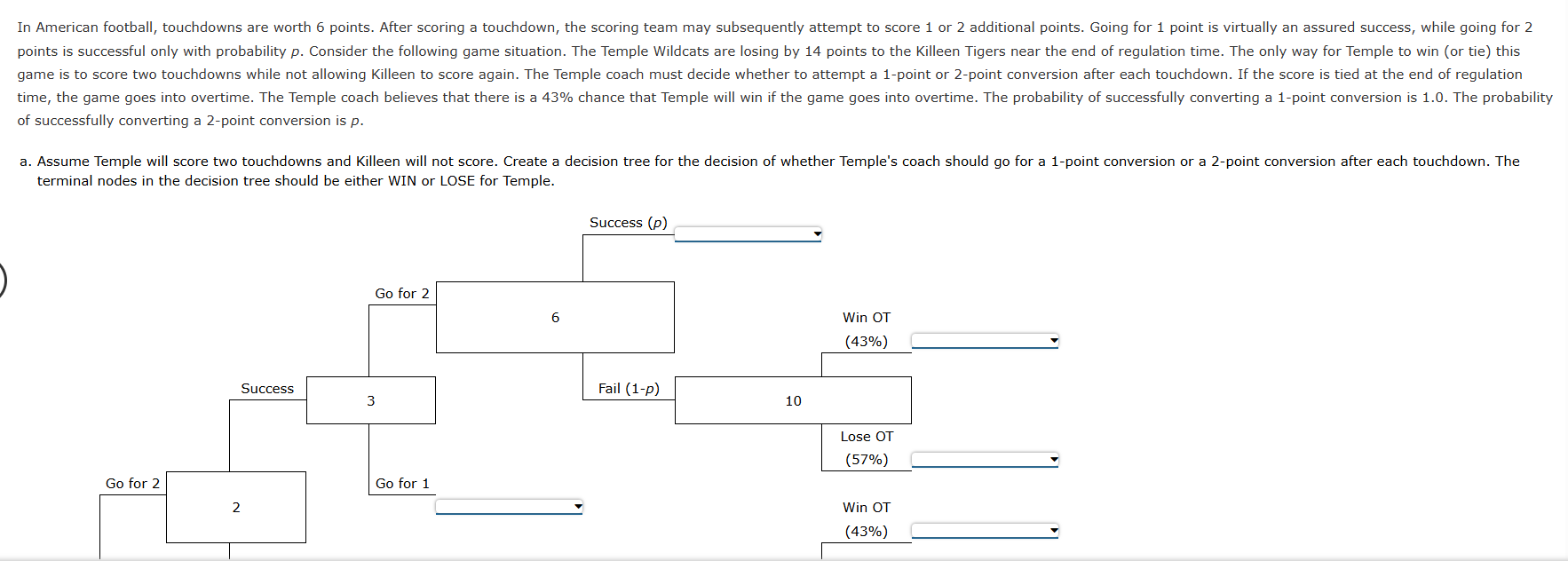
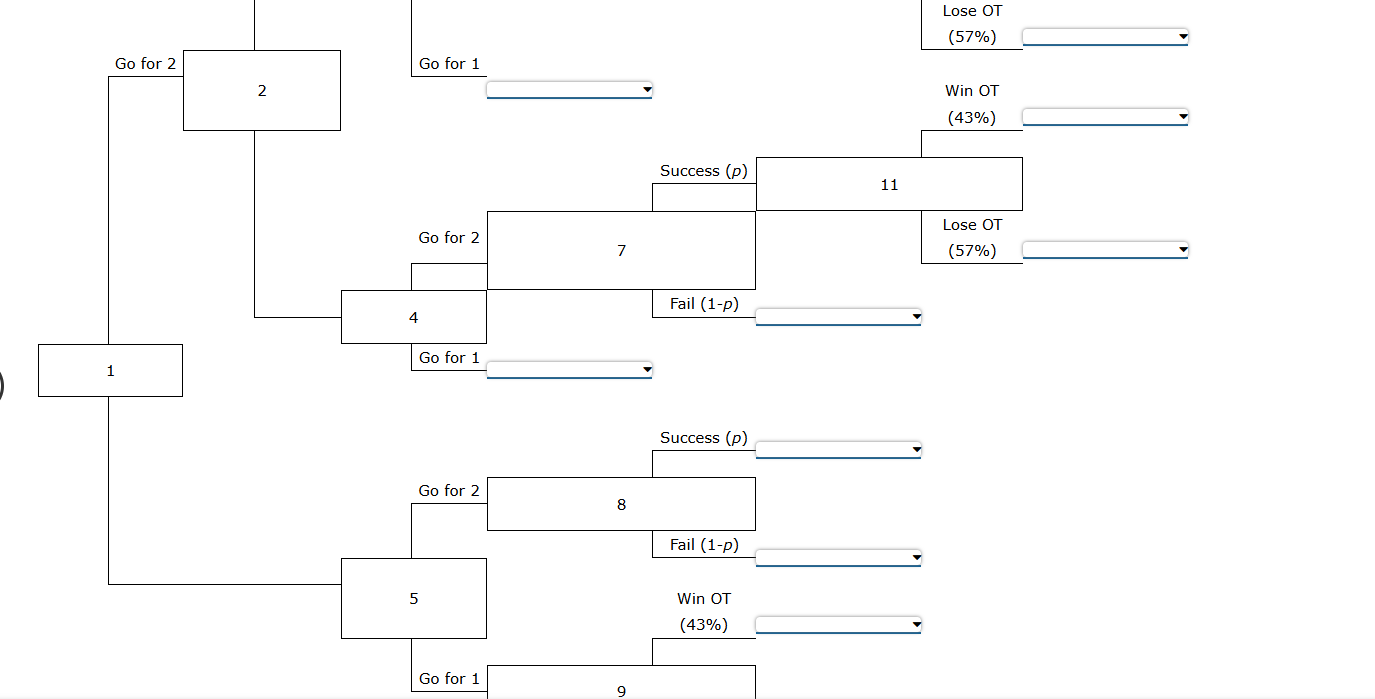
Question: Suppose that you are given a decision situation with three possible states of nature: S1, S2, and S3. The prior probabilities are P(S1) = 0.22,
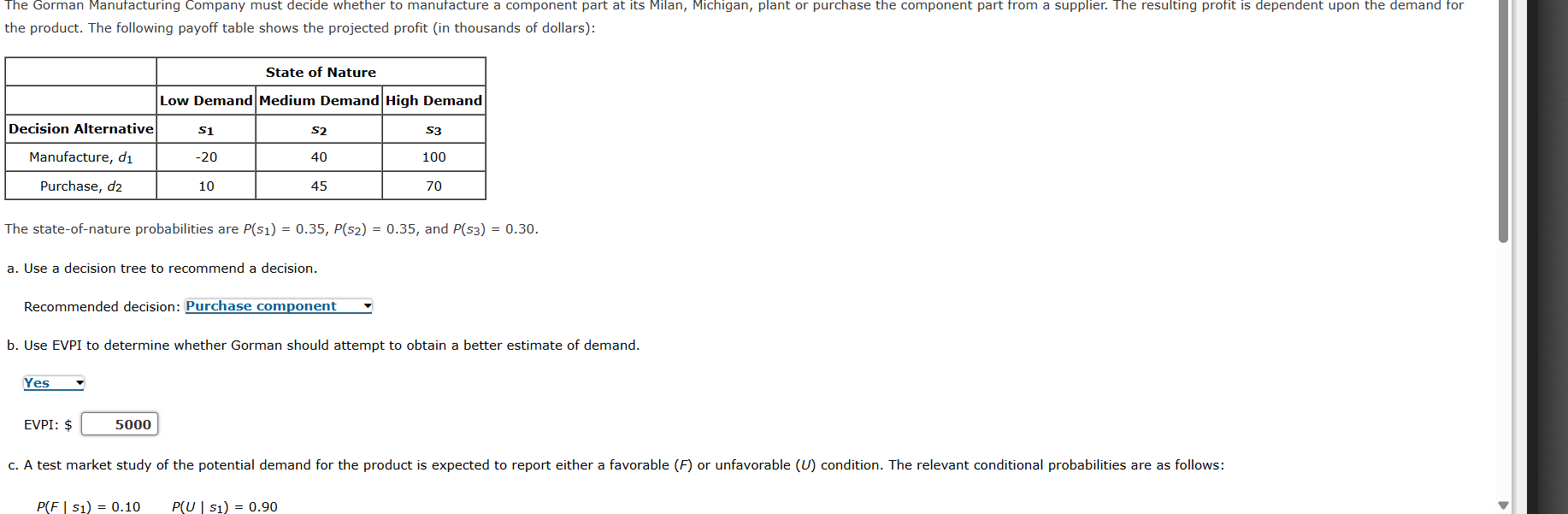
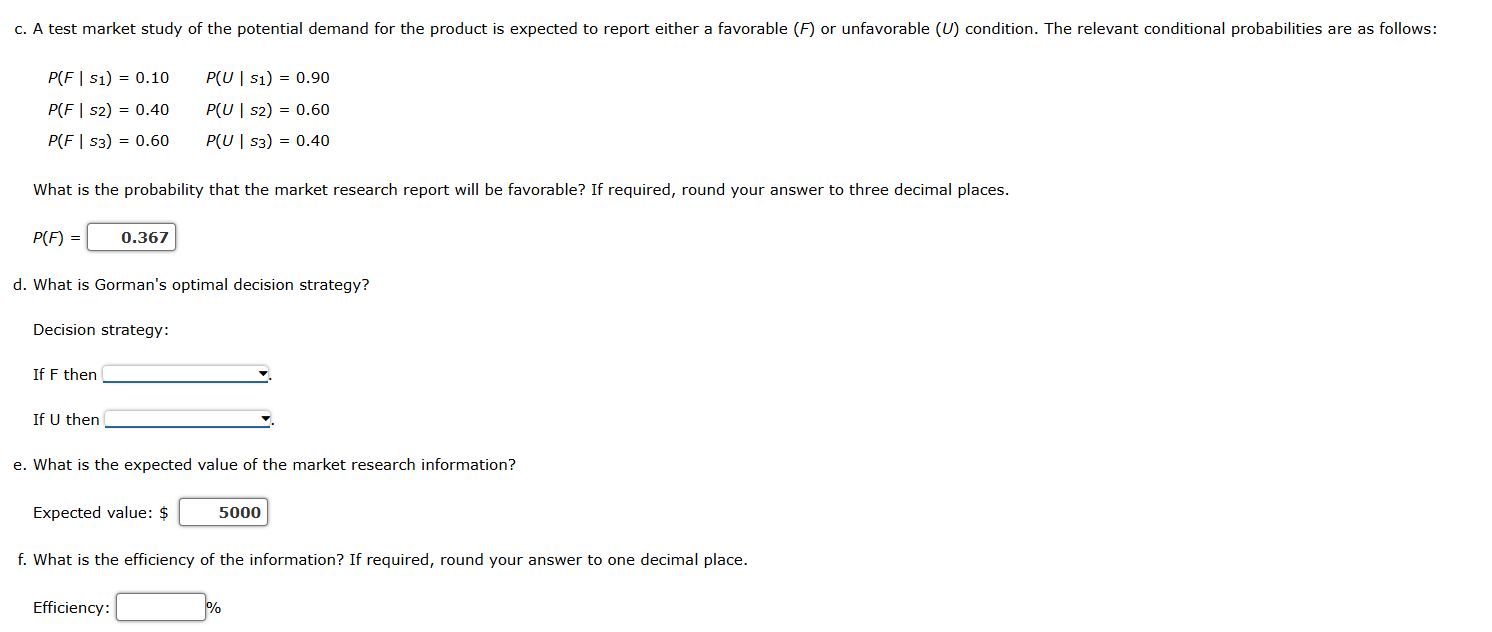
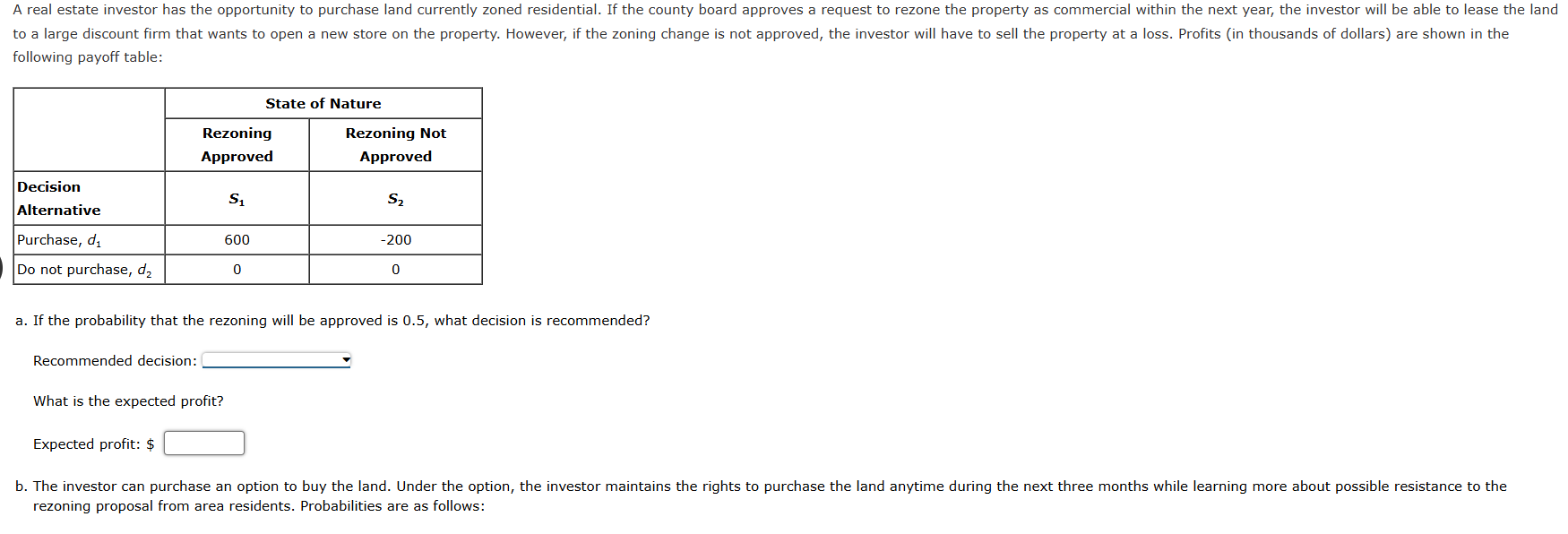
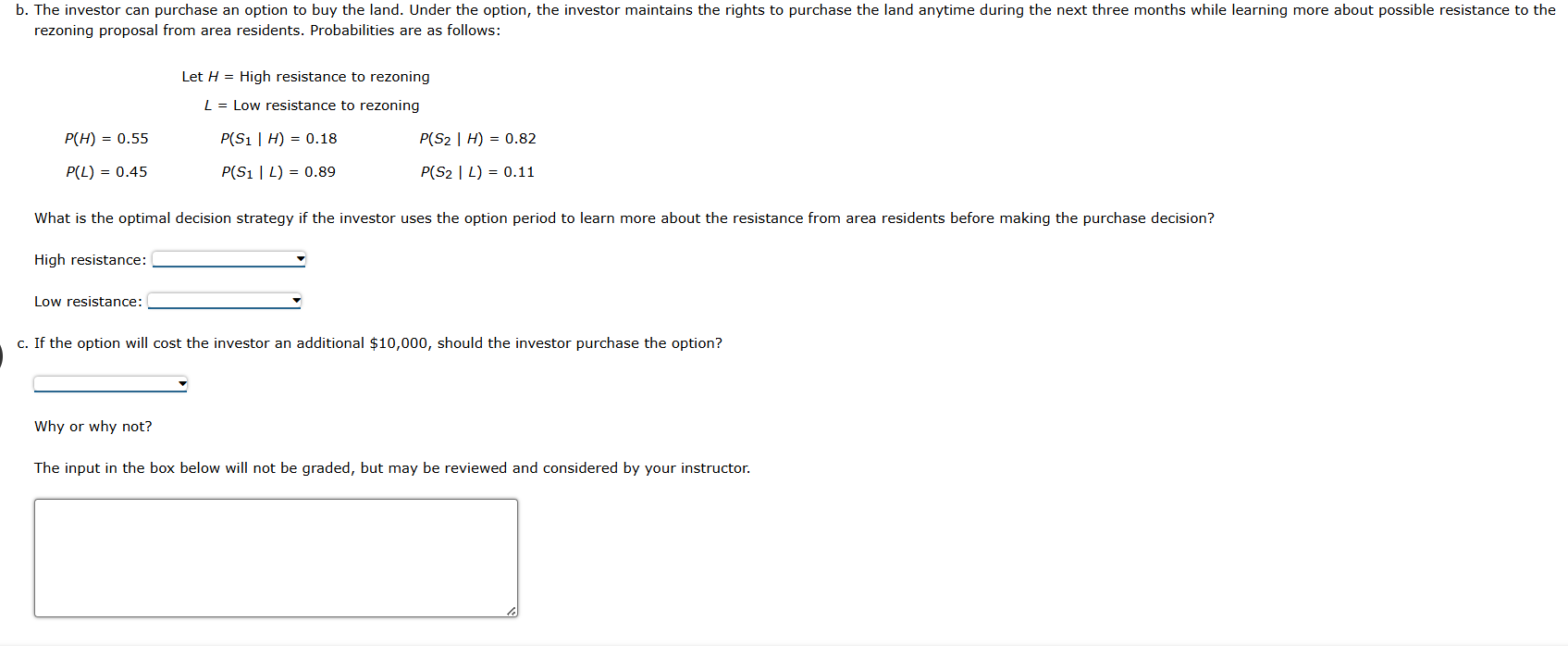
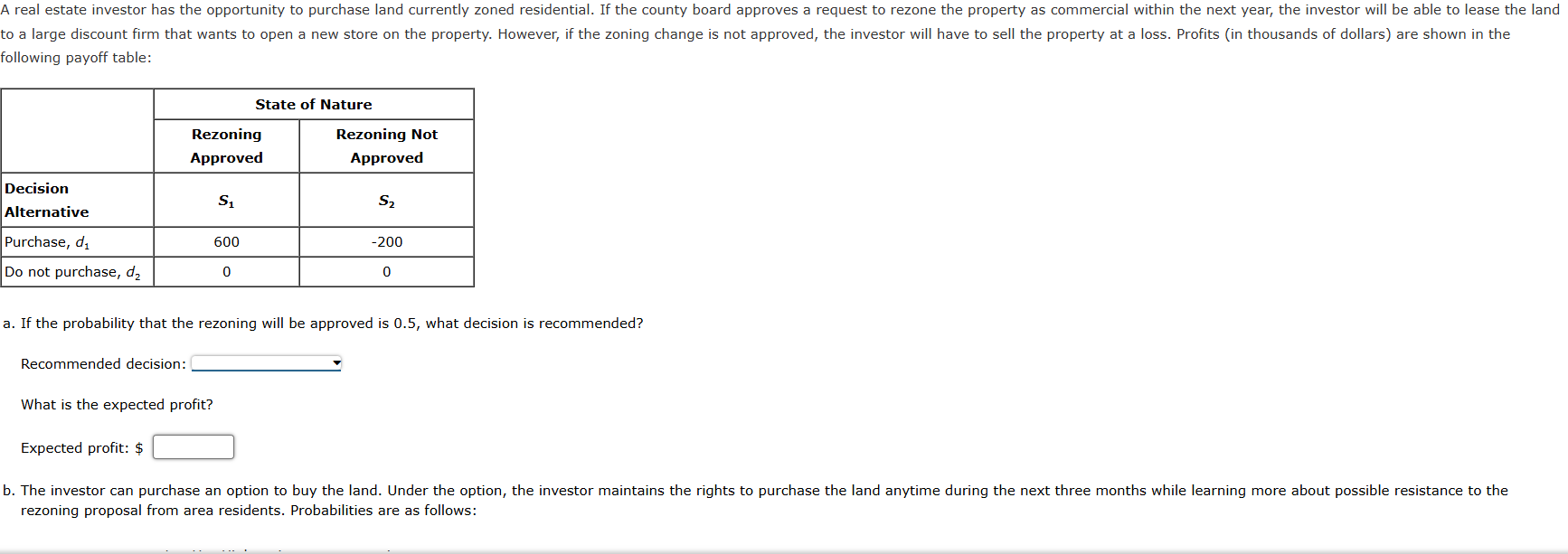
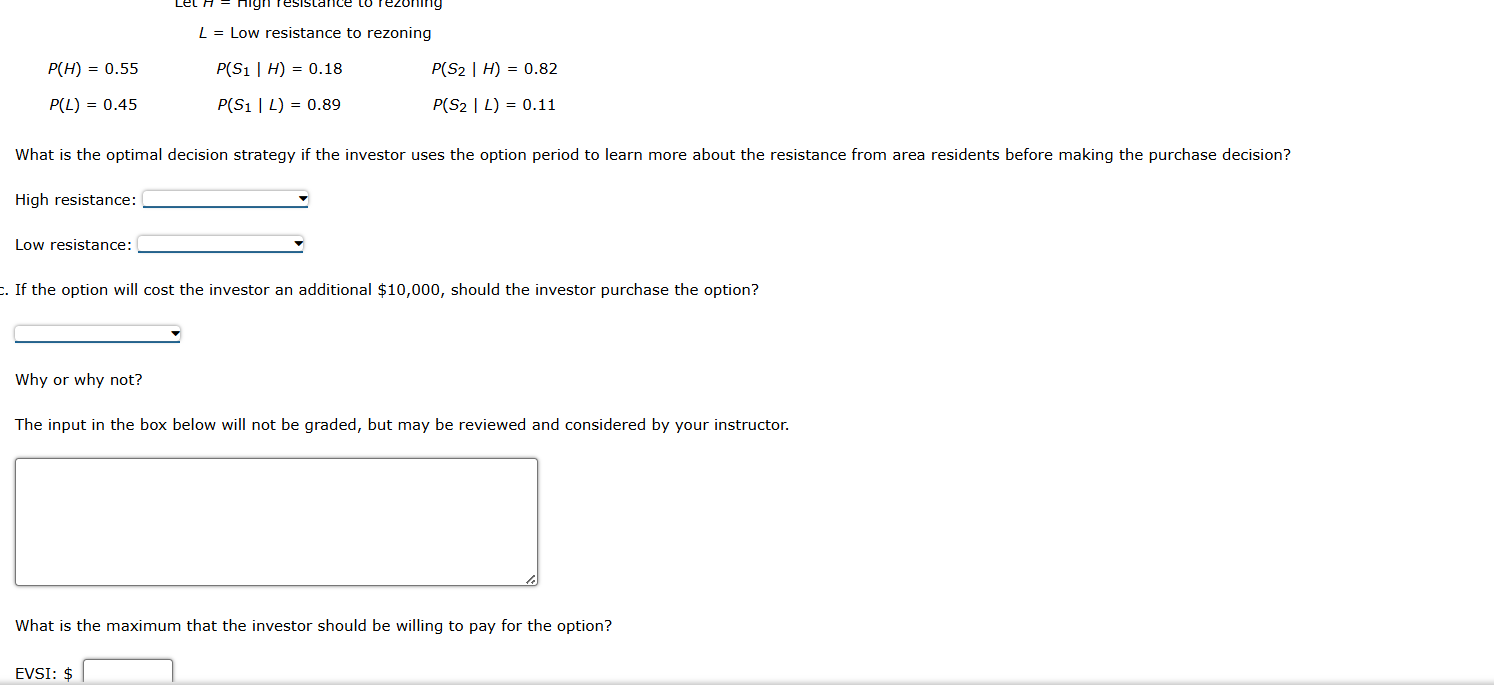
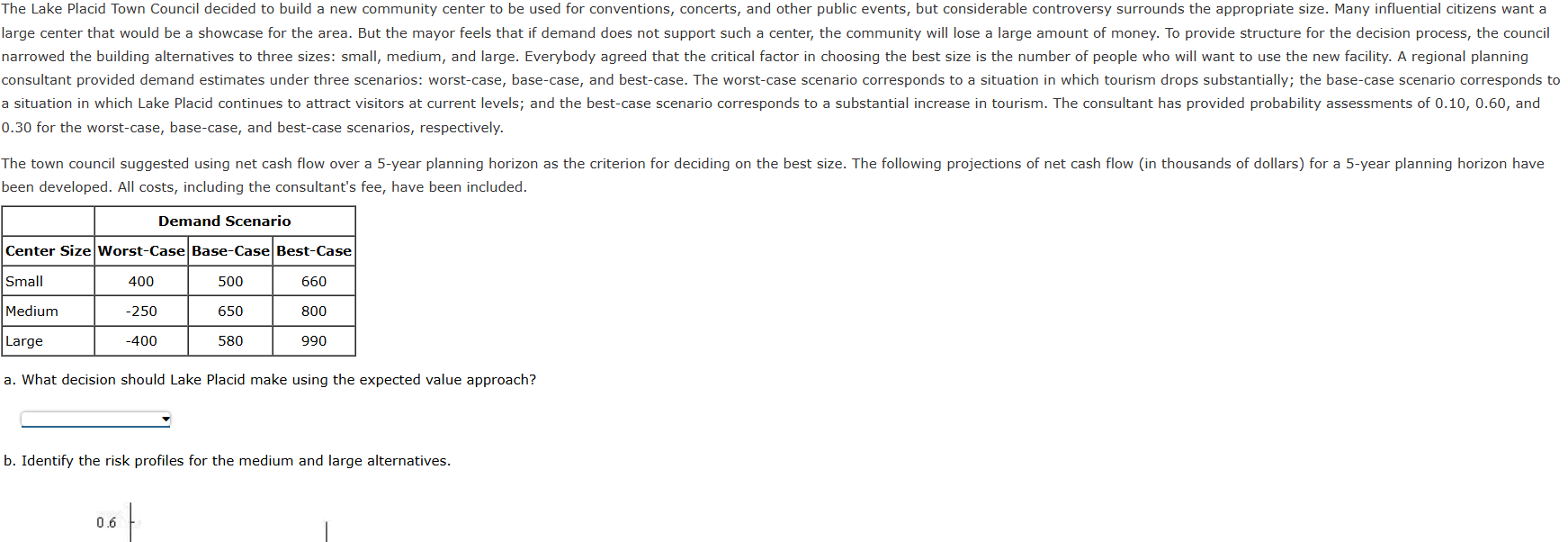
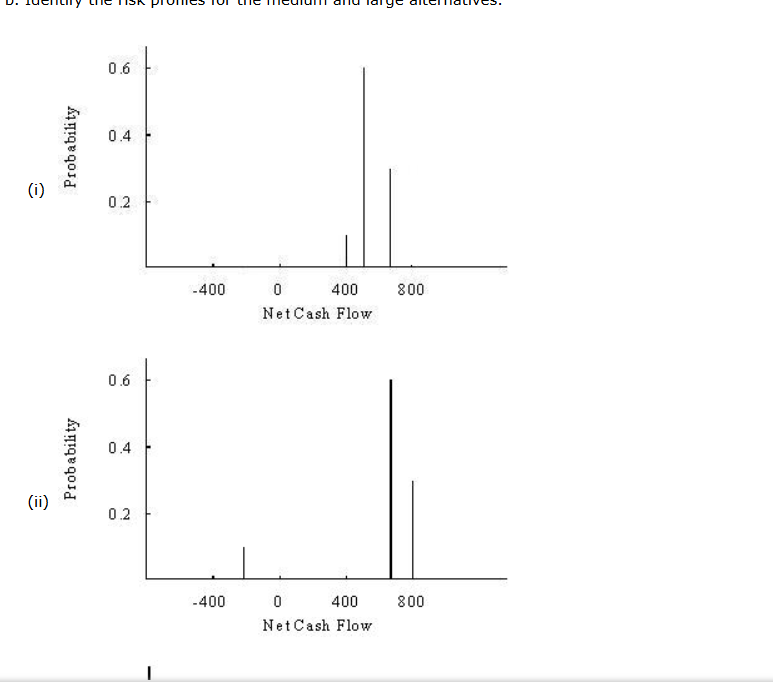
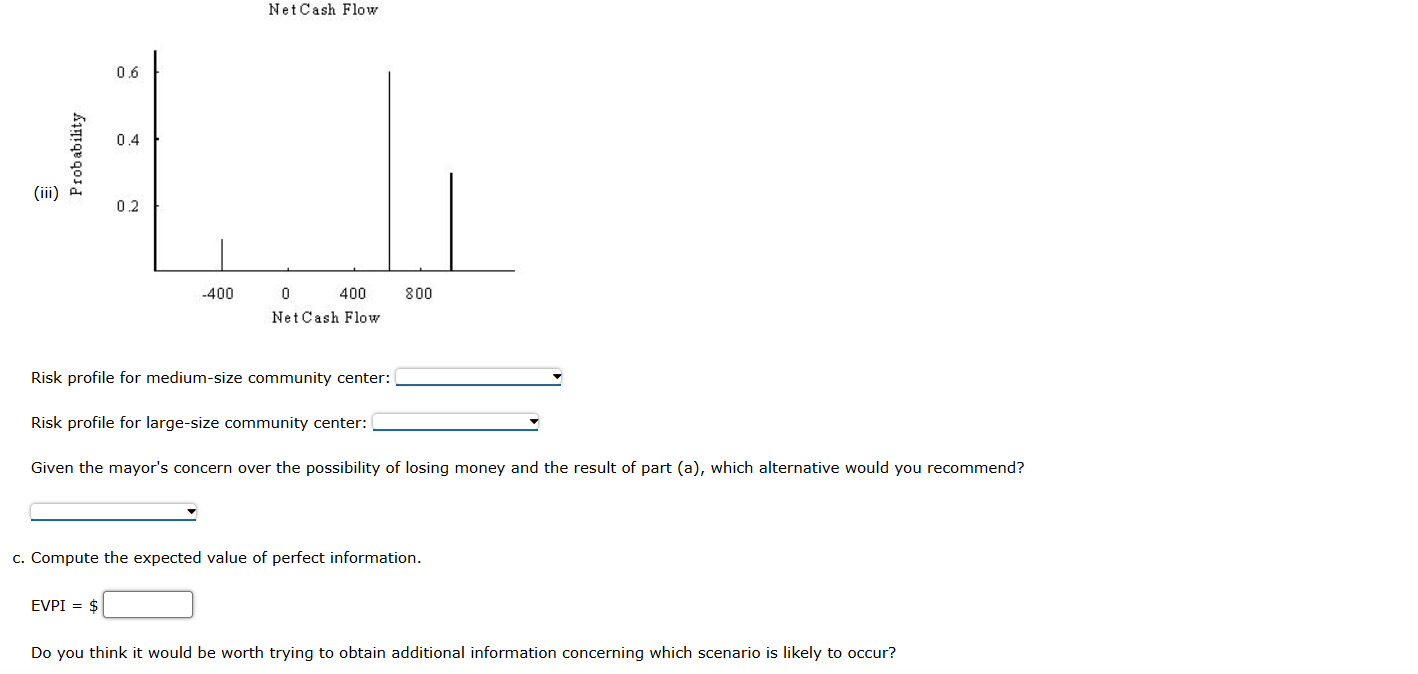
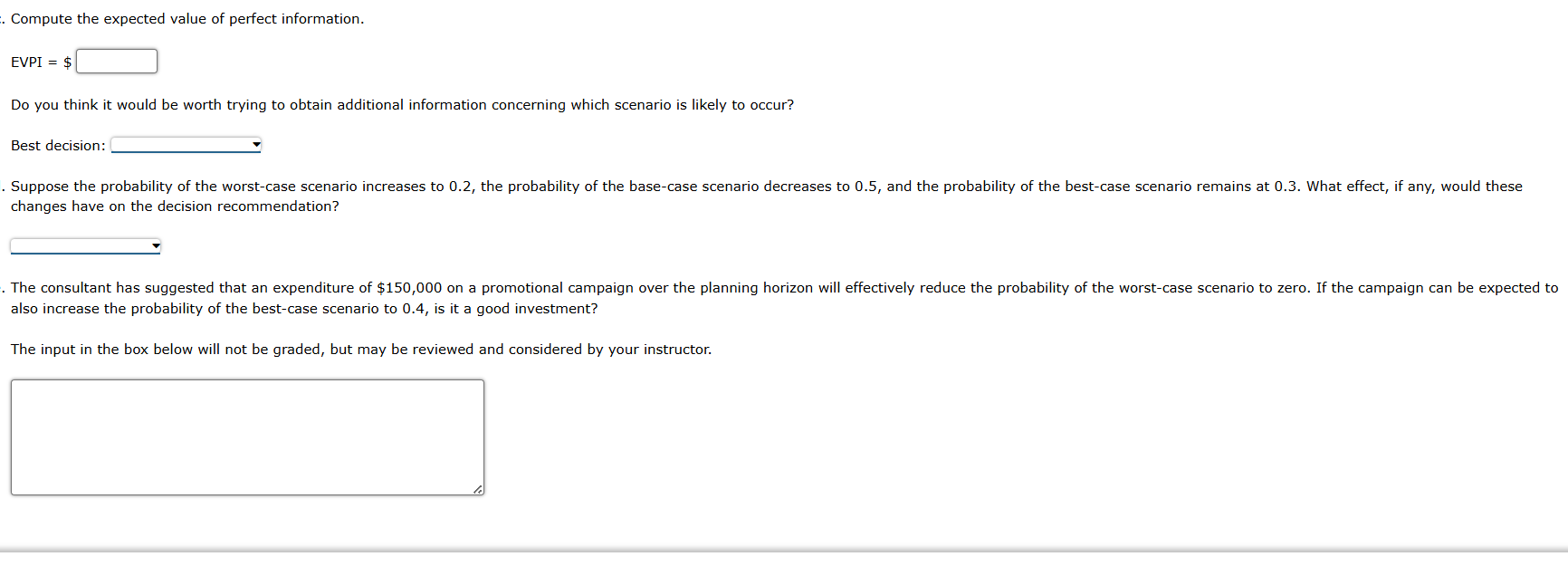
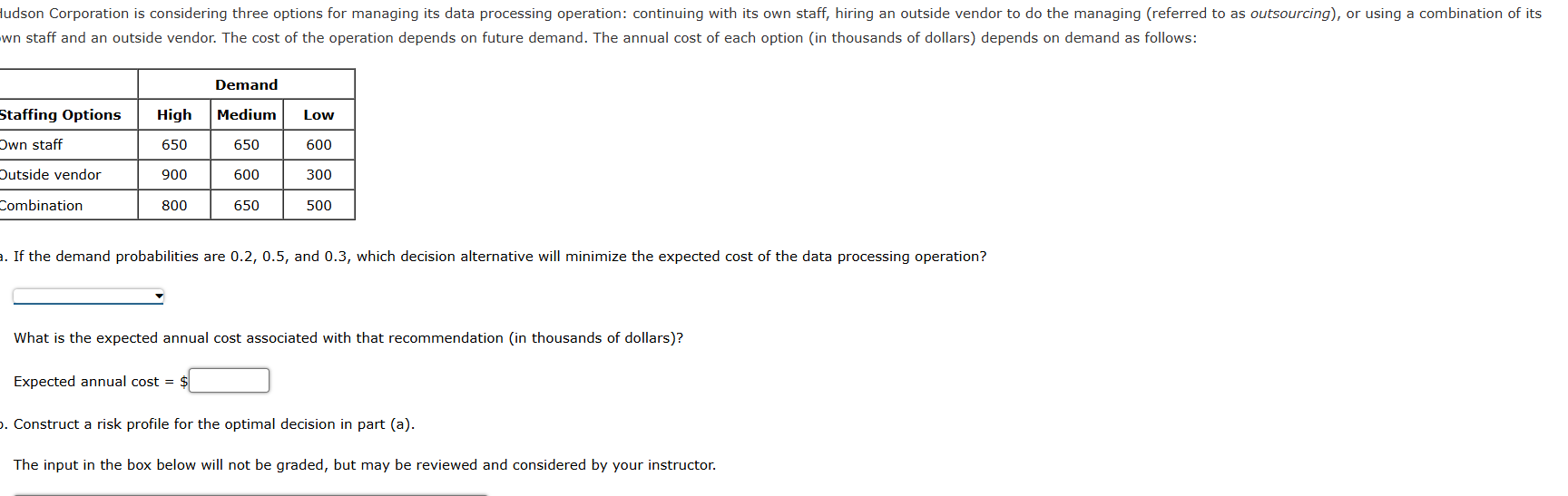
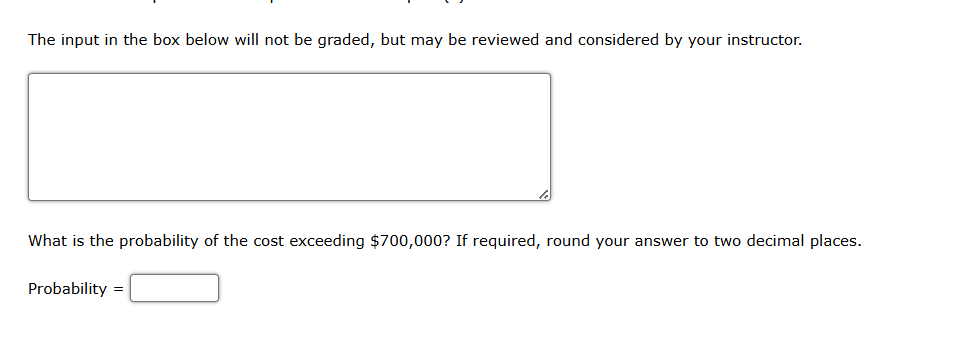
Suppose that you are given a decision situation with three possible states of nature: S1, S2, and S3. The prior probabilities are P(S1) = 0.22, P(S2) = 0.59, and P($3) = 0.19. With sample information I, P(I | S1) = 0.15, P(I | $2) = 0.04, and P(I | $3) = 0.22. Compute the revised or posterior probabilities: P(Si | I), P($2 | D), and P(S3 | D). If required, round your answers to four decimal places. State of Nature S1 0.3351 S2 0.2401 S3 0.4259 Total ProbabilityThe Gorman Manufacturing Company must decide whether to manufacture a component part at its Milan, Michigan, plant or purchase the component part from a supplier. The resulting profit is dependent upon the demand for the product. The following payoff table shows the projected profit (in thousands of dollars): State of Nature Low Demand Medium Demand High Demand Decision Alternative $1 S2 S3 Manufacture, d1 -20 40 100 Purchase, d2 10 45 70 The state-of-nature probabilities are P(s1) = 0.35, P(s2) = 0.35, and P(53) = 0.30. a. Use a decision tree to recommend a decision. Recommended decision: Purchase component b. Use EVPI to determine whether Gorman should attempt to obtain a better estimate of demand. Yes EVPI: $ 5000 c. A test market study of the potential demand for the product is expected to report either a favorable (F) or unfavorable (U) condition. The relevant conditional probabilities are as follows: P(F $1) = 0.10 P(U | $1) = 0.90C. A test market study of the potential demand for the product is expected to report either a favorable (F) or unfavorable (U) condition. The relevant conditional probabilities are as follows: P(F| 51) = 0.10 P(U | 51) = 0.90 P(F | s2) = 0.40 P(U | s2) = 0.60 P(F|s3) =0.60 P(U|s3) =040 What is the probability that the market research report will be favorable? If required, round your answer to three decimal places. P(F) = d. What is Gorman's optimal decision strategy? Decision strategy: If F then . If U then . e. What is the expected value of the market research information? Expected value: $ f. What is the efficiency of the information? If required, round your answer to one decimal place. Efficiency: :]% A real estate investor has the opportunity to purchase land currently zoned residential. If the county board approves a request to rezone the property as commercial within the next year, the investor will be able to lease the land to a large discount firm that wants to open a new store on the property. However, if the zoning change is not approved, the investor will have to sell the property at a loss. Profits (in thousands of dollars) are shown in the following payoff table: State of Nature Rezoning Rezoning Not Approved Approved Decision . S, 5, Alternative rowes | | wm | 0 Do not purchase, d, 0 a. If the probability that the rezoning will be approved is 0.5, what decision is recommended? Recommended decision: What is the expected profit? Expected profit: $ :] b. The investor can purchase an option to buy the land. Under the option, the investor maintains the rights to purchase the land anytime during the next three months while learning more about possible resistance to the rezoning proposal from area residents. Probabilities are as follows: b. The investor can purchase an option to buy the land. Under the option, the investor maintains the rights to purchase the land anytime during the next three months while learning more about possible resistance to the rezoning proposal from area residents. Probabilities are as follows: Let H = High resistance to rezoning L = Low resistance to rezoning P(H) = 0.55 P(S1| H) = 0.18 P(Sz2 | H) = 0.82 P(L) = 0.45 P(51| L) =0.89 P(Sz2 | L) =0.11 What is the optimal decision strategy if the investor uses the option period to learn more about the resistance from area residents before making the purchase decision? High resistance: > Low resistance: c. If the option will cost the investor an additional $10,000, should the investor purchase the option? Why or why not? The input in the box below will not be graded, but may be reviewed and considered by your instructor. What is the maximum that the investor should be willing to pay for the option? cvstis [ A real estate investor has the opportunity to purchase land currently zoned residential. If the county board approves a request to rezone the property as commercial within the next year, the investor will be able to lease the land to a large discount firm that wants to open a new store on the property. However, if the zoning change is not approved, the investor will have to sell the property at a loss. Profits (in thousands of dollars) are shown in the following payoff table: State of Nature Rezoning Rezoning Not Approved Approved Decision - 52 Alternative e | ew | aw a. If the probability that the rezoning will be approved is 0.5, what decision is recommended? Recommended decision: What is the expected profit? Expected profit: :] b. The investor can purchase an option to buy the land. Under the option, the investor maintains the rights to purchase the land anytime during the next three months while learning more about possible resistance to the rezoning proposal from area residents. Probabilities are as follows: L = Low resistance to rezoning P(H) = 0.55 P(S1 | H) = 0.18 P(S2 | H) = 0.82 P(L) = 0.45 P(S1 | L) = 0.89 P(S2 | L) = 0.11 What is the optimal decision strategy if the investor uses the option period to learn more about the resistance from area residents before making the purchase decision? High resistance: Low resistance: If the option will cost the investor an additional $10,000, should the investor purchase the option? Why or why not? The input in the box below will not be graded, but may be reviewed and considered by your instructor. What is the maximum that the investor should be willing to pay for the option? EVSI: $\f\fThe Lake Placid Town Council decided to build a new community center to be used for conventions, concerts, and other public events, but considerable controversy surrounds the appropriate size. Many influential citizens want a large center that would be a showcase for the area. But the mayor feels that if demand does not support such a center, the community will lose a large amount of money. To provide structure for the decision process, the council narrowed the building alternatives to three sizes: small, medium, and large. Everybody agreed that the critical factor in choosing the best size is the number of people who will want to use the new facility. A regional planning consultant provided demand estimates under three scenarios: worst-case, base-case, and best-case. The worst-case scenario corresponds to a situation in which tourism drops substantially; the base-case scenario corresponds to a situation in which Lake Placid continues to attract visitors at current levels; and the best-case scenario corresponds to a substantial increase in tourism. The consultant has provided probability assessments of 0.10, 0.60, and 0.30 for the worst-case, base-case, and best-case scenarios, respectively. The town council suggested using net cash flow over a 5-year planning horizon as the criterion for deciding on the best size. The following projections of net cash flow (in thousands of dollars) for a 5-year planning horizon have been developed. All costs, including the consultant's fee, have been included. Demand Scenario Center Size|Worst-Case|Base-Case|Best-Case a. What decision should Lake Placid make using the expected value approach? b. Identify the risk profiles for the medium and large alternatives. ol \fNetCash Flow 06 L 2 04 2 = iii) o~ (i) % -400 o 400 g00 NetCash Flow Risk profile for medium-size community center: Risk profile for large-size community center: - Given the mayor's concern over the possibility of losing money and the result of part (a), which alternative would you recommend? . Compute the expected value of perfect information. v=s[ ] Do you think it would be worth trying to obtain additional information concerning which scenario is likely to occur? . Compute the expected value of perfect information. evre = Do you think it would be worth trying to obtain additional information concerning which scenario is likely to occur? Best decision: - . Suppose the probability of the worst-case scenario increases to 0.2, the probability of the base-case scenario decreases to 0.5, and the probability of the best-case scenario remains at 0.3. What effect, if any, would these changes have on the decision recommendation? . The consultant has suggested that an expenditure of $150,000 on a promotional campaign over the planning horizon will effectively reduce the probability of the worst-case scenario to zero. If the campaign can be expected to also increase the probability of the best-case scenario to 0.4, is it a good investment? The input in the box below will not be graded, but may be reviewed and considered by your instructor. fudson Cerporation is considering three options for managing its data processing operation: continuing with its own staff, hiring an outside vendor to do the managing (referred to as outsourcing), or using a combination of its whn staff and an outside vendor. The cost of the operation depends on future demand. The annual cost of each option (in thousands of dollars) depends on demand as follows: Staffing Options Jwn staff Dutside vendor Combination 1. If the demand probabilities are 0.2, 0.5, and 0.3, which decision alternative will minimize the expected cost of the data processing operation? What is the expected annual cost associated with that recommendation (in thousands of dollars)? Expected annual cost = $:] ). Construct a risk profile for the optimal decision in part (a). The input in the box below will not be graded, but may be reviewed and considered by your instructor. The input in the box below will not be graded, but may be reviewed and considered by your instructor. What is the probability of the cost exceeding $700,0007? If required, round your answer to two decimal places. Probability = :] Following is the payoff table for the Pittsburgh Development Corporation (PDC) Condominium Project. Amounts are in millions of dollars. State of Nature Decision Alternative|Strong Demand S1|Weak Demand S2 Small complex, di Medium complex, d2 Large complex, d3 Suppose PDC is optimistic about the potential for the luxury high-rise condominium complex and that this optimism leads to an initial subjective probability assessment of 0.8 that demand will be strong (S1) and a corresponding probability of 0.2 that demand will be weak (S2). Assume the decision alternative to build the large condominium complex was found to be optimal using the expected value approach. Also, a sensitivity analysis was conducted for the payoffs associated with this decision alternative. It was found that the large complex remained optimal as long as the payoff for the strong demand was greater than or equal to $17.5 million and as long as the payoff for the weak demand was greater than or equal to -$18 million. a. Consider the medium complex decision. How much could the payoff under strong demand increase and still keep decision alternative dz the optimal solution? If required, round your answer to two decimal places. The payoff for the medium complex under strong demand remains less than or equal to $ :] million, the large complex remains the best decision. b. Consider the small complex decision. How much could the payoff under strong demand increase and still keep decision alternative da the optimal selution? If required, round your answer to two decimal places. The payoff for the small complex under strong demand remains less than or equal to $ :] million, the large complex remains the best decision. In American football, touchdowns are worth 6 points. After scoring a touchdown, the scoring team may subsequently attempt to score 1 or 2 additional peints. Geing for 1 peint is virtually an assured success, while going for 2 points is successful only with probability p. Consider the following game situation. The Temple Wildcats are losing by 14 peints to the Killeen Tigers near the end of regulation time. The only way for Temple to win (or tie) this game is to score two touchdowns while not allowing Killeen to score again. The Temple coach must decide whether to attempt a 1-point or 2-point conversion after each touchdown. If the score is tied at the end of regulation time, the game goes into overtime. The Temple coach believes that there is a 43% chance that Temple will win if the game goes into overtime. The probability of successfully converting a 1-point conversion is 1.0. The probability of successfully converting a 2-point conversion is p. a. Assume Temple will score two touchdowns and Killeen will not score. Create a decision tree for the decision of whether Temple's coach should go for a 1-point conversion or a 2-point conversion after each touchdown. The terminal nodes in the decision tree should be either WIN or LOSE for Temple. Success (p) Go for 2 6 Win OT (43%) ____ > Success Fail (1-p) 3 10 Lose OT (57%) - Go for 2 Go for 1 2 ~ Win OT (43%) _____ = \\ Lose OT (57%) Go for 2 Go for 1 2 Win OT (43%) Success (p) 11 Lose OT Go for 2 7 (57%) Fail (1-p) 4 Go for 1 1 Success (p) Go for 2 8 Fail (1-p) 5 Win OT (43%) Go for 1\fLose OT (57%) - 1. Assume that a WIN results in a value of 1.0 and LOSE results in a value of 0. Further, assume that the probability of converting a 2-point conversion is p = 34%. Should Temple's coach go for a 1-point conversion or 2-poir conversion after scoring the first touchdown? The Temple coach for 2 points after the first touchdown
Step by Step Solution
There are 3 Steps involved in it
1 Expert Approved Answer
Step: 1 Unlock
Question Has Been Solved by an Expert!
Get step-by-step solutions from verified subject matter experts
Step: 2 Unlock
Step: 3 Unlock
Students Have Also Explored These Related Mathematics Questions!