







Question: Suppose that you are working with a CISC machine using a 1.9 GHz clock (i.e., the clock ticks 1.9 billion times per second). This

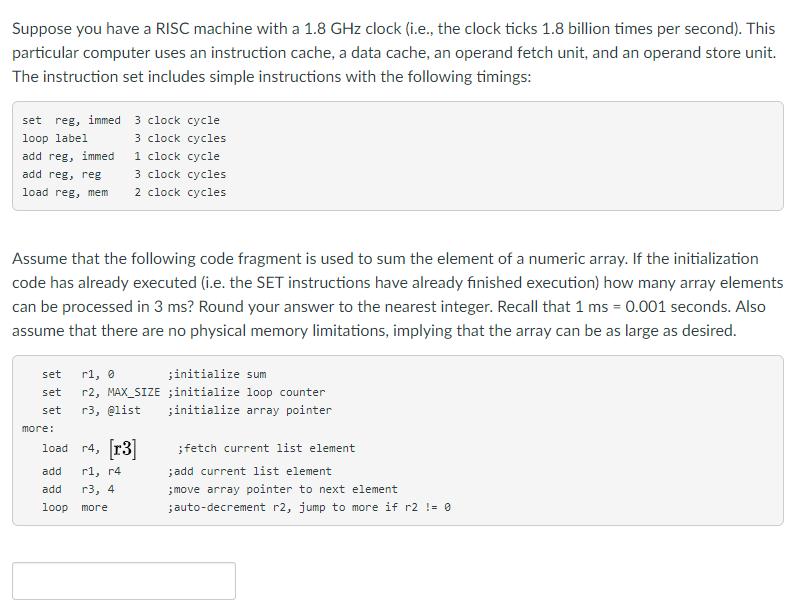
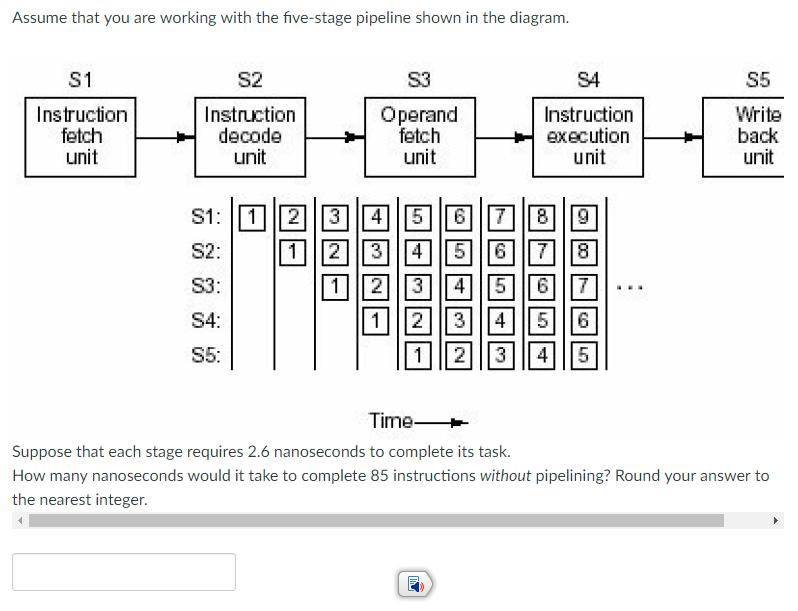
Suppose that you are working with a CISC machine using a 1.9 GHz clock (i.e., the clock ticks 1.9 billion times per second). This particular computer uses MASM-like instructions with the following timings: add reg, mem 7 clock cycles (i.e., the ADD micro-program has 7 instructions) add reg, immed 2 clock cycles loop label. 5 clock cycles Suppose that the following code fragment is used to sum elements of a numeric array. For this problem, assume that memory limitations are non-existent and that there is no limit to the size of the array. mov bx, 0 mov ecx, MAX SIZE mov esi, OFFSET list more: add bx, esi add [esi], 2 loop more ;initialize sum ;initialize loop counter ;initialize array pointer ;add current list element ;move array pointer to next element ;auto-decrement ecx, jump to more if ecx = 0 After initialization, how many array elements can be processed in 3.5 ms? Round your answer to the nearest integer. Note that 1 ms. = 0.001 second. Suppose you have a RISC machine with a 1.8 GHz clock (i.e., the clock ticks 1.8 billion times per second). This particular computer uses an instruction cache, a data cache, an operand fetch unit, and an operand store unit. The instruction set includes simple instructions with the following timings: set reg, immed 3 clock cycle loop label 3 clock cycles add reg, immed 1 clock cycle add reg, reg load reg, mem 3 clock cycles 2 clock cycles Assume that the following code fragment is used to sum the element of a numeric array. If the initialization code has already executed (i.e. the SET instructions have already finished execution) how many array elements can be processed in 3 ms? Round your answer to the nearest integer. Recall that 1 ms = 0.001 seconds. Also assume that there are no physical memory limitations, implying that the array can be as large as desired. set set set more: load add add loop r1, 0 r2, MAX SIZE r3, @list r4, [r3] r1, r4 r3, 4 more ;initialize sum ;initialize loop counter initialize array pointer ;fetch current list element ; add current list element ;move array pointer to next element ;auto-decrement r2, jump to more if r2 = 0 Assume that you are working with the five-stage pipeline shown in the diagram. S1 Instruction fetch unit S2 Instruction decode unit S1: S2: S3: S4: S5: S3 Operand fetch unit 2 3 3 4 5 6 7 8 9 1 2 3 4 5 6 7 8 1 S4 Instruction execution unit 2 3 4 5 6 7 1 2 3 4 5 1 2 3 4 000 LO TM 6 5 S5 Write back unit Time- Suppose that each stage requires 2.6 nanoseconds to complete its task. How many nanoseconds would it take to complete 85 instructions without pipelining? Round your answer to the nearest integer.
Step by Step Solution
There are 3 Steps involved in it

Get step-by-step solutions from verified subject matter experts
 Study Help