







Question: Suppose the HTML object references 3 very small objects on the same web server. Neglecting transmission times, how much time elapses from when the client
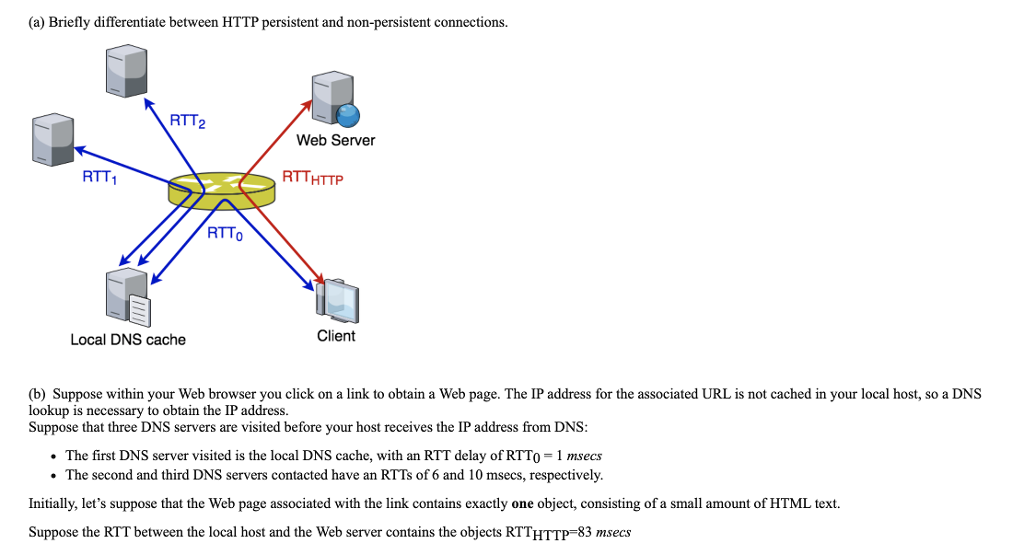
Suppose the HTML object references 3 very small objects on the same web server. Neglecting transmission times, how much time elapses from when the client clicks on the link until the base object and all 3 additional objects are received from web server at the client, assume that the client is configured to support a maximum of 5 parallel TCP connections, with non-persistent HTTP.
Suppose the HTML object references 3 very small objects on the same web server. Neglecting transmission times, how much time elapses from when the client clicks on the link until the base object and all 3 additional objects are received from web server at the client, assume that the client is configured to support a maximum of 5 parallel TCP connections, with persistent HTTP.
(a) Briefly differentiate between HTTP persistent and non-persistent connections. RTT2 Web Server RTT1 RTTHTTP RTTo Local DNS cache Client (b) Suppose within your Web browser you click on a link to obtain a Web page. The IP address for the associated URL is not cached in your local host, so a DNS lookup is necessary to obtain the IP address. Suppose that three DNS servers are visited before your host receives the IP address from DNS: The first DNS server visited is the local DNS cache, with an RTT delay of RTTo- 1 msecs .The second and third DNS servers contacted have an RTTs of 6 and 10 msecs, respectively Initially, let's suppose that the Web page associated with the link contains exactly one object, consisting of a small amount of HTML text. Suppose the RTT between the local host and the Web server contains the objects RTTHTTP-83 msecs
Step by Step Solution
There are 3 Steps involved in it

Get step-by-step solutions from verified subject matter experts
 Study Help