







Question: Suppose the representative consumer's preferences are given by the utility function, U(C, 1) = aln C + (1- a) In / Where C is consumption
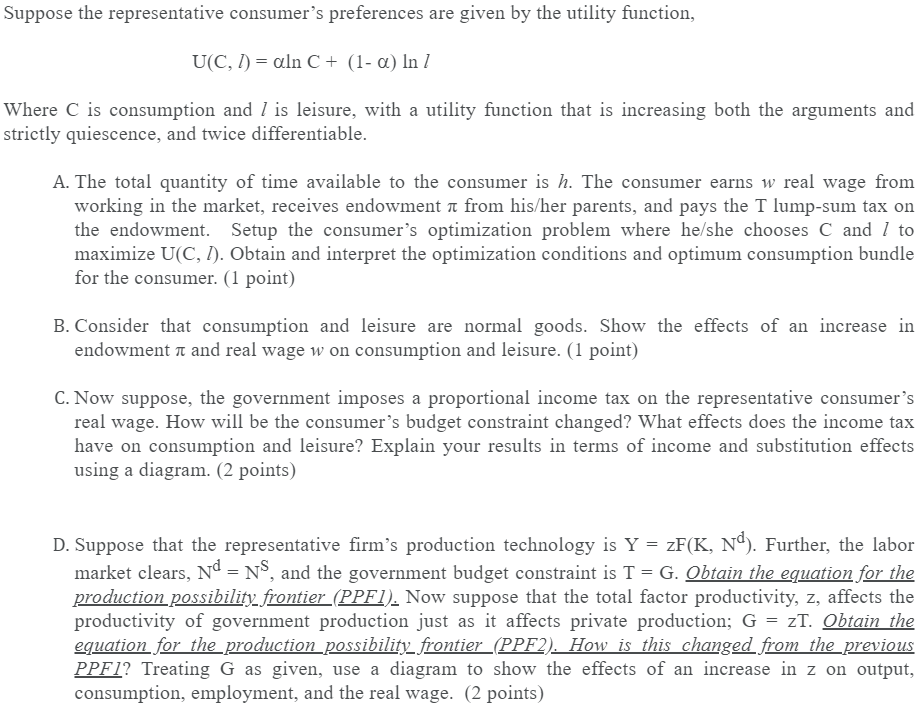
Suppose the representative consumer's preferences are given by the utility function, U(C, 1) = aln C + (1- a) In / Where C is consumption and / is leisure, with a utility function that is increasing both the arguments and strictly quiescence, and twice differentiable. A. The total quantity of time available to the consumer is h. The consumer earns w real wage from working in the market, receives endowment at from his/her parents, and pays the T lump-sum tax on the endowment. Setup the consumer's optimization problem where he/she chooses C and / to maximize U(C, /). Obtain and interpret the optimization conditions and optimum consumption bundle for the consumer. (1 point) B. Consider that consumption and leisure are normal goods. Show the effects of an increase in endowment at and real wage w on consumption and leisure. (1 point) C. Now suppose, the government imposes a proportional income tax on the representative consumer's real wage. How will be the consumer's budget constraint changed? What effects does the income tax have on consumption and leisure? Explain your results in terms of income and substitution effects using a diagram. (2 points) D. Suppose that the representative firm's production technology is Y = zF(K, NO). Further, the labor market clears, NO = No, and the government budget constraint is T = G. Obtain the equation for the production possibility frontier (PPF/)_ Now suppose that the total factor productivity, z, affects the productivity of government production just as it affects private production; G = zT. Obtain the equation for the production possibility frontier (PPF2). How is this changed from the previous PPF1? Treating G as given, use a diagram to show the effects of an increase in z on output, consumption, employment, and the real wage. (2 points)
Step by Step Solution
There are 3 Steps involved in it

Get step-by-step solutions from verified subject matter experts
 Study Help