







Question: Suppose the runtime of an algorithm is given by the recurrence T(n) = f(n) + sigma_i=1^k T(n/b_i) (0 1, n_0, s.t. Forall n > n_0,
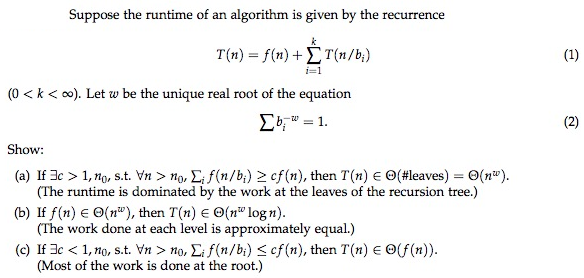
Suppose the runtime of an algorithm is given by the recurrence T(n) = f(n) + sigma_i=1^k T(n/b_i) (0 1, n_0, s.t. Forall n > n_0, sigma_i f(n/b_i) greaterthanorequalto cf(n), then T(n) elementof Theta(#leaves) = Theta(n^w). (The runtime is dominated by the work at the leaves of the recursion tree.) (b) If f(n) elementof Theta (n^w), then T(n) elementof Theta(n^w log n) (The work done at each level is approximately equal.) (c) If ReverseElement c n_0, sigma_i f(n/b_i) lessthanorequalto cf(n), then T(n) elementof Theta(f(n)). (Most of the work is done at the root.) Suppose the runtime of an algorithm is given by the recurrence T(n) = f(n) + sigma_i=1^k T(n/b_i) (0 1, n_0, s.t. Forall n > n_0, sigma_i f(n/b_i) greaterthanorequalto cf(n), then T(n) elementof Theta(#leaves) = Theta(n^w). (The runtime is dominated by the work at the leaves of the recursion tree.) (b) If f(n) elementof Theta (n^w), then T(n) elementof Theta(n^w log n) (The work done at each level is approximately equal.) (c) If ReverseElement c n_0, sigma_i f(n/b_i) lessthanorequalto cf(n), then T(n) elementof Theta(f(n)). (Most of the work is done at the root.)
Step by Step Solution
There are 3 Steps involved in it

Get step-by-step solutions from verified subject matter experts
 Study Help